Curry Bush
Hypericum revolutum · Accepted scientific name
Scientific literature: Very Sparse (3 studies) · ★☆☆☆☆
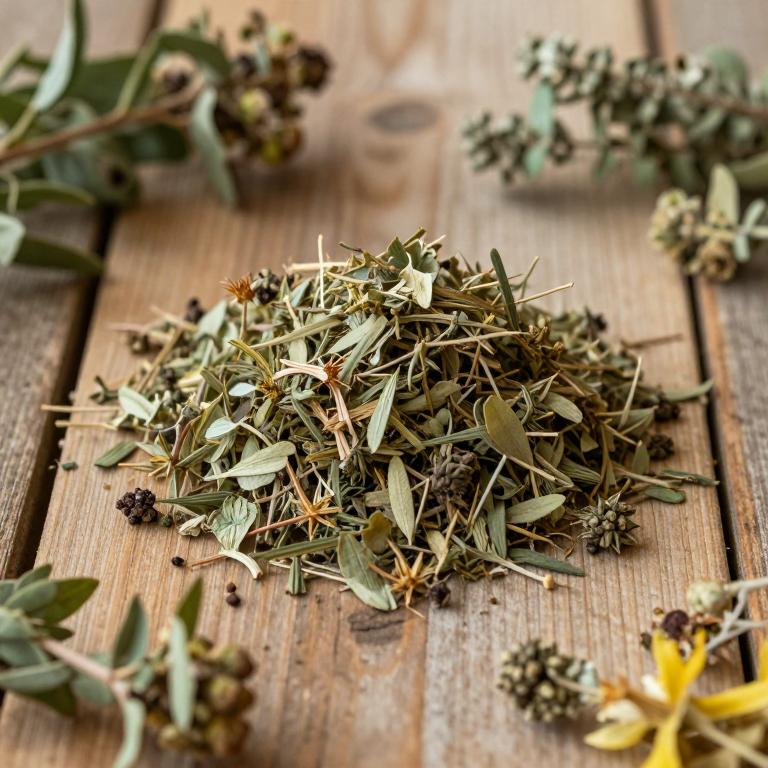
Curry Bush, scientifically known as Hypericum revolutum, is a versatile evergreen shrub native to parts of Asia. Renowned for its aromatic foliage, it is widely used in culinary traditions to impart unique flavors. Beyond the kitchen, this medicinal plant is valued in traditional practices for its potential therapeutic properties.
- Family
- Hypericaceae
- Native range
- Africa
- Parts used
- Not available
- Common names
- Curry Bush · Forest-Primrose
- Scientific synonyms
- Not available
Names and Synonyms
Common Names
- Curry Bush
- forest-primrose
Scientific Names
Accepted name
Hypericum revolutumSources: Wikidata, Catalogue of Life
Taxonomical Classification
This plant belongs to the kingdom Plantae within the phylum Streptophyta and the class Equisetopsida. It is further classified under the subclass Magnoliidae and the order Malpighiales, falling into the family Hypericaceae. Ultimately, Hypericum revolutum is identified by its genus, Hypericum.
| Rank | Classification |
|---|---|
| Kingdom | Plantae |
| Phylum | Streptophyta |
| Class | Equisetopsida |
| Subclass | Magnoliidae |
| Order | Malpighiales |
| Family | Hypericaceae |
| Genus | Hypericum |
Sources: The World Checklist of Vascular Plants (WCVP)
Distribution
This plant exhibits a specific distribution across several regions of the African continent. In West Tropical Africa, it can be found specifically within the borders of Nigeria. Its presence extends into West-Central Tropical Africa, where it inhabits Burundi, Cameroon, and the Congo. Additionally, the species is documented within the Gulf of Guinea Islands. This pattern highlights the plant's reliance on the tropical climates found throughout these diverse locations.
| Region | Area |
|---|---|
| West Tropical Africa | Nigeria |
| West-Central Tropical Africa | Burundi |
| West-Central Tropical Africa | Cameroon |
| West-Central Tropical Africa | Congo |
| West-Central Tropical Africa | Gulf of Guinea Is. |
| West-Central Tropical Africa | Rwanda |
| West-Central Tropical Africa | DR Congo |
| Northeast Tropical Africa | Eritrea |
| Northeast Tropical Africa | Ethiopia |
| Northeast Tropical Africa | Sudan-South Sudan |
Sources: The World Checklist of Vascular Plants (WCVP)
Botanical Identification
Ecology
The ecology of Hypericum revolutum is defined by its broad adaptability across diverse montane and subalpine landscapes, spanning a significant altitudinal gradient. This species thrives within an extensive elevational range, establishing itself in habitats as low as 365 m AMSL and extending its presence to high-altitude environments reaching a maximum of 2732 m AMSL. This wide vertical distribution suggests a high degree of ecological plasticity, allowing the plant to colonize various microclimates and soil conditions found throughout these varying elevations. Such a vast range indicates that the species can navigate significant fluctuations in temperature, UV exposure, and moisture availability, making it a resilient component of its native ecosystem across both lower foothills and upper mountainous reaches.
- Elevational range max:
- 2732 m AMSL
- Elevational range min:
- 365 m AMSL
Life history
The life history of Hypericum revolutum is characterized by its status as a perennial plant, allowing it to persist in its environment over multiple growing seasons. As a perennial species, it avoids the complete die-back seen in annuals, instead establishing a robust root system that supports repeated cycles of vegetative growth and reproductive effort. Throughout its life cycle, the plant undergoes seasonal transformations, emerging from dormancy to produce foliage and eventually developing its flowering structures. This long-lived nature enables the plant to occupy stable ecological niches, where it can invest energy into complex reproductive strategies and long-term survival within its specific habitat.
- Lifecycle :
- perennial
Morphology
The morphology of Hypericum revolutum is characterized by a woody growth form, functioning as a self-supporting shrub rather than a climber, liana, or vine. The plant exhibits an independent life strategy, acting as a non-parasitic organism that grows in terrestrial environments, ranging from purely terrestrial to semiaquatic habitats, and does not function as an epiphyte. In terms of stature, it is a substantial specimen with a plant height that varies from a minimum of 0.33 m to a maximum of 3.65 m.
- Aquatic :
- terrestrial
- Climber :
- self-supporting
- Epiphyte :
- terrestrial
- Growth form :
- shrub
- Parasite :
- independent
- Plant height max:
- 3.65 m
- Plant height min:
- 0.33 m
- Woodiness :
- woody
Reproduction
Reproduction in Hypericum revolutum is characterized by the production of specialized seeds that exhibit specific morphological dimensions. The reproductive output of this species involves seeds with a highly consistent mass profile, where the mean seed mass is recorded at 4.5e-05 g. Within the natural variation of the species, individual seed masses range from a minimum of 4e-05 g to a maximum of 5e-05 g. These precise measurements indicate a standardized reproductive strategy regarding the energy investment per seed, which is a critical factor in its dispersal and establishment within its ecological niche.
- Seed mass max:
- 5e-05 g
- Seed mass mean:
- 4.5e-05 g
- Seed mass min:
- 4e-05 g
Sources: Global Inventory of Floras and Traits (GIFT)
Chemicals
Hypericum revolutum has 2 reported phytochemicals identified across 0 scientific publications and several other databases. The most consistently reported chemicals include 3-HYDROXY-2,4-DIMETHOXY-9H-XANTHEN-9-ONE, 4-Hydroxy-2,3-dimethoxy-9H-xanthen-9-one.
| Chemical | Supporting sources | Consensus |
|---|---|---|
| 3-HYDROXY-2,4-DIMETHOXY-9H-XANTHEN-9-ONE | 1 supporting sources | ★☆☆☆☆ |
| 4-Hydroxy-2,3-dimethoxy-9H-xanthen-9-one | 1 supporting sources | ★☆☆☆☆ |
3-HYDROXY-2,4-DIMETHOXY-9H-XANTHEN-9-ONE
- Molecules (Basel, Switzerland)
4-Hydroxy-2,3-dimethoxy-9H-xanthen-9-one
- Molecules (Basel, Switzerland)
Conditions
Hypericum revolutum has 1 reported investigations on conditions identified across 0 scientific publications and several other databases. The most consistently reported conditions include diarrhea.
| Condition | Supporting sources | Consensus |
|---|---|---|
| Diarrhea | 1 supporting sources | ★☆☆☆☆ |
Diarrhea
- BMC complementary medicine and therapies
Preparations
Hypericum revolutum has 1 reported preparations identified across 0 scientific publications and several other databases. The most consistently reported preparations include Crude methanol extracts.
| Preparation | Supporting sources | Consensus |
|---|---|---|
| Crude methanol extracts | 1 supporting sources | ★☆☆☆☆ |
Crude methanol extracts
- East African medical journal