Shrubby St. John's-Wort
Hypericum prolificum · Accepted scientific name
Scientific literature: Very Sparse (8 studies) · ★☆☆☆☆
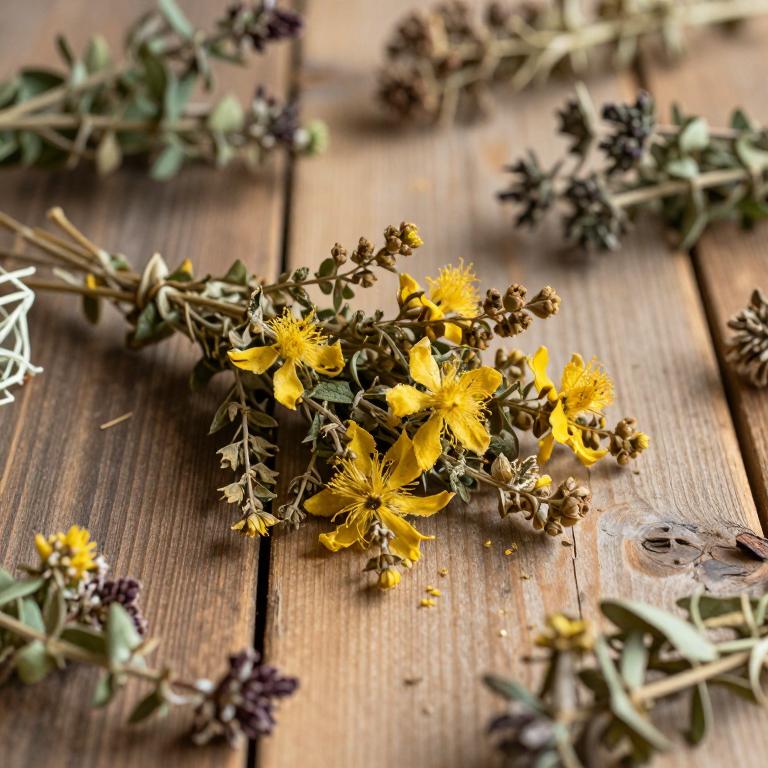
Shrubby St. John's-Worrt, scientifically known as Hypericum prolificum, is a resilient perennial shrub distinguished by its dense foliage and vibrant yellow blossoms. Renowned for its medicinal properties, this plant contains bioactive compounds often utilized in traditional remedies to support emotional well-being and promote skin healing and recovery.
Names and Synonyms
Common Names
- shrubby St. John's-wort
- broombush
- Shrubby St. Johnswort
Scientific Names
Accepted name
Hypericum prolificumSynonyms
- Myriandra spathulata
- Myriandra ledifolia
- Myriandra prolifica
- Hypericum spathulatum
- Myriandra prolifica var. spathulata
- Brathys prolifica
Regional and Traditional Names
French:
- millepertuis prolifère
Sources: Wikidata, Catalogue of Life
Taxonomical Classification
This plant belongs to the kingdom Plantae and is classified under the phylum Streptophyta within the class Equisetopsida. Following its descent through the subclass Magnoliidae and order Malpighiales, it is a member of the family Hypericaceae. Finally, it is categorized under the genus Hypericum as the species Hypericum prolificum.
| Rank | Classification |
|---|---|
| Kingdom | Plantae |
| Phylum | Streptophyta |
| Class | Equisetopsida |
| Subclass | Magnoliidae |
| Order | Malpighiales |
| Family | Hypericaceae |
| Genus | Hypericum |
Sources: The World Checklist of Vascular Plants (WCVP)
Distribution
This plant exhibits a broad and diverse geographical distribution across several continents. In Middle Europe, it can be found growing within the borders of Germany. Its range extends across North America, specifically spanning the Eastern Canadian province of Ontario. Within the North-Central United States, the species is established in the state of Illinois. Additionally, the plant is commonly documented throughout Iowa and Minnesota.
| Region | Area |
|---|---|
| Middle Europe | Germany |
| Eastern Canada | Ontario |
| North-Central U.S.A. | Illinois |
| North-Central U.S.A. | Iowa |
| North-Central U.S.A. | Minnesota |
| North-Central U.S.A. | Missouri |
| North-Central U.S.A. | Oklahoma |
| North-Central U.S.A. | Wisconsin |
| Northeastern U.S.A. | Connecticut |
| Northeastern U.S.A. | Indiana |
Sources: The World Checklist of Vascular Plants (WCVP)
Botanical Identification
Life history
The life history of Hypericum prolificum is characterized by its classification as a perennial, meaning it completes its life cycle over multiple years rather than expiring after a single growing season. As a perennial species, it establishes a robust root system that allows it to survive periods of dormancy and re-emerge annually to undergo its reproductive stages. Throughout its lifespan, the plant progresses through distinct phases of vegetative growth, where it accumulates biomass and energy, followed by reproductive phases where it produces flowers and seeds to ensure the continuation of the species. This perennial nature provides the plant with a competitive advantage in its habitat, as it can build resilience and structural complexity over time, allowing for consistent seasonal cycles of growth and reproduction.
- Lifecycle :
- perennial
Morphology
The morphology of Hypericum prolificum is characterized by a shrubby growth form, manifesting as a woody plant that maintains a self-supporting structure rather than acting as a vine or liana. It typically reaches a mean plant height of approximately 1 m. This species is strictly terrestrial in its ecological habit, functioning as an independent organism that does not exhibit parasitic or epiphytic behaviors.
- Aquatic :
- terrestrial
- Climber :
- self-supporting
- Epiphyte :
- terrestrial
- Growth form :
- shrub
- Parasite :
- independent
- Plant height mean:
- 1 m
- Woodiness :
- woody
Reproduction
The reproduction of Hypericum prolificum is characterized by a specific seasonal flowering window and the production of minute seeds. The flowering period typically commences in June and continues through to August, marking the plant's primary reproductive phase. During this time, the plant produces flowers that eventually lead to the development of seeds. The resulting seeds are exceptionally small and uniform in size, with a recorded mean seed mass of 1e-04 g. This consistency is reflected in the seed mass data, as both the minimum and maximum measured seed mass values are also 1e-04 g, indicating a highly standardized seed size for this species.
- Flowering time :
- Jun
- Flowering time :
- Aug
- Seed mass mean:
- 1e-04 g
Sources: Global Inventory of Floras and Traits (GIFT)
Chemicals
Hypericum prolificum has 3 reported phytochemicals identified across 0 scientific publications and several other databases. The most consistently reported chemicals include prolifenone A, prolifenone B, prolificin A.
| Chemical | Supporting sources | Consensus |
|---|---|---|
| prolifenone A | 1 supporting sources | ★☆☆☆☆ |
| prolifenone B | 1 supporting sources | ★☆☆☆☆ |
| prolificin A | 1 supporting sources | ★☆☆☆☆ |
prolifenone A
- Journal of natural products
prolifenone B
- Journal of natural products
prolificin A
- Journal of natural products
Activities
Hypericum prolificum has 4 reported activities identified across 0 scientific publications and several other databases. The most consistently reported activities include Antihypertensive, Antioxidant, Diuretic, Hepatoprotective.
| Activity | Supporting sources | Consensus |
|---|---|---|
| Antihypertensive | 1 supporting sources | ★☆☆☆☆ |
| Antioxidant | 1 supporting sources | ★☆☆☆☆ |
| Diuretic | 1 supporting sources | ★☆☆☆☆ |
| Hepatoprotective | 1 supporting sources | ★☆☆☆☆ |
Antihypertensive
- Plants (Basel, Switzerland)
Antioxidant
- Plants (Basel, Switzerland)
Diuretic
- Plants (Basel, Switzerland)
Hepatoprotective
- Plants (Basel, Switzerland)
Preparations
Hypericum prolificum has 1 reported preparations identified across 0 scientific publications and several other databases. The most consistently reported preparations include Water extracts.
| Preparation | Supporting sources | Consensus |
|---|---|---|
| Water extracts | 1 supporting sources | ★☆☆☆☆ |
Water extracts
- Natural product research