Hypericum laricifolium
Hypericum laricifolium · Accepted scientific name
Scientific literature: Very Sparse (28 studies) · ★☆☆☆☆
, scientifically known as Hypericum laricifolium, is a versatile medicinal shrub belonging to the Hypericaceae family. Renowned for its bioactive compounds, this plant is traditionally utilized in various herbal remedies to address inflammation and skin ailments. Its unique properties make it a significant subject in ethnobotanical and pharmacological research.
- Family
- Hypericaceae
- Native range
- Southern America
- Parts used
- Not available
- Common names
- Not available
- Scientific synonyms
- Hypericum Laricifolium Var. Acerosum · Hypericum Laricoides · 6 more
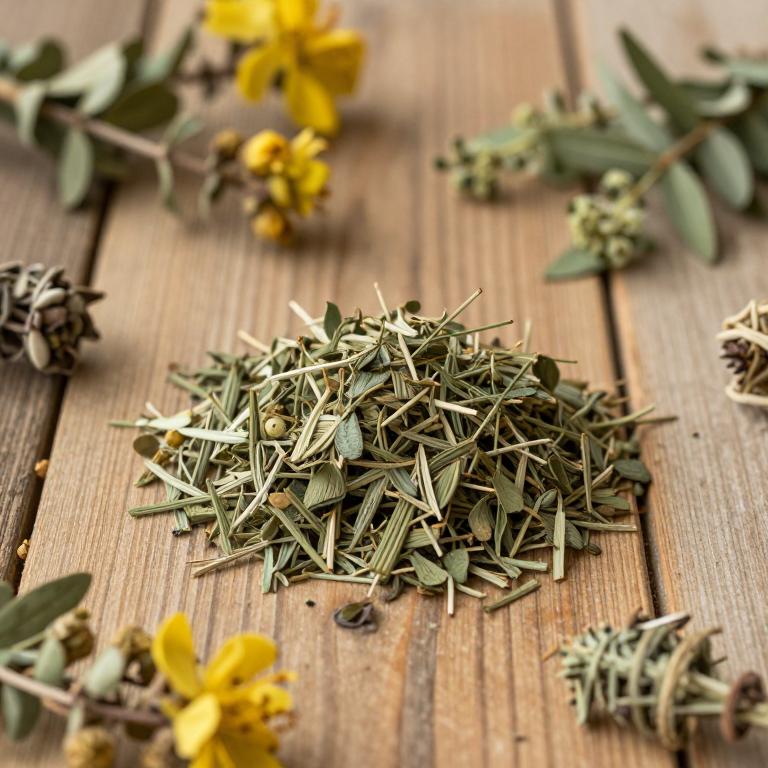
Names and Synonyms
Scientific Names
Accepted name
Hypericum laricifoliumSynonyms
- Hypericum laricifolium var. acerosum
- Hypericum laricoides
- Hypericum acerosum
- Brathys laricifolia
- Brathys acerosa
- Hypericum platypetalum
- Hypericum racemulosum
- Hypericum tinctorum
Regional and Traditional Names
Spanish:
- romerillo
Sources: Wikidata, Catalogue of Life
Taxonomical Classification
This plant belongs to the kingdom Plantae within the phylum Streptophyta and the class Equisetopsida. Under the subclass Magnoliidae, it is classified within the order Malpighiales and the family Hypericaceae. Finally, it is identified by its genus, Hypericum.
| Rank | Classification |
|---|---|
| Kingdom | Plantae |
| Phylum | Streptophyta |
| Class | Equisetopsida |
| Subclass | Magnoliidae |
| Order | Malpighiales |
| Family | Hypericaceae |
| Genus | Hypericum |
Sources: The World Checklist of Vascular Plants (WCVP)
Distribution
This plant exhibits a specific distribution pattern across the tropical regions of the Americas. In Northern South America, it can be found growing within the borders of Venezuela. Its presence extends into Western South America, where it is documented in Colombia. Furthermore, the species is naturally distributed throughout Ecuador. Finally, its geographical range reaches into the western territories of Peru.
| Region | Area |
|---|---|
| Northern South America | Venezuela |
| Western South America | Colombia |
| Western South America | Ecuador |
| Western South America | Peru |
Sources: The World Checklist of Vascular Plants (WCVP)
Botanical Identification
Ecology
The ecology of Hypericum laricifolium is defined by its specialized adaptation to high-altitude montane and subalpine environments. This species thrives within a specific vertical niche, occupying an elevational range that spans from a minimum of 2500 m AMSL to a maximum of 4300 m AMSL. Such a broad altitudinal distribution suggests a high degree of environmental plasticity, allowing it to persist in varying microclimates ranging from temperate mountain slopes to the more extreme, cold-stressed conditions of near-alpine zones. Its presence at these significant heights indicates an ability to tolerate intense ultraviolet radiation, fluctuating diurnal temperatures, and potentially thin, rocky soils characteristic of high-elevation terrain.
- Elevational range max:
- 4300 m AMSL
- Elevational range min:
- 2500 m AMSL
Morphology
The morphology of Hypericum laricifolium is characterized by a woody growth form, functioning as a self-supporting shrub. It is an independent species that does not exhibit parasitic behavior, maintaining a terrestrial existence rather than acting as an epiphyte. The plant's habit is strictly non-aquatic, categorized as terrestrial, and it lacks any climbing mechanisms such as lianas or vines, instead relying on its own structural integrity for support.
- Aquatic :
- terrestrial
- Climber :
- self-supporting
- Epiphyte :
- terrestrial
- Growth form :
- shrub
- Parasite :
- independent
- Woodiness :
- woody
Physiology
The physiology of Hypericum laricifolium is characterized by a fundamental reliance on the C3 photosynthetic pathway, a mechanism wherein carbon dioxide is fixed directly into a three-carbon compound during the initial stage of the Calvin cycle. This metabolic strategy involves the enzyme RuBisCO facilitating the carboxylation of ribulose-1,5-bisphosphate, which is typical for many temperate woody shrubs and herbaceous perennials within the Hypericaceae family. Through this C3 process, the plant utilizes sunlight to drive the conversion of water and carbon dioxide into chemical energy in the form of carbohydrates, supporting its vegetative growth and the synthesis of secondary metabolites. The efficiency of this pathway is closely tied to the plant's transpiration rates and its ability to manage photorespiration, particularly in varying environmental light intensities and moisture availability.
- Photosynthetic pathway :
- C3
Sources: Global Inventory of Floras and Traits (GIFT)
Chemicals
Hypericum laricifolium has 19 reported phytochemicals identified across 0 scientific publications and several other databases. The most consistently reported chemicals include caffeic acid, p-Hydroxybenzoic acid, quercetin, 3 Epi betulinic Acid, 3,4-Dimethoxy-benzoic acid.
| Chemical | Supporting sources | Consensus |
|---|---|---|
| caffeic acid | 2 supporting sources | ★☆☆☆☆ |
| p-Hydroxybenzoic acid | 2 supporting sources | ★☆☆☆☆ |
| quercetin | 2 supporting sources | ★☆☆☆☆ |
| 3 Epi betulinic Acid | 1 supporting sources | ★☆☆☆☆ |
| 3,4-Dimethoxy-benzoic acid | 1 supporting sources | ★☆☆☆☆ |
| BETA-SITOSTEROL | 1 supporting sources | ★☆☆☆☆ |
| CHLOROGENIC ACID | 1 supporting sources | ★☆☆☆☆ |
| Docosanol | 1 supporting sources | ★☆☆☆☆ |
| Kaempferol 3-O-glucuronide | 1 supporting sources | ★☆☆☆☆ |
| Quercetin 3-O-rhamnoside | 1 supporting sources | ★☆☆☆☆ |
caffeic acid
- Chemical & pharmaceutical bulletin
- Molecules (Basel, Switzerland)
p-Hydroxybenzoic acid
- Chemical & pharmaceutical bulletin
- Molecules (Basel, Switzerland)
quercetin
- Chemical & pharmaceutical bulletin
- Molecules (Basel, Switzerland)
3 Epi betulinic Acid
- Chemical & pharmaceutical bulletin
3,4-Dimethoxy-benzoic acid
- Chemical & pharmaceutical bulletin
BETA-SITOSTEROL
- Chemical & pharmaceutical bulletin
CHLOROGENIC ACID
- Molecules (Basel, Switzerland)
Docosanol
- Chemical & pharmaceutical bulletin
Kaempferol 3-O-glucuronide
- Molecules (Basel, Switzerland)
Quercetin 3-O-rhamnoside
- Chemical & pharmaceutical bulletin
Conditions
Hypericum laricifolium has 5 reported investigations on conditions identified across 0 scientific publications and several other databases. The most consistently reported conditions include Streptococcus mutans, Streptococcus salivarius, Streptococcus sanguinis, bacterial infections, dental caries.
| Condition | Supporting sources | Consensus |
|---|---|---|
| Streptococcus mutans | 1 supporting sources | ★☆☆☆☆ |
| Streptococcus salivarius | 1 supporting sources | ★☆☆☆☆ |
| Streptococcus sanguinis | 1 supporting sources | ★☆☆☆☆ |
| Bacterial infections | 1 supporting sources | ★☆☆☆☆ |
| Dental caries | 1 supporting sources | ★☆☆☆☆ |
Streptococcus mutans
- Journal of clinical and experimental dentistry
Streptococcus salivarius
- Journal of clinical and experimental dentistry
Streptococcus sanguinis
- Journal of clinical and experimental dentistry
Bacterial infections
- Journal of ethnopharmacology
Dental caries
- Journal of clinical and experimental dentistry
Preparations
Hypericum laricifolium has 1 reported preparations identified across 0 scientific publications and several other databases. The most consistently reported preparations include Crude extracts.
| Preparation | Supporting sources | Consensus |
|---|---|---|
| Crude extracts | 1 supporting sources | ★☆☆☆☆ |
Crude extracts
- Journal of ethnopharmacology