stinking tutsan
Hypericum hircinum · Accepted scientific name
Scientific literature: Very Sparse (19 studies) · ★☆☆☆☆
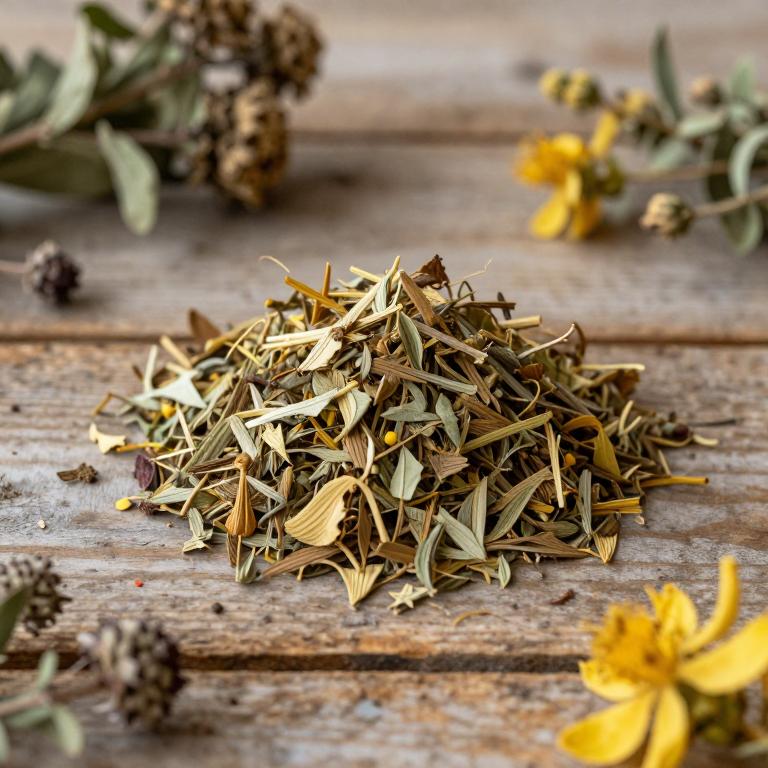
Stinking tutsan, scientifically known as Hypericum hircinum, is a distinctive shrub belonging to the Hypericaceae family. Characterized by its pungent aroma and bright yellow blooms, this medicinal plant is valued in traditional practices for its diverse therapeutic properties, often utilized to address inflammatory conditions and support overall wellness.
- Family
- Hypericaceae
- Native range
- Europe
- Parts used
- Leaf
- Common names
- Stinking Tutsan
- Scientific synonyms
- Androsaemum Hircinum
Names and Synonyms
Common Names
- Stinking Tutsan
Scientific Names
Accepted name
Hypericum hircinumSynonyms
- Androsaemum hircinum
Regional and Traditional Names
German:
- Bocks-Johanniskraut
- Bocks-Johanniskraut
French:
- Millepertuis a odeur de bouc
Sources: Wikidata, Catalogue of Life
Taxonomical Classification
This plant belongs to the kingdom Plantae and is classified under the phylum Streptophyta and class Equisetopsida. Within the subclass Magnoliidae, it falls under the order Malpighiales and the family Hypericaceae. Finally, it is identified by the genus Hypericum.
| Rank | Classification |
|---|---|
| Kingdom | Plantae |
| Phylum | Streptophyta |
| Class | Equisetopsida |
| Subclass | Magnoliidae |
| Order | Malpighiales |
| Family | Hypericaceae |
| Genus | Hypericum |
Sources: The World Checklist of Vascular Plants (WCVP)
Distribution
This plant exhibits a specific distribution pattern across various regions of Europe. In Northern Europe, its presence is documented in both Great Britain and Ireland. Moving toward Southwestern Europe, the species can be found throughout France. It also inhabits the Mediterranean islands, specifically within the Baleares. Finally, its range extends to the island of Corse.
| Region | Area |
|---|---|
| Northern Europe | Great Britain |
| Northern Europe | Ireland |
| Southwestern Europe | Baleares |
| Southwestern Europe | Corse |
| Southwestern Europe | France |
| Southwestern Europe | Portugal |
| Southwestern Europe | Sardegna |
| Southwestern Europe | Spain |
| Southeastern Europe | Greece |
| Southeastern Europe | Italy |
Sources: The World Checklist of Vascular Plants (WCVP)
Botanical Identification
Life history
The life history of Hypericum hircinum is characterized by a perennial lifecycle, allowing the plant to persist through multiple growing seasons. In terms of its structural development and growth habit, it exhibits a dual classification of life forms, functioning as both a phanerophyte and a nanophanerophyte. This indicates that while it possesses the capacity to maintain visible stem structures above the ground, its growth remains relatively low, typically staying close to the substrate.
- Life form :
- nanophanerophyte
- Life form :
- phanerophyte
- Lifecycle :
- perennial
Morphology
The morphology of Hypericum hircinum is characterized by its diverse ecological adaptability and structural composition. This species exhibits a versatile habitat range, functioning as an aquatic, semiaquatic, or terrestrial plant depending on environmental conditions. It presents a distinct growth form categorized as a shrub or subshrub, developing a robust and woody structure rather than remaining non-woody. Furthermore, the plant is an independent organism, meaning it does not rely on a host for nutrients, operating as an independent species within its ecosystem.
- Aquatic :
- terrestrial
- Growth form :
- shrub
- Parasite :
- independent
- Woodiness :
- woody
Physiology
The physiology of Hypericum hircinum is characterized by its efficient carbon assimilation and specific morphological adaptations to its environment. The plant utilizes a C3 photosynthetic pathway, which involves the direct fixation of atmospheric carbon dioxide into organic compounds through the Calvin cycle without the specialized spatial separation found in C4 or CAM plants. This metabolic strategy is closely linked to its leaf architecture, as evidenced by a mean Specific Leaf Area (SLA) of 243.2 cm²/g. This relatively high SLA value indicates a high ratio of leaf area to dry mass, suggesting a physiological investment in maximizing light interception and gas exchange surface area, which facilitates robust photosynthetic activity and rapid biomass accumulation.
- Photosynthetic pathway :
- C3
- Specific Leaf Area (SLA) mean:
- 243.2 cm²/g
Reproduction
The reproduction of Hypericum hircinum is characterized by the production of minute seeds that facilitate its dispersal and propagation. These seeds exhibit specific quantitative morphological traits, with a measured mean seed mass of 7.67e-05 g. The variation within the seed population is relatively narrow, as the individual seed masses range from a minimum of 6e-05 g to a maximum of 1e-04 g. This lightweight seed structure is indicative of the plant's reproductive strategy, allowing for efficient distribution within its ecological niche.
- Seed mass max:
- 1e-04 g
- Seed mass mean:
- 7.67e-05 g
- Seed mass min:
- 6e-05 g
Sources: Global Inventory of Floras and Traits (GIFT)
Plant Parts
Hypericum hircinum has 1 reported plant parts identified across 2 scientific publications and several other databases that are studied for medicinal purposes. The most consistently reported plant part include leaf.
| Plant part | Supporting sources | Consensus |
|---|---|---|
| Leaf | 2 supporting sources | ★☆☆☆☆ |
Leaf
- Journal of natural products
- Microorganisms
Chemicals
Hypericum hircinum has 3 reported phytochemicals identified across 2 scientific publications and several other databases. The most consistently reported chemicals include Flavonoids, Terpenes, quercetin.
| Chemical | Supporting sources | Consensus |
|---|---|---|
| Flavonoids | 1 supporting sources | ★☆☆☆☆ |
| Terpenes | 1 supporting sources | ★☆☆☆☆ |
| quercetin | 1 supporting sources | ★☆☆☆☆ |
Flavonoids
- Plants (Basel, Switzerland)
Terpenes
- Plants (Basel, Switzerland)
quercetin
- Journal of natural products
Activities
Hypericum hircinum has 5 reported activities identified across 2 scientific publications and several other databases. The most consistently reported activities include Antidepressant, Antifungal, Antimicrobial, Antioxidant, Antiviral.
| Activity | Supporting sources | Consensus |
|---|---|---|
| Antidepressant | 1 supporting sources | ★☆☆☆☆ |
| Antifungal | 1 supporting sources | ★☆☆☆☆ |
| Antimicrobial | 1 supporting sources | ★☆☆☆☆ |
| Antioxidant | 1 supporting sources | ★☆☆☆☆ |
| Antiviral | 1 supporting sources | ★☆☆☆☆ |
Antidepressant
- Plants (Basel, Switzerland)
Antifungal
- Plants (Basel, Switzerland)
Antimicrobial
- Plants (Basel, Switzerland)
Antioxidant
- Plants (Basel, Switzerland)
Antiviral
- Plants (Basel, Switzerland)
Conditions
Hypericum hircinum has 7 reported investigations on conditions identified across 2 scientific publications and several other databases. The most consistently reported conditions include burns, cough, migraine, respiratory diseases, rheumatism.
| Condition | Supporting sources | Consensus |
|---|---|---|
| Burns | 1 supporting sources | ★☆☆☆☆ |
| Cough | 1 supporting sources | ★☆☆☆☆ |
| Migraine | 1 supporting sources | ★☆☆☆☆ |
| Respiratory diseases | 1 supporting sources | ★☆☆☆☆ |
| Rheumatism | 1 supporting sources | ★☆☆☆☆ |
| Wound healing | 1 supporting sources | ★☆☆☆☆ |
| Wounds | 1 supporting sources | ★☆☆☆☆ |
Burns
- Plants (Basel, Switzerland)
Cough
- Journal of ethnopharmacology
Migraine
- Plants (Basel, Switzerland)
Respiratory diseases
- Plants (Basel, Switzerland)
Rheumatism
- Plants (Basel, Switzerland)
Wound healing
- Pharmaceutical biology
Wounds
- Plants (Basel, Switzerland)
Preparations
Hypericum hircinum has 1 reported preparations identified across 2 scientific publications and several other databases. The most consistently reported preparations include aerial parts.
| Preparation | Supporting sources | Consensus |
|---|---|---|
| Aerial parts | 1 supporting sources | ★☆☆☆☆ |
Aerial parts
- Journal of ethnopharmacology