Hypericum helianthemoides
Hypericum helianthemoides · Accepted scientific name
Scientific literature: Very Sparse (14 studies) · ★☆☆☆☆
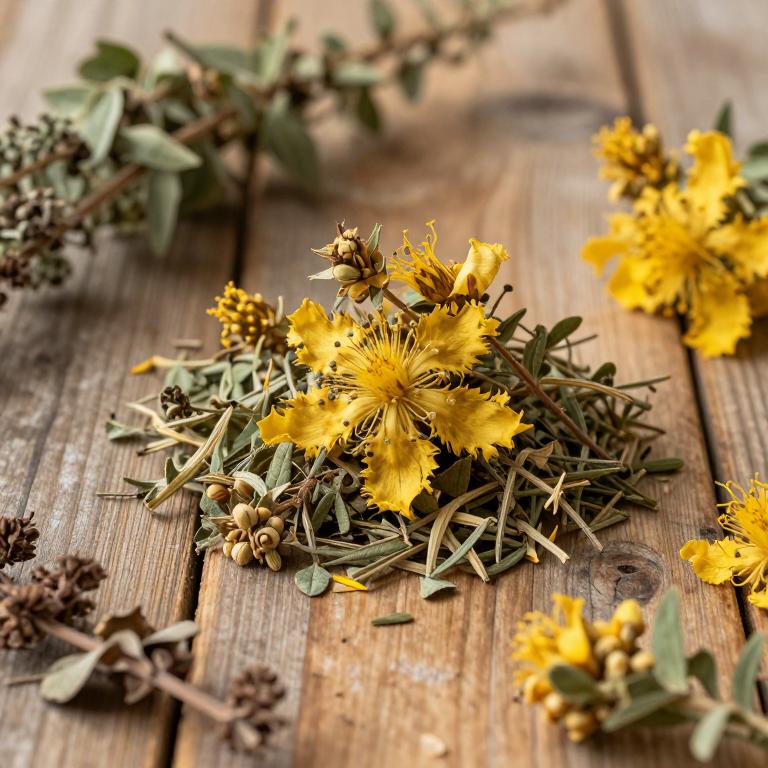
, scientifically known as Hypericum helianthemoides, is a perennial herb native to the rocky, alpine regions of Europe. Often called the sun rose, this resilient plant features striking yellow blossoms. While less common in modern pharmacology than its relatives, it remains a fascinating subject in traditional botanical studies and ecology.
- Family
- Hypericaceae
- Native range
- Asia-Temperate
- Parts used
- Flower
- Common names
- Not available
- Scientific synonyms
- Hypericum Helianthemoides Subsp. Atropatanum · Hypericum Helianthemoides Subsp. Badchyzum · 6 more
Names and Synonyms
Scientific Names
Accepted name
Hypericum helianthemoidesSynonyms
- Hypericum helianthemoides subsp. atropatanum
- Hypericum helianthemoides subsp. badchyzum
- Hypericum hyssopifolium subsp. helianthemoides
- Hypericum leptocladum
- Hypericum cyclosepalum var. elbrusense
- Hypericum atropatanum
- Drosanthe helianthemoides
- Hypericum helianthemoides var. latifolium
Sources: Wikidata, Catalogue of Life
Taxonomical Classification
This plant belongs to the kingdom Plantae within the phylum Streptophyta and the class Equisetopsida. It is further classified under the subclass Magnoliidae and the order Malpighiales. Finally, it is a member of the family Hypericaceae and the genus Hypericum.
| Rank | Classification |
|---|---|
| Kingdom | Plantae |
| Phylum | Streptophyta |
| Class | Equisetopsida |
| Subclass | Magnoliidae |
| Order | Malpighiales |
| Family | Hypericaceae |
| Genus | Hypericum |
Sources: The World Checklist of Vascular Plants (WCVP)
Distribution
This plant exhibits a specific geographical distribution across several key regions of Western and Central Asia. In the realm of Western Asia, its presence is documented across the territories of Türkiye, Iraq, and Iran. Moving toward the Caucasus region, it can also be found throughout the Transcaucasus. Additionally, the species extends its range into Central Asia, specifically within Turkmenistan. Collectively, these locations define the natural habitat where this medicinal species thrives.
| Region | Area |
|---|---|
| Central Asia | Turkmenistan |
| Caucasus | Transcaucasus |
| Western Asia | Iran |
| Western Asia | Iraq |
| Western Asia | Türkiye |
Sources: The World Checklist of Vascular Plants (WCVP)
Botanical Identification
Ecology
The ecology of Hypericum helianthemoides is characterized by its preference for specific high-altitude terrain, primarily thriving within a defined elevational range that reaches a maximum of 1300 m AMSL. This species is typically found inhabiting diverse and often rugged environments, including mountains, steppe regions, and stony places. These habitats suggest an adaptation to well-drained, rocky substrates and open landscapes where it can withstand the climatic variations inherent to montane and semi-arid steppe ecosystems.
- Elevational range max:
- 1300 m AMSL
- Habitat :
- mountains, steppe, stony places
Life history
The life history of Hypericum helianthemoides is characterized by its status as a perennial plant, allowing it to persist in its environment through multiple growing seasons. As a long-lived species, it establishes a stable presence within its habitat, typically relying on robust root systems to survive periods of dormancy. Its developmental cycle involves seasonal growth patterns where it emerges, flowers, and undergoes seed production annually, while the individual plant continues to mature and expand its biomass over several years. This perennial nature ensures that the species can withstand localized environmental fluctuations, maintaining a continuous presence in its ecological niche through sustained vegetative and reproductive efforts.
- Lifecycle :
- perennial
Morphology
The morphology of Hypericum helianthemoides is characterized by its growth form as a non-woody herb. The plant typically exhibits a relatively low stature, with a height ranging from a minimum of 0.2 m to a maximum of 0.5 m.
- Growth form :
- herb
- Plant height max:
- 0.5 m
- Plant height min:
- 0.2 m
- Woodiness :
- non-woody
Reproduction
The reproduction of Hypericum helianthemoides is characterized by a specific seasonal flowering window that facilitates its pollination process. The plant begins its flowering stage in May, marking the onset of its reproductive activity for the season. This flowering period continues through the early summer months, reaching its conclusion in June. This relatively concentrated timeframe of floral development is essential for the plant's lifecycle, ensuring that its reproductive structures are available for pollinators during this specific period of the year.
- Flowering time :
- May
- Flowering time :
- Jun
Sources: Global Inventory of Floras and Traits (GIFT)
Plant Parts
Hypericum helianthemoides has 1 reported plant parts identified across 1 scientific publications and several other databases that are studied for medicinal purposes. The most consistently reported plant part include flower.
| Plant part | Supporting sources | Consensus |
|---|---|---|
| Flower | 1 supporting sources | ★☆☆☆☆ |
Flower
- Pharmaceutical biology
Chemicals
Hypericum helianthemoides has 1 reported phytochemicals identified across 1 scientific publications and several other databases. The most consistently reported chemicals include Germacrene D.
| Chemical | Supporting sources | Consensus |
|---|---|---|
| Germacrene D | 1 supporting sources | ★☆☆☆☆ |
Germacrene D
- Pharmaceutical biology
Activities
Hypericum helianthemoides has 2 reported activities identified across 1 scientific publications and several other databases. The most consistently reported activities include Antibacterial, Antioxidant.
| Activity | Supporting sources | Consensus |
|---|---|---|
| Antibacterial | 1 supporting sources | ★☆☆☆☆ |
| Antioxidant | 1 supporting sources | ★☆☆☆☆ |
Antibacterial
- Pharmaceutical biology
Antioxidant
- Pharmaceutical biology
Conditions
Hypericum helianthemoides has 10 reported investigations on conditions identified across 1 scientific publications and several other databases. The most consistently reported conditions include burns, depression, eczema, gastroenteritis, hysteria.
| Condition | Supporting sources | Consensus |
|---|---|---|
| Burns | 1 supporting sources | ★☆☆☆☆ |
| Depression | 1 supporting sources | ★☆☆☆☆ |
| Eczema | 1 supporting sources | ★☆☆☆☆ |
| Gastroenteritis | 1 supporting sources | ★☆☆☆☆ |
| Hysteria | 1 supporting sources | ★☆☆☆☆ |
| Neuralgia | 1 supporting sources | ★☆☆☆☆ |
| Rheumatism | 1 supporting sources | ★☆☆☆☆ |
| Trauma | 1 supporting sources | ★☆☆☆☆ |
| Ulcers | 1 supporting sources | ★☆☆☆☆ |
| Wounds | 1 supporting sources | ★☆☆☆☆ |
Burns
- Pharmaceutical biology
Depression
- Pharmaceutical biology
Eczema
- Pharmaceutical biology
Gastroenteritis
- Pharmaceutical biology
Hysteria
- Pharmaceutical biology
Neuralgia
- Pharmaceutical biology
Rheumatism
- Pharmaceutical biology
Trauma
- Pharmaceutical biology
Ulcers
- Pharmaceutical biology
Wounds
- Pharmaceutical biology