Hypericum faberi
Hypericum faberi · Accepted scientific name
Scientific literature: Very Sparse (7 studies) · ★☆☆☆☆
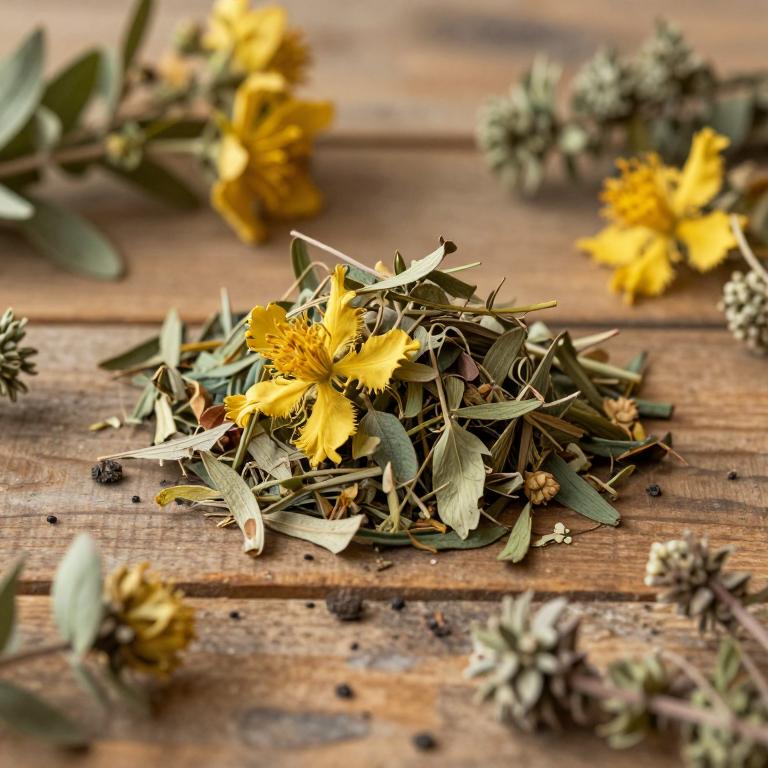
, scientifically known as Hypericum faberi, is a perennial herb belonging to the Hypericaceae family. Often found in disturbed soils and meadows, this plant is distinguished by its vibrant yellow flowers and elliptical leaves. Historically valued in traditional medicine, it offers unique biochemical properties worthy of botanical study.
- Family
- Hypericaceae
- Native range
- Asia-Temperate
- Parts used
- Not available
- Common names
- Not available
- Scientific synonyms
- Not available
Names and Synonyms
Scientific Names
Accepted name
Hypericum faberiSources: Wikidata
Taxonomical Classification
This plant belongs to the kingdom Plantae and is classified under the phylum Streptophyta within the class Equisetopsida. As a member of the subclass Magnoliidae and the order Malpighiales, it is further categorized into the family Hypericaceae. Ultimately, its specific taxonomic identity is defined by the genus Hypericum.
| Rank | Classification |
|---|---|
| Kingdom | Plantae |
| Phylum | Streptophyta |
| Class | Equisetopsida |
| Subclass | Magnoliidae |
| Order | Malpighiales |
| Family | Hypericaceae |
| Genus | Hypericum |
Sources: The World Checklist of Vascular Plants (WCVP)
Distribution
This plant, known as Hypericum faberi, exhibits a specific range within the diverse landscapes of China. Its presence is notably documented throughout the South-Central regions of the country. Additionally, the species can be found growing across the North-Central territories. The distribution further extends into the lush areas of Southeast China. These findings highlight the plant's broad ecological footprint across multiple Chinese provinces.
| Region | Area |
|---|---|
| China | China South-Central |
| China | China North-Central |
| China | China Southeast |
Sources: The World Checklist of Vascular Plants (WCVP)
Botanical Identification
Ecology
The ecology of Hypericum faberi is characterized by its distribution across a significant altitudinal gradient, allowing it to occupy diverse mountain ecosystems. This species typically thrives within an elevational range that spans from a minimum of 1100 m AMSL to a maximum of 2600 m AMSL. Throughout its natural habitat, it maintains a mean elevation of approximately 1850 m AMSL, positioning it primarily within montane to subalpine environmental zones. This wide vertical distribution suggests an adaptability to varying temperature regimes, atmospheric pressures, and moisture levels found across different highland strata.
- Elevational range max:
- 2600 m AMSL
- Elevational range mean:
- 1850 m AMSL
- Elevational range min:
- 1100 m AMSL
Life history
The life history of Hypericum faberi is characterized by its status as a perennial species, allowing it to persist through multiple growing seasons. Its developmental cycle involves establishing a robust root system that supports its long-term survival and ability to regenerate annually. As a perennial, the plant undergoes seasonal vegetative growth followed by a reproductive phase, typically triggered by specific photoperiods or temperature shifts. This multi-year lifecycle enables the plant to accumulate energy reserves, ensuring it can withstand unfavorable environmental conditions and emerge successfully in subsequent years to complete its flowering and seed production stages.
- Lifecycle :
- perennial
Morphology
The morphology of Hypericum faberi is characterized by a herbaceous growth form, existing as both a herb and a forb. The plant is non-woody in structure and is categorized as a self-supporting species rather than a climber. In terms of stature, it typically reaches a mean plant height of 0.5 m, though individual specimens vary in size, with heights ranging from a minimum of 0.2 m to a maximum of 0.8 m.
- Climber :
- self-supporting
- Growth form :
- herb
- Plant height max:
- 0.8 m
- Plant height mean:
- 0.5 m
- Plant height min:
- 0.2 m
- Woodiness :
- non-woody
Physiology
The physiological development of the foliage in Hypericum faberi is characterized by specific morphological dimensions that define its vegetative structure. The leaf architecture exhibits significant variability in scale, with longitudinal measurements ranging from a minimum of 1 cm to a maximum length of 2.5 cm, resulting in an average leaf length of 1.75 cm. Complementing this longitudinal growth, the transverse dimension of the leaves is similarly constrained, maintaining a minimum width of 0.6 cm and reaching a maximum width of 0.8 cm. These precise dimensional parameters indicate a specialized leaf morphology optimized for the plant's specific ecological niche and metabolic requirements.
- Leaf length max:
- 2.5 cm
- Leaf length mean:
- 1.75 cm
- Leaf length min:
- 1 cm
- Leaf width max:
- 0.8 cm
- Leaf width min:
- 0.6 cm
Reproduction
The reproduction of Hypericum faberi is characterized by the development of small, specialized fruits that exhibit specific morphological dimensions. The fruit length within a population varies, ranging from a minimum of 0.5 cm to a maximum of 0.6 cm, with an average length of 0.55 cm. Similarly, the fruit width shows slight fluctuations, measuring as narrow as 0.35 cm at its minimum and reaching a maximum of 0.4 cm, resulting in a mean fruit width of 0.375 cm.
- Fruit length max:
- 0.6 cm
- Fruit length mean:
- 0.55 cm
- Fruit length min:
- 0.5 cm
- Fruit width max:
- 0.4 cm
- Fruit width mean:
- 0.375 cm
- Fruit width min:
- 0.35 cm
Sources: Global Inventory of Floras and Traits (GIFT)
Chemicals
Hypericum faberi has 3 reported phytochemicals identified across 0 scientific publications and several other databases. The most consistently reported chemicals include CHLOROGENIC ACID, pseudohypericin, quercetin.
| Chemical | Supporting sources | Consensus |
|---|---|---|
| CHLOROGENIC ACID | 1 supporting sources | ★☆☆☆☆ |
| pseudohypericin | 1 supporting sources | ★☆☆☆☆ |
| quercetin | 1 supporting sources | ★☆☆☆☆ |
CHLOROGENIC ACID
- Journal of ethnopharmacology
pseudohypericin
- Journal of ethnopharmacology
quercetin
- Journal of ethnopharmacology
Activities
Hypericum faberi has 1 reported activities identified across 0 scientific publications and several other databases. The most consistently reported activities include Anticancer.
| Activity | Supporting sources | Consensus |
|---|---|---|
| Anticancer | 1 supporting sources | ★☆☆☆☆ |
Anticancer
- Journal of ethnopharmacology
Conditions
Hypericum faberi has 1 reported investigations on conditions identified across 0 scientific publications and several other databases. The most consistently reported conditions include depression.
| Condition | Supporting sources | Consensus |
|---|---|---|
| Depression | 1 supporting sources | ★☆☆☆☆ |
Depression
- Zhong yao cai = Zhongyaocai = Journal of Chinese medicinal materials
Preparations
Hypericum faberi has 1 reported preparations identified across 0 scientific publications and several other databases. The most consistently reported preparations include whole plants.
| Preparation | Supporting sources | Consensus |
|---|---|---|
| Whole plants | 1 supporting sources | ★☆☆☆☆ |
Whole plants
- Natural products and bioprospecting