Hypericum carinatum
Hypericum carinatum · Accepted scientific name
Scientific literature: Very Sparse (6 studies) · ★☆☆☆☆
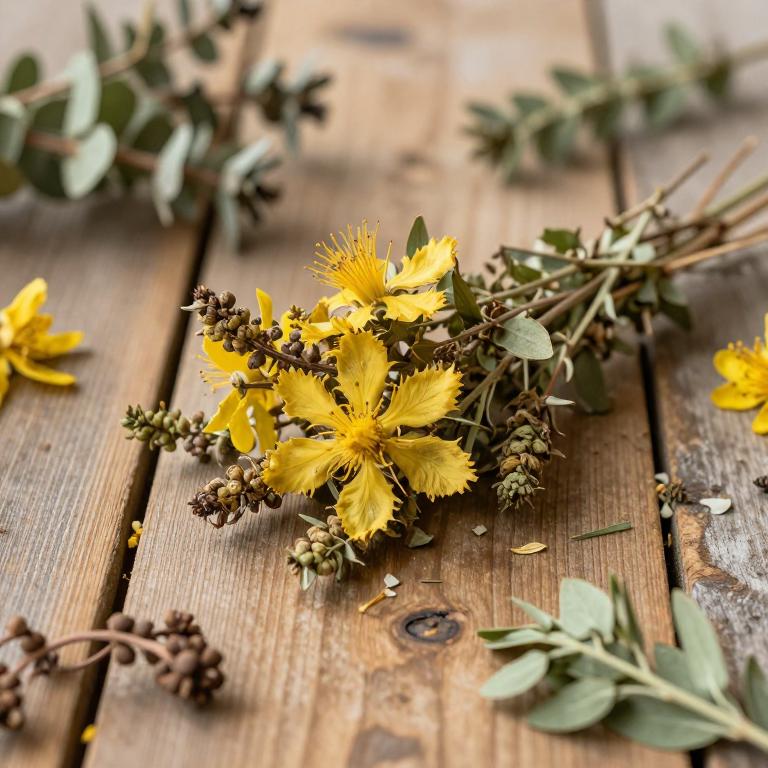
Hypericum carinaatum, scientifically known as Hypericum carinatum, is a distinctive medicinal herb belonging to the Hypericaceae family. Renowned for its unique floral structures, this plant holds significant pharmacological potential. It contains bioactive compounds that offer therapeutic benefits, making it a subject of interest for natural medicine and botanical research.
- Family
- Hypericaceae
- Native range
- Southern America
- Parts used
- Leaf
- Common names
- Not available
- Scientific synonyms
- Hypericum Altissimum · Hypericum Megapotamicum · 1 more
Names and Synonyms
Scientific Names
Accepted name
Hypericum carinatumSynonyms
- Hypericum altissimum
- Hypericum megapotamicum
- Hypericum paraguense
Sources: Wikidata
Taxonomical Classification
This plant, Hypericum carinatum, belongs to the kingdom Plantae and the phylum Streptophyta. Within the class Equisetopsida and subclass Magnoliidae, it is classified under the order Malpighiales. Finally, it is a member of the family Hypericaceae and falls under the genus Hypericum.
| Rank | Classification |
|---|---|
| Kingdom | Plantae |
| Phylum | Streptophyta |
| Class | Equisetopsida |
| Subclass | Magnoliidae |
| Order | Malpighiales |
| Family | Hypericaceae |
| Genus | Hypericum |
Sources: The World Checklist of Vascular Plants (WCVP)
Distribution
This plant exhibits a specific geographical distribution concentrated within the southern regions of South America. It can be found across various territories, including the Northeast and Northwest regions of Argentina. Additionally, its presence extends into the neighboring country of Paraguay. The species is also documented throughout Uruguay. Finally, the plant is located within the southern part of Brazil.
| Region | Area |
|---|---|
| Brazil | Brazil South |
| Southern South America | Argentina Northeast |
| Southern South America | Argentina Northwest |
| Southern South America | Paraguay |
| Southern South America | Uruguay |
Sources: The World Checklist of Vascular Plants (WCVP)
Botanical Identification
Ecology
The ecology of Hypericum carinaatum is characterized by its ability to thrive across a diverse range of altitudes, spanning from sea level (0 m AMSL) up to a maximum elevation of 2000 m AMSL. This plant exhibits significant ecological plasticity, inhabiting various distinct environments including anthropic areas (Área Antrópica), open grasslands (Campo Limpo), riparian forests or gallery forests (Floresta Ciliar ou Galeria), and mixed ombrophilous forests (Floresta Ombrófila Mista). This wide distribution across different successional stages and forest types suggests a resilient nature capable of adapting to both natural forest ecosystems and human-disturbed landscapes.
- Elevational range max:
- 2000 m AMSL
- Elevational range min:
- 0 m AMSL
- Habitat :
- Área Antrópica, Campo Limpo, Floresta Ciliar ou Galeria, Floresta Ombrófila Mista
Life history
The life history of Hypericum carinaatum is characterized by its nature as a perennial organism, meaning it persists through multiple growing seasons rather than completing its cycle in a single year. As a perennial, the plant establishes a stable presence in its habitat, often developing robust root systems that allow it to survive periods of dormancy and emerge annually to undergo its reproductive stages. This lifecycle enables the plant to accumulate resources over several years, facilitating more substantial flowering and seed production in subsequent seasons compared to annual species. Throughout its lifespan, the plant undergoes periodic vegetative growth and reproductive phases, contributing to its long-term survival and ability to colonize its specific ecological niche.
- Lifecycle :
- perennial
Morphology
The morphology of Hypericum carinatum is characterized by a versatile growth form that can manifest as either a shrub or a herbaceous plant. Structurally, the species exhibits varying degrees of woodiness, possessing woody characteristics that support its development. While it can adapt to different moisture levels, its primary habitat classification is terrestrial, though it maintains the capacity to exist in semiaquatic or aquatic environments. In terms of its physical stance, the plant is categorized as a self-supporting organism, functioning as both an obligatory and facultative self-supporting structure rather than a climbing liana or vine. Furthermore, it is an independent species that does not exhibit parasitic behavior, and it maintains a terrestrial lifestyle rather than acting as an epiphyte.
- Aquatic :
- terrestrial
- Climber :
- self-supporting
- Epiphyte :
- terrestrial
- Growth form :
- shrub
- Growth form :
- herb
- Parasite :
- independent
- Woodiness :
- woody
Sources: Global Inventory of Floras and Traits (GIFT)
Plant Parts
Hypericum carinatum has 1 reported plant parts identified across 1 scientific publications and several other databases that are studied for medicinal purposes. The most consistently reported plant part include leaf.
| Plant part | Supporting sources | Consensus |
|---|---|---|
| Leaf | 1 supporting sources | ★☆☆☆☆ |
Leaf
- Journal of natural products
Chemicals
Hypericum carinatum has 5 reported phytochemicals identified across 1 scientific publications and several other databases. The most consistently reported chemicals include 1-EICOSANOL, CAMPESTEROL, STIGMASTEROL, Sitosterol, Uliginosin B.
| Chemical | Supporting sources | Consensus |
|---|---|---|
| 1-EICOSANOL | 1 supporting sources | ★☆☆☆☆ |
| CAMPESTEROL | 1 supporting sources | ★☆☆☆☆ |
| STIGMASTEROL | 1 supporting sources | ★☆☆☆☆ |
| Sitosterol | 1 supporting sources | ★☆☆☆☆ |
| Uliginosin B | 1 supporting sources | ★☆☆☆☆ |
1-EICOSANOL
- Journal of natural products
CAMPESTEROL
- Journal of natural products
STIGMASTEROL
- Journal of natural products
Sitosterol
- Journal of natural products
Uliginosin B
- Journal of natural products
Preparations
Hypericum carinatum has 1 reported preparations identified across 1 scientific publications and several other databases. The most consistently reported preparations include leaves.
| Preparation | Supporting sources | Consensus |
|---|---|---|
| Leaves | 1 supporting sources | ★☆☆☆☆ |
Leaves
- Journal of natural products