tutsan
Hypericum androsaemum · Accepted scientific name
Scientific literature: Sparse (52 studies) · ★★☆☆☆
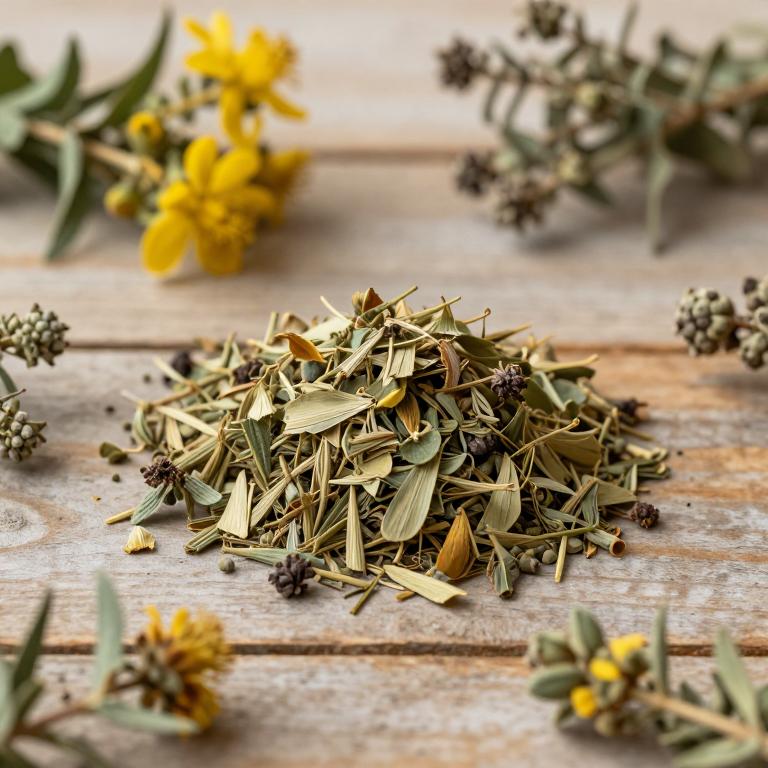
Tutsan, scientifically known as Hypericum androsaemuon, is a resilient perennial shrub native to the Mediterranean. Belonging to the Hypericaceae family, it is distinguished by its bright yellow, star-shaped flowers. While primarily used in ornamental landscaping, it holds significant ethnobotanical interest for its traditional medicinal properties and unique bioactive compounds.
Names and Synonyms
Common Names
- tutsan
- tutsan St. John's-wort
- Bible-leaf
Scientific Names
Accepted name
Hypericum androsaemumSynonyms
- Androsaemum vulgare
- Hypericum androsaemum var. dilatatum
- Hypericum androsaemum f. variegatum
- Androsaemum officinale
Regional and Traditional Names
German:
- Blut-Johanniskraut
- Blutjohanniskraut
- Mannsblut
- Mannsblut
- Blut-Johanniskraut
French:
- Millepertuis androsème
- Millepertuis Androsème
- Millepertuis androseme
- Herbe-à-tous-maux
- Toute-saine
- Toute-bonne
- androsème
- millepertuis androsème
- toute-naine
- toute-saine
- Millepertuis sanguin
- Androsème officinal
Sources: Wikidata, Catalogue of Life
Taxonomical Classification
This plant belongs to the kingdom Plantae and the phylum Streptophyta, falling under the class Equisetopsida and subclass Magnoliidae. Within the order Malpighiales, it is classified under the family Hypericaceae. Finally, its taxonomic placement is completed within the genus Hypericum.
| Rank | Classification |
|---|---|
| Kingdom | Plantae |
| Phylum | Streptophyta |
| Class | Equisetopsida |
| Subclass | Magnoliidae |
| Order | Malpighiales |
| Family | Hypericaceae |
| Genus | Hypericum |
Sources: The World Checklist of Vascular Plants (WCVP)
Distribution
This plant exhibits a specific geographical distribution across various regions of Europe. In Northern Europe, its presence can be noted in both Great Britain and Ireland. Moving toward the central part of the continent, it is also found throughout Middle Europe. Specifically, the species inhabits several countries including Austria and Belgium. Finally, its range extends into the territory of Germany within the Middle European region.
| Region | Area |
|---|---|
| Northern Europe | Great Britain |
| Northern Europe | Ireland |
| Middle Europe | Austria |
| Middle Europe | Belgium |
| Middle Europe | Germany |
| Southwestern Europe | Corse |
| Southwestern Europe | France |
| Southwestern Europe | Portugal |
| Southwestern Europe | Spain |
| Southeastern Europe | Bulgaria |
Sources: The World Checklist of Vascular Plants (WCVP)
Botanical Identification
Ecology
The ecology of Hypericum androsaemum is defined by its presence in diverse mountainous and forested terrains. This species exhibits a broad altitudinal distribution, ranging from sea level up to a maximum elevation of 1300 m AMSL, though it is most characteristically found at a mean elevation of approximately 2600 m AMSL. By occupying both forest environments and high-altitude mountain landscapes, the plant adapts to varying levels of canopy cover and topographic complexity within these montane ecosystems.
- Elevational range max:
- 1300 m AMSL
- Elevational range mean:
- 2600 m AMSL
- Elevational range min:
- 0 m AMSL
- Habitat :
- forest, mountains
Life history
The life history of Hypericum androsaemum is characterized by a perennial lifecycle, allowing the plant to persist through multiple growing seasons. In terms of its structural development and survival strategy, the species exhibits a dual life form classification, functioning as both a phanerophyte and a nanophanerophyte, which dictates its growth habit and how it manages its buds in relation to the ground surface. Furthermore, its deciduousness is categorized as variable, meaning the plant may shed its leaves or retain them depending on specific environmental conditions and seasonal shifts.
- Deciduousness :
- variable
- Life form :
- nanophanerophyte
- Life form :
- phanerophyte
- Lifecycle :
- perennial
Morphology
The morphology of Hypericum androsaemum is characterized by a growth form that transitions between a shrub and a herb, manifesting as a non-woody, self-supporting structure. As a terrestrial plant, it functions as an independent organism rather than a parasite or an epiphyte. The plant's stature is relatively modest, with a height that typically ranges from a minimum of 0.3 m to a maximum of 1.5 m, resulting in a mean plant height of approximately 0.625 m. Although it possesses the structural integrity to be self-supporting, its non-woody nature and herbaceous to shrubby habit define its physical presence within its terrestrial habitat.
- Aquatic :
- terrestrial
- Climber :
- self-supporting
- Epiphyte :
- terrestrial
- Growth form :
- shrub
- Growth form :
- herb
- Parasite :
- independent
- Plant height max:
- 1.5 m
- Plant height mean:
- 0.625 m
- Plant height min:
- 0.3 m
- Woodiness :
- non-woody
Physiology
The physiology of Hypericum androsaemum is characterized by a C3 photosynthetic pathway, which dictates its carbon fixation processes and metabolic efficiency. The plant's vegetative morphology is defined by specific leaf dimensions, where the leaf length varies from a minimum of 3.5 cm to a maximum of 9 cm. Concurrently, the leaf width exhibits significant structural variation, ranging from a minimum of 0.4 cm to a maximum of 6.5 cm, with a mean width measured at 3 cm. Furthermore, regarding its nutrient acquisition strategy, the species does not function as a nitrogen fixer, relying instead on the uptake of available nitrogen from the soil rather than through symbiotic atmospheric fixation.
- Leaf length max:
- 9 cm
- Leaf length min:
- 3.5 cm
- Leaf width max:
- 6.5 cm
- Leaf width mean:
- 0.4 cm
- Leaf width min:
- 3 cm
- Nitrogen fixer :
- no
- Photosynthetic pathway :
- C3
Reproduction
The reproduction of Hypericum androsaemum is primarily driven by sexual processes, as asexual reproduction is noted to be absent. The flowering cycle is extensive and variable, typically beginning in December and continuing through to August. This reproductive phase is supported by a biotic pollination syndrome, specifically utilizing insect pollination to facilitate fertilization. Following successful pollination, the plant develops fruit classified as a berry, which is characterized by a mean length of 1 cm and a mean width of 1 cm. These fruits are dehiscence-based, meaning they are capable of dehiscence to release their contents. The dispersal of the species follows a zoochorous strategy, specifically through endozoochory, where seeds are dispersed via the digestive tracts of animals. The resulting seeds are remarkably consistent in size, with a fixed seed length of 10 mm. The mass of these seeds is quite small, with a mean seed mass of approximately $9.00625 \times 10^{-5}$ g, ranging from a minimum of $5 \times 10^{-5}$ g to a maximum of $1 \times 10^{-4}$ g.
- Dehiscence :
- dehiscent
- Dispersal syndrome :
- zoochorous
- Dispersal syndrome :
- endozoochorous
- Flowering time :
- Dec
- Flowering time :
- Aug
- Fruit length mean:
- 1 cm
- Fruit type :
- berry
- Fruit width mean:
- 1 cm
- Pollination syndrome :
- insect
- Pollination syndrome :
- biotic
- Reproduction asexual :
- absent
- Seed length mean:
- 10 mm
- Seed mass max:
- 1e-04 g
- Seed mass mean:
- 9.00625e-05 g
- Seed mass min:
- 5e-05 g
Sources: Global Inventory of Floras and Traits (GIFT)
Plant Parts
Hypericum androsaemum has 1 reported plant parts identified across 1 scientific publications and several other databases that are studied for medicinal purposes. The most consistently reported plant part include leaf.
| Plant part | Supporting sources | Consensus |
|---|---|---|
| Leaf | 1 supporting sources | ★☆☆☆☆ |
Leaf
- Basic & clinical pharmacology & toxicology
Chemicals
Hypericum androsaemum has 17 reported phytochemicals identified across 1 scientific publications and several other databases. The most consistently reported chemicals include CHLOROGENIC ACID, 1,3,5-Trihydroxyxanthone, 1,3,6,7-Tetrahydroxyxanthone, 1,3,7-Trihydroxyxanthone, 1,7-Dihydroxyxanthone.
| Chemical | Supporting sources | Consensus |
|---|---|---|
| CHLOROGENIC ACID | 2 supporting sources | ★☆☆☆☆ |
| 1,3,5-Trihydroxyxanthone | 1 supporting sources | ★☆☆☆☆ |
| 1,3,6,7-Tetrahydroxyxanthone | 1 supporting sources | ★☆☆☆☆ |
| 1,3,7-Trihydroxyxanthone | 1 supporting sources | ★☆☆☆☆ |
| 1,7-Dihydroxyxanthone | 1 supporting sources | ★☆☆☆☆ |
| CATECHIN | 1 supporting sources | ★☆☆☆☆ |
| CINNAMIC ACID | 1 supporting sources | ★☆☆☆☆ |
| Flavonoids | 1 supporting sources | ★☆☆☆☆ |
| Glucosides | 1 supporting sources | ★☆☆☆☆ |
| Hyperoside | 1 supporting sources | ★☆☆☆☆ |
CHLOROGENIC ACID
- Biomedicine & pharmacotherapy = Biomedecine & pharmacotherapie
- Food and chemical toxicology : an international journal published for the British Industrial Biological Research Association
1,3,5-Trihydroxyxanthone
- Phytochemistry
1,3,6,7-Tetrahydroxyxanthone
- Planta medica
1,3,7-Trihydroxyxanthone
- Phytochemistry
1,7-Dihydroxyxanthone
- Planta medica
CATECHIN
- Biomedicine & pharmacotherapy = Biomedecine & pharmacotherapie
CINNAMIC ACID
- Planta
Flavonoids
- Pakistan journal of pharmaceutical sciences
Glucosides
- Planta medica
Hyperoside
- Biomedicine & pharmacotherapy = Biomedecine & pharmacotherapie
Activities
Hypericum androsaemum has 20 reported activities identified across 1 scientific publications and several other databases. The most consistently reported activities include Antiinflammatory, Anthelmintic, AntiHIV, Antibacterial, Anticancer.
| Activity | Supporting sources | Consensus |
|---|---|---|
| Antiinflammatory | 2 supporting sources | ★☆☆☆☆ |
| Anthelmintic | 1 supporting sources | ★☆☆☆☆ |
| AntiHIV | 1 supporting sources | ★☆☆☆☆ |
| Antibacterial | 1 supporting sources | ★☆☆☆☆ |
| Anticancer | 1 supporting sources | ★☆☆☆☆ |
| Anticarcinomic | 1 supporting sources | ★☆☆☆☆ |
| Antiedemic | 1 supporting sources | ★☆☆☆☆ |
| Antiglycation | 1 supporting sources | ★☆☆☆☆ |
| Antileukemic | 1 supporting sources | ★☆☆☆☆ |
| Antimalarial | 1 supporting sources | ★☆☆☆☆ |
Antiinflammatory
- Dr. Duke
- Phytotherapy research : PTR
Anthelmintic
- Dr. Duke
AntiHIV
- Dr. Duke
Antibacterial
- Dr. Duke
Anticancer
- Dr. Duke
Anticarcinomic
- Dr. Duke
Antiedemic
- Dr. Duke
Antiglycation
- Pakistan journal of pharmaceutical sciences
Antileukemic
- Dr. Duke
Antimalarial
- Dr. Duke
Conditions
Hypericum androsaemum has 10 reported investigations on conditions identified across 1 scientific publications and several other databases. The most consistently reported conditions include burns, depression, diabetes related complications, inflammation, liver diseases.
| Condition | Supporting sources | Consensus |
|---|---|---|
| Burns | 1 supporting sources | ★☆☆☆☆ |
| Depression | 1 supporting sources | ★☆☆☆☆ |
| Diabetes related complications | 1 supporting sources | ★☆☆☆☆ |
| Inflammation | 1 supporting sources | ★☆☆☆☆ |
| Liver diseases | 1 supporting sources | ★☆☆☆☆ |
| Oxidative dna damage | 1 supporting sources | ★☆☆☆☆ |
| Oxidative damage | 1 supporting sources | ★☆☆☆☆ |
| Oxidative injury | 1 supporting sources | ★☆☆☆☆ |
| Oxidative stress | 1 supporting sources | ★☆☆☆☆ |
| Wounds | 1 supporting sources | ★☆☆☆☆ |
Burns
- Journal of ethnopharmacology
Depression
- Biomedicine & pharmacotherapy = Biomedecine & pharmacotherapie
Diabetes related complications
- Pakistan journal of pharmaceutical sciences
Inflammation
- Phytotherapy research : PTR
Liver diseases
- Basic & clinical pharmacology & toxicology
Oxidative dna damage
- Food and chemical toxicology : an international journal published for the British Industrial Biological Research Association
Oxidative damage
- Journal of ethnopharmacology
Oxidative injury
- Journal of ethnopharmacology
Oxidative stress
- Biomedicine & pharmacotherapy = Biomedecine & pharmacotherapie
Wounds
- Journal of ethnopharmacology
Preparations
Hypericum androsaemum has 4 reported preparations identified across 1 scientific publications and several other databases. The most consistently reported preparations include infusion, cell cultures, ethanol:water (4:6) extract, water extracts.
| Preparation | Supporting sources | Consensus |
|---|---|---|
| Infusion | 2 supporting sources | ★☆☆☆☆ |
| Cell cultures | 1 supporting sources | ★☆☆☆☆ |
| Ethanol:water (4:6) extract | 1 supporting sources | ★☆☆☆☆ |
| Water extracts | 1 supporting sources | ★☆☆☆☆ |
Infusion
- Biological & pharmaceutical bulletin
- Journal of ethnopharmacology
Cell cultures
- Planta medica
Ethanol:water (4:6) extract
- Basic & clinical pharmacology & toxicology
Water extracts
- Food and chemical toxicology : an international journal published for the British Industrial Biological Research Association