many-flowered marsh-pennywort
Hydrocotyle umbellata · Accepted scientific name
Scientific literature: Very Sparse (14 studies) · ★☆☆☆☆
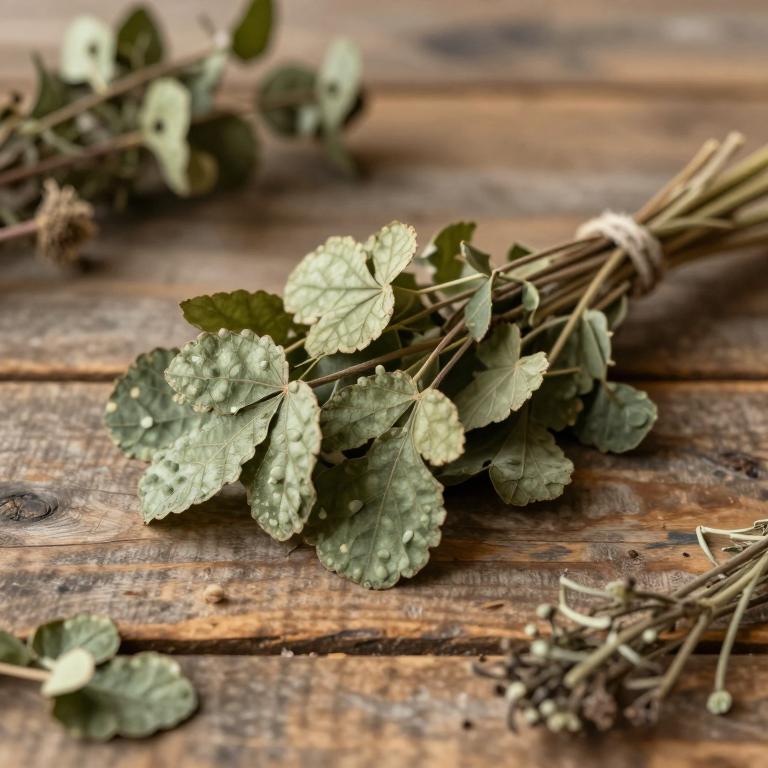
Many-flowered marsh-pennywort, scientifically known as Hydrocotyle umbellata, is a creeping perennial herb found in wetlands globally. Renowned for its medicinal properties, this plant is traditionally used to treat skin ailments, inflammation, and digestive issues. Its unique umbrella-like leaves and medicinal versatility make it a significant botanical specimen.
Names and Synonyms
Common Names
- many-flowered marsh-pennywort
- many-flowered water-pennywort
- water pennywort
- dollarweed
- many-flower marsh-pennywort
- manyflower marsh pennywort
- navel-wort
Scientific Names
Accepted name
Hydrocotyle umbellataSynonyms
- Hydrocotyle umbellata var. scaposa
- Hydrocotyle umbellata var. umbellulata
- Hydrocotyle afra
- Hydrocotyle scaposa
- Hydrocotyle polystachya
- Hydrocotyle fluitans
- Hydrocotyle umbellata var. intermedia
- Hydrocotyle umbellata var. microphylla
- Hydrocotyle umbellulata
Regional and Traditional Names
French:
- Hydrocotyle à ombelle
- hydrocotyle à ombelle
Sources: Wikidata, Catalogue of Life
Taxonomical Classification
This plant belongs to the kingdom Plantae and is classified under the phylum Streptophyta and the class Equisetopsida. Within the subclass Magnoliidae, it falls under the order Apiales and the family Araliaceae. Finally, it is identified by the genus Hydrocotyle, specifically as the species Hydrocotyle umbellata.
| Rank | Classification |
|---|---|
| Kingdom | Plantae |
| Phylum | Streptophyta |
| Class | Equisetopsida |
| Subclass | Magnoliidae |
| Order | Apiales |
| Family | Araliaceae |
| Genus | Hydrocotyle |
Sources: The World Checklist of Vascular Plants (WCVP)
Distribution
This plant exhibits a diverse geographical distribution that spans across several continents and various climatic zones. In the Indo-China region, it can be found growing in Thailand. Its range extends to the Southern Hemisphere, specifically inhabiting the northern parts of New Zealand. Moving to North America, the species is located in Eastern Canada within Nova Scotia. Finally, the plant is established in the United States, ranging from Oregon in the Northwest to Illinois in the North-Central region.
| Region | Area |
|---|---|
| Indo-China | Thailand |
| New Zealand | New Zealand North |
| Eastern Canada | Nova Scotia |
| Northwestern U.S.A. | Oregon |
| North-Central U.S.A. | Illinois |
| North-Central U.S.A. | Minnesota |
| North-Central U.S.A. | Oklahoma |
| Northeastern U.S.A. | Connecticut |
| Northeastern U.S.A. | Indiana |
| Northeastern U.S.A. | Massachusetts |
Sources: The World Checklist of Vascular Plants (WCVP)
Botanical Identification
Ecology
The ecology of Hydrocotyle umbellata is characterized by its ability to thrive across a broad altitudinal gradient, ranging from sea level up to an elevation of 3000 m AMSL. This wide vertical distribution allows the species to inhabit diverse ecological niches, from lowland coastal wetlands and riparian zones to higher-altitude montane environments. Typically found in moist, saturated habitats, it plays a role in stabilizing soil in wet areas and often colonizes the margins of ponds, marshes, and slow-moving streams. Its adaptability to varying elevations suggests a high degree of tolerance to different temperature regimes and atmospheric pressures, enabling it to persist in both tropical lowland ecosystems and cooler, high-elevation aquatic habitats.
- Elevational range max:
- 3000 m AMSL
- Elevational range min:
- 0 m AMSL
Life history
The life history of Hydrocotyle umbellata is characterized by its nature as a perennial plant, allowing it to persist through multiple growing seasons. It typically establishes itself in moist or aquatic environments, where it employs a spreading growth habit to colonize available substrate. Throughout its lifecycle, the plant utilizes both sexual and asexual reproduction methods to ensure its continued presence in its habitat; while it produces flowers for seed dispersal, it also frequently expands through the development of stolons or rhizomes that root at the nodes, facilitating vegetative propagation. This perennial strategy enables the species to maintain stable populations and effectively compete for space in wetland ecosystems over extended periods.
- Lifecycle :
- perennial
Morphology
The morphology of Hydrocotyle umbellata is characterized by its diverse growth habits and structural adaptations. As a non-woody plant, it exhibits a soft, succulent texture typical of a herb and specifically functions as a forb. Its ecological strategy is highly versatile, manifesting as an aquatic, semiaquatic, or terrestrial species depending on the moisture availability of its environment. While it can spread across various substrates, it is not an epiphyte, maintaining a terrestrial existence rather than growing on other plants. The plant is an independent organism, showing no parasitic tendencies toward its hosts. Furthermore, it possesses a self-supporting climbing habit, allowing it to spread across surfaces without being an obligatory vine or liana.
- Aquatic :
- terrestrial
- Climber :
- self-supporting
- Epiphyte :
- terrestrial
- Growth form :
- herb
- Growth form :
- forb
- Parasite :
- independent
- Woodiness :
- non-woody
Physiology
The physiology of Hydrocotyle umbellata is characterized by its metabolic efficiency and specialized adaptations to semi-aquatic or moist environments. As a plant utilizing the C3 photosynthetic pathway, it fixes carbon dioxide directly through the Calvin cycle within the mesophyll cells, a process that is highly effective in the temperate to tropical humid habitats where it typically thrives. This metabolic strategy allows for consistent biomass production under moderate light and temperature conditions, though it remains sensitive to photorespiration under high-heat or high-light stress. The plant's physiological processes are closely integrated with its morphological ability to spread via creeping stolons, which facilitates nutrient uptake and water transport across varying substrates. Furthermore, its physiological regulation of gas exchange and water potential is finely tuned to manage the transitions between saturated soils and more exposed terrestrial surfaces, ensuring stable cellular turgor and metabolic continuity.
- Photosynthetic pathway :
- C3
Sources: Global Inventory of Floras and Traits (GIFT)
Chemicals
Hydrocotyle umbellata has 4 reported phytochemicals identified across 0 scientific publications and several other databases. The most consistently reported chemicals include Hibalactone, Flavonoids, Saponins, Tannins.
| Chemical | Supporting sources | Consensus |
|---|---|---|
| Hibalactone | 2 supporting sources | ★☆☆☆☆ |
| Flavonoids | 1 supporting sources | ★☆☆☆☆ |
| Saponins | 1 supporting sources | ★☆☆☆☆ |
| Tannins | 1 supporting sources | ★☆☆☆☆ |
Hibalactone
- Journal of traditional and complementary medicine
- Biomedicine & pharmacotherapy = Biomedecine & pharmacotherapie
Flavonoids
- Phytochemical analysis : PCA
Saponins
- Phytochemical analysis : PCA
Tannins
- Phytochemical analysis : PCA
Activities
Hydrocotyle umbellata has 1 reported activities identified across 0 scientific publications and several other databases. The most consistently reported activities include Antinociceptive.
| Activity | Supporting sources | Consensus |
|---|---|---|
| Antinociceptive | 1 supporting sources | ★☆☆☆☆ |
Antinociceptive
- Biomedicine & pharmacotherapy = Biomedecine & pharmacotherapie
Conditions
Hydrocotyle umbellata has 7 reported investigations on conditions identified across 0 scientific publications and several other databases. The most consistently reported conditions include cancer, edema, hypertension, inflammation, nociception.
| Condition | Supporting sources | Consensus |
|---|---|---|
| Cancer | 1 supporting sources | ★☆☆☆☆ |
| Edema | 1 supporting sources | ★☆☆☆☆ |
| Hypertension | 1 supporting sources | ★☆☆☆☆ |
| Inflammation | 1 supporting sources | ★☆☆☆☆ |
| Nociception | 1 supporting sources | ★☆☆☆☆ |
| Pain | 1 supporting sources | ★☆☆☆☆ |
| Pleurisy | 1 supporting sources | ★☆☆☆☆ |
Cancer
- Nutrition and cancer
Edema
- Biomedicine & pharmacotherapy = Biomedecine & pharmacotherapie
Hypertension
- Journal of ethnopharmacology
Inflammation
- Nutrition and cancer
Nociception
- Biomedicine & pharmacotherapy = Biomedecine & pharmacotherapie
Pain
- Nutrition and cancer
Pleurisy
- Biomedicine & pharmacotherapy = Biomedecine & pharmacotherapie
Preparations
Hydrocotyle umbellata has 1 reported preparations identified across 0 scientific publications and several other databases. The most consistently reported preparations include Hydrocotyle umbellata extract (HUE).
| Preparation | Supporting sources | Consensus |
|---|---|---|
| Hydrocotyle umbellata extract (hue) | 1 supporting sources | ★☆☆☆☆ |
Hydrocotyle umbellata extract (hue)
- Nutrition and cancer