Hippeastrum puniceum subsp. puniceum
Hippeastrum puniceum subsp. puniceum · Accepted scientific name
Scientific literature: Very Sparse (16 studies) · ★☆☆☆☆
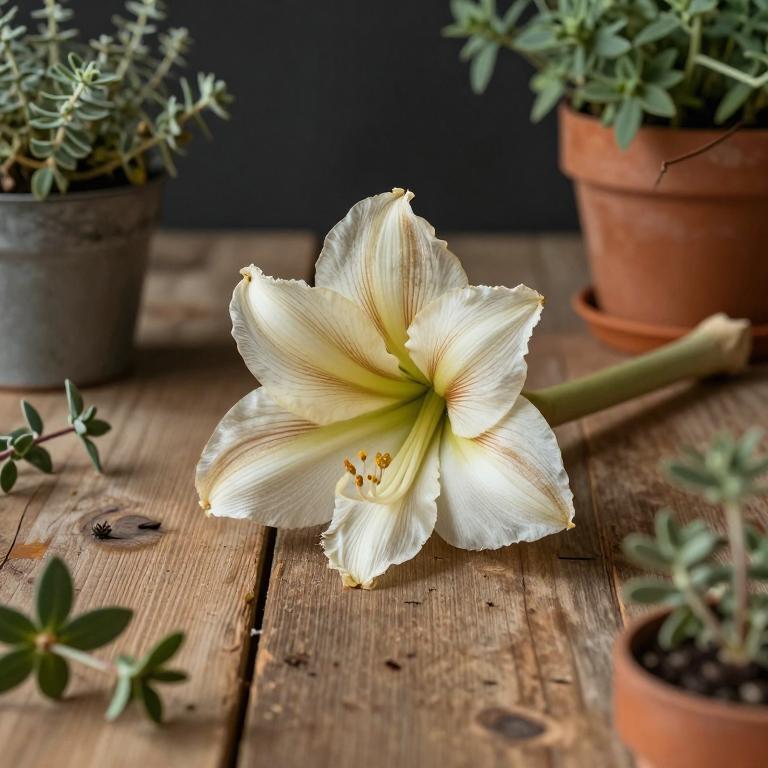
, scientifically known as Hippeastrum puniceum subsp. puniceum, is a striking perennial herb prized for its vibrant, trumpet-shaped scarlet blooms. Beyond its ornamental appeal, this plant holds significant ethnobotanical importance, traditionally utilized in various cultures for its diverse medicinal properties, offering potential therapeutic benefits in holistic healing practices.
- Family
- Amaryllidaceae
- Native range
- Africa
- Parts used
- Not available
- Common names
- Not available
- Scientific synonyms
- Hippeastrum Barreirasum · Hippeastrum Equestre Var. Majus · 33 more
Names and Synonyms
Scientific Names
Accepted name
Hippeastrum puniceum subsp. puniceumSynonyms
- Hippeastrum barreirasum
- Hippeastrum equestre var. majus
- Hippeastrum puniceum var. majus
- Hippeastrum puniceum f. pyrrochroum
- Hippeastrum puniceum f. roezlii
- Hippeastrum puniceum f. spathaceum
- Hippeastrum roezlii
- Amaryllis belladonna var. barbata
- Amaryllis barbata
- Amaryllis belladonna var. major
- Amaryllis belladonna subsp. major
- Amaryllis belladonna subsp. barbata
- Amaryllis crociflora
- Amaryllis pyrrochroa
- Amaryllis spathacea
- Amaryllis belladonna var. semiplena
- Hippeastrum equestre var. plena
- Amaryllis brasiliensis var. nana
- Amaryllis equestris var. plena
- Hippeastrum equestre var. glabrifolium
- Hippeastrum equestre var. minus
- Hippeastrum equestre var. semiplenum
- Hippeastrum equestre var. wolteri
- Hippeastrum ignescens
- Hippeastrum occidentale
- Hippeastrum pyrrochroum
- Hippeastrum spathaceum
- Hippeastrum wolteri
- Hippeastrum barbatum
- Hippeastrum crociflorum
- Amaryllis roezlii
- Amaryllis barreirasa
- Amaryllis brasiliensis
- Amaryllis equestris var. major
- Hippeastrum puniceum f. barbatum
Taxonomical Classification
This plant belongs to the kingdom Plantae within the phylum Streptophyta and the class Equisetopsida. Under the subclass Magnoliidae and order Asparagales, it is classified in the family Amaryllidaceae. Finally, its specific taxonomic placement is within the genus Hippeastrum.
| Rank | Classification |
|---|---|
| Kingdom | Plantae |
| Phylum | Streptophyta |
| Class | Equisetopsida |
| Subclass | Magnoliidae |
| Order | Asparagales |
| Family | Amaryllidaceae |
| Genus | Hippeastrum |
Sources: The World Checklist of Vascular Plants (WCVP)
Distribution
This plant exhibits a broad and diverse geographical distribution across the African continent. In Northern Africa, it can be found specifically within the borders of Tunisia. Its presence extends into West-Central Tropical Africa, where it inhabits the Gulf of Guinea Islands and the nation of Rwanda. Moving toward the southern regions, the species is also documented in South Tropical Africa within Angola. Finally, the distribution reaches into Zimbabwe, completing its wide range across various African landscapes.
| Region | Area |
|---|---|
| Northern Africa | Tunisia |
| West-Central Tropical Africa | Gulf of Guinea Is. |
| West-Central Tropical Africa | Rwanda |
| South Tropical Africa | Angola |
| South Tropical Africa | Zimbabwe |
| Western Indian Ocean | Chagos Archipelago |
| Western Indian Ocean | Rodrigues |
| Western Indian Ocean | Seychelles |
| Indian Subcontinent | Sri Lanka |
| Papuasia | Solomon Is. |
Sources: The World Checklist of Vascular Plants (WCVP)
Chemicals
Hippeastrum puniceum subsp. puniceum has 9 reported phytochemicals identified across 0 scientific publications and several other databases. The most consistently reported chemicals include ACETYLCARANINE, Buphanidrine, UNDULATINE, 3-O-Acetylhamayne, ANHYDROLYCORINIUM CHLORIDE.
| Chemical | Supporting sources | Consensus |
|---|---|---|
| ACETYLCARANINE | 3 supporting sources | ★★☆☆☆ |
| Buphanidrine | 2 supporting sources | ★☆☆☆☆ |
| UNDULATINE | 2 supporting sources | ★☆☆☆☆ |
| 3-O-Acetylhamayne | 1 supporting sources | ★☆☆☆☆ |
| ANHYDROLYCORINIUM CHLORIDE | 1 supporting sources | ★☆☆☆☆ |
| Ambelline | 1 supporting sources | ★☆☆☆☆ |
| Belladine | 1 supporting sources | ★☆☆☆☆ |
| Buphanamine | 1 supporting sources | ★☆☆☆☆ |
| lycorine | 1 supporting sources | ★☆☆☆☆ |
ACETYLCARANINE
- Journal of natural products
- Fitoterapia
- Natural product research
Buphanidrine
- Fitoterapia
- Natural product research
UNDULATINE
- Journal of natural products
- Fitoterapia
3-O-Acetylhamayne
- Molecules (Basel, Switzerland)
ANHYDROLYCORINIUM CHLORIDE
- Journal of natural products
Ambelline
- Journal of natural products
Belladine
- Fitoterapia
Buphanamine
- Molecules (Basel, Switzerland)
lycorine
- Natural product research
Activities
Hippeastrum puniceum subsp. puniceum has 1 reported activities identified across 0 scientific publications and several other databases. The most consistently reported activities include Antineoplastic.
| Activity | Supporting sources | Consensus |
|---|---|---|
| Antineoplastic | 1 supporting sources | ★☆☆☆☆ |
Antineoplastic
- Journal of natural products
Preparations
Hippeastrum puniceum subsp. puniceum has 4 reported preparations identified across 0 scientific publications and several other databases. The most consistently reported preparations include Amaryllis belladonna bulbs, Chloroform extract, alkaloid extract, hexane and chloroform extracts.
| Preparation | Supporting sources | Consensus |
|---|---|---|
| Amaryllis belladonna bulbs | 1 supporting sources | ★☆☆☆☆ |
| Chloroform extract | 1 supporting sources | ★☆☆☆☆ |
| Alkaloid extract | 1 supporting sources | ★☆☆☆☆ |
| Hexane and chloroform extracts | 1 supporting sources | ★☆☆☆☆ |
Amaryllis belladonna bulbs
- Journal of natural products
Chloroform extract
- Natural product research
Alkaloid extract
- Natural product research
Hexane and chloroform extracts
- Natural product research