Hippeastrum breviflorum
Hippeastrum breviflorum · Accepted scientific name
Scientific literature: Very Sparse (2 studies) · ★☆☆☆☆
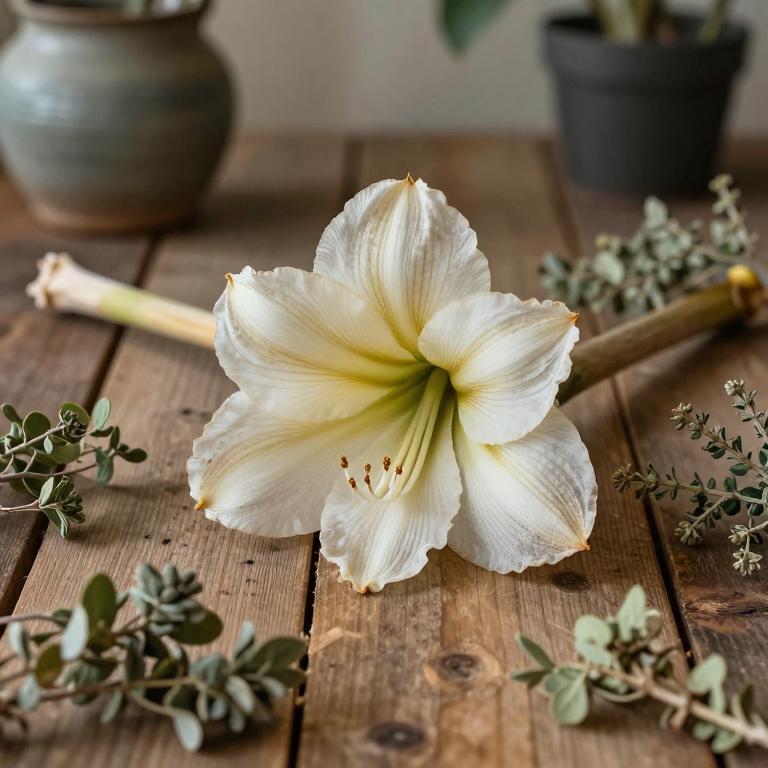
, scientifically known as Hippeastrum breviflorum, is a striking ornamental plant valued for its delicate, short-tubed flowers. Beyond its aesthetic appeal, this species holds significant interest in ethnobotany. Its unique chemical properties offer potential therapeutic benefits, making it a subject of study for various traditional medicinal applications worldwide.
- Family
- Amaryllidaceae
- Native range
- Southern America
- Parts used
- Not available
- Common names
- Not available
- Scientific synonyms
- Not available
Names and Synonyms
Scientific Names
Accepted name
Hippeastrum breviflorumSources: Wikidata, Catalogue of Life
Taxonomical Classification
This plant, known scientifically as Hippeastrum breviflorum, belongs to the kingdom Plantae and the phylum Streptophyta. Within the class Equisetopsida and subclass Magnoliidae, it is categorized under the order Asparagales and the family Amaryllidaceae. Finally, it is classified under the genus Hippeastrum.
| Rank | Classification |
|---|---|
| Kingdom | Plantae |
| Phylum | Streptophyta |
| Class | Equisetopsida |
| Subclass | Magnoliidae |
| Order | Asparagales |
| Family | Amaryllidaceae |
| Genus | Hippeastrum |
Sources: The World Checklist of Vascular Plants (WCVP)
Distribution
This plant is specifically native to the region of Southern South America. Its geographical range is quite restricted, primarily focusing on the northeastern parts of Argentina. Within this specific territory, the species finds its unique ecological niche to thrive. Because of this limited distribution, it is considered an endemic element of that local landscape. Understanding this precise location is essential for the conservation of the species.
| Region | Area |
|---|---|
| Southern South America | Argentina Northeast |
Sources: The World Checklist of Vascular Plants (WCVP)
Botanical Identification
Ecology
The ecology of Hippeastrum breviflorum is characterized by its adaptation to specific Brazilian landscapes, primarily thriving within the distinct environments of Campo de Altitude and Restingas. This species exhibits a broad altitudinal distribution, occupying a vertical range that begins at sea level (0 m AMSL) and extends up to an elevation of 800 m AMSL. By inhabiting both the high-altitude grasslands and the coastal sandy ecosystems, the plant demonstrates a capacity to persist in varied terrains ranging from coastal lowlands to montane shrublands.
- Elevational range max:
- 800 m AMSL
- Elevational range min:
- 0 m AMSL
- Habitat :
- Campo de Altitude, Restinga
Life history
The life history of Hippeastrum breviflorum is characterized by a perennial lifecycle, allowing the plant to persist through multiple growing seasons. As a member of the Amaryllidaceae family, it functions as a geophyte, storing essential nutrients and water within underground structures to survive periods of dormancy or environmental stress. This specialized life form further classifies it as a cryptophyte, meaning its vital regenerative organs are protected beneath the soil surface, ensuring its survival and ability to re-emerge during favorable conditions.
- Life form :
- geophyte
- Life form :
- cryptophyte
- Lifecycle :
- perennial
Morphology
The morphology of Hippeastrum breviflorum is characterized by its growth form as a non-woody herb, typically functioning as a self-supporting plant rather than a climber. It is categorized as a terrestrial species, lacking any epiphytic tendencies such as being a holoepiphyte or hemiepiphyte, and it maintains an independent existence without acting as a parasite. While its habitat can range across different moisture levels, it is specifically described within the spectrum of aquatic, semiaquatic, or terrestrial environments. As a herbaceous plant, it lacks woody structures, consisting instead of soft, fleshy tissues that support its upright or spreading habit.
- Aquatic :
- semiaquatic
- Climber :
- self-supporting
- Epiphyte :
- terrestrial
- Growth form :
- herb
- Parasite :
- independent
- Woodiness :
- non-woody
Sources: Global Inventory of Floras and Traits (GIFT)
Chemicals
Hippeastrum breviflorum has 1 reported phytochemicals identified across 0 scientific publications and several other databases. The most consistently reported chemicals include lycorine.
| Chemical | Supporting sources | Consensus |
|---|---|---|
| lycorine | 1 supporting sources | ★☆☆☆☆ |
lycorine
- Planta medica
Conditions
Hippeastrum breviflorum has 1 reported investigations on conditions identified across 0 scientific publications and several other databases. The most consistently reported conditions include Trichomonas vaginalis.
| Condition | Supporting sources | Consensus |
|---|---|---|
| Trichomonas vaginalis | 1 supporting sources | ★☆☆☆☆ |
Trichomonas vaginalis
- Planta medica
Preparations
Hippeastrum breviflorum has 1 reported preparations identified across 0 scientific publications and several other databases. The most consistently reported preparations include extracts.
| Preparation | Supporting sources | Consensus |
|---|---|---|
| Extracts | 1 supporting sources | ★☆☆☆☆ |
Extracts
- Planta medica