hogweed
Heracleum sphondylium · Accepted scientific name
Scientific literature: Sparse (61 studies) · ★★☆☆☆
Hogweed, scientifically known as Heracleum sphondylium, is a versatile perennial herb found across Europe and Asia. Long valued in traditional herbalism, its leaves and stems possess nutritional and medicinal properties. While often considered a common wildflower, its diverse phytochemical profile offers intriguing potential for therapeutic applications in modern wellness.
- Family
- Apiaceae
- Native range
- Europe
- Parts used
- Not available
- Common names
- Eurasian Cow-Parsnip · European Cow-Parsnip · 11 more
- Scientific synonyms
- Pastinaca Sphondylium · Sphondylium Vulgare
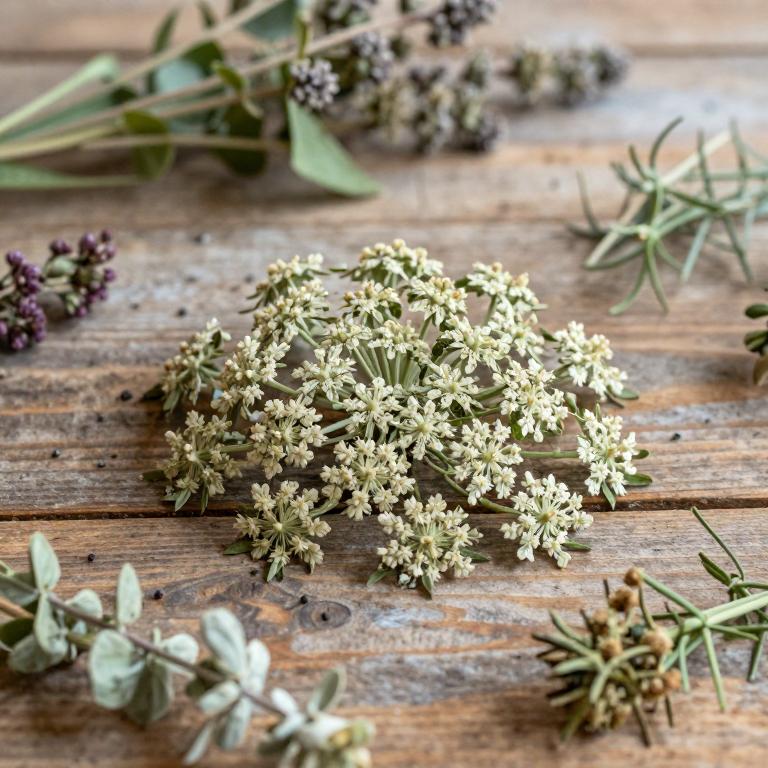
Names and Synonyms
Common Names
- Eurasian cow-parsnip
- European cow-parsnip
- eltrot
- meadow cow-parsnip
- Cow Parsnip
- Hogweed
- Keck
- Kecks
- cow-parsnip
- meadow-parsnip
- Eurasian cow parsnip
- common hogweed
- meadow cow parsnip
Scientific Names
Accepted name
Heracleum sphondyliumSynonyms
- Pastinaca sphondylium
- Sphondylium vulgare
Regional and Traditional Names
Spanish:
- Talaprados
- Heracleum setosum var. granatense
- Copa garbancera
- Cornases
- Heracleum sibiricum subsp. longifolium
- Belleraca
- Zebuoda
- Hierba de Hércules
- Heracleum alpinum var. pyrenaicum
- Heracleum granatense
- Heracleum pyrenaicum
- Branca-ursina espuria
- Heracleum alpinum subsp. benearnense
- Heracleum panaces
- Heracleum longifolium
- Cancuera
- Hierba de Hercules
- branca ursina alemana
- Branca ursina
German:
- Wiesen-Bärenklau
- Gemeiner Bärenklau
- Wiesenbärenklau
- Gewöhnliche Bärenklau
- Wiesen-Bärenklau
- Wiesen-Baerenklau
- Gemeiner Bärenklau
French:
- Berce commune
- Berce Sphondyle
- Grande Berce
- berce commune - patte dours
- berce commune
- berce des prés
- berce sphondyle
- grande berce
- Berce des pres
- Patte d'ours
Sources: Wikidata, Catalogue of Life
Taxonomical Classification
This plant belongs to the kingdom Plantae and the phylum Streptophyta, falling under the class Equisetopsida and subclass Magnoliidae. It is classified within the order Apiales and the family Apiaceae. Finally, its specific taxonomic identification is placed within the genus Heracleum.
| Rank | Classification |
|---|---|
| Kingdom | Plantae |
| Phylum | Streptophyta |
| Class | Equisetopsida |
| Subclass | Magnoliidae |
| Order | Apiales |
| Family | Apiaceae |
| Genus | Heracleum |
Sources: The World Checklist of Vascular Plants (WCVP)
Distribution
This plant is widely distributed across several regions in Northern Europe. In the northernmost reaches of the continent, it can be found growing in Iceland and Finland. Its presence also extends to the islands of the Faroe Islands and Great Britain. Additionally, the species is well-documented within the borders of Denmark. Together, these locations highlight the plant's preference for northern maritime and continental climates.
| Region | Area |
|---|---|
| Northern Europe | Denmark |
| Northern Europe | Finland |
| Northern Europe | Føroyar |
| Northern Europe | Great Britain |
| Northern Europe | Iceland |
| Northern Europe | Ireland |
| Northern Europe | Norway |
| Northern Europe | Sweden |
| Middle Europe | Austria |
| Middle Europe | Belgium |
Sources: The World Checklist of Vascular Plants (WCVP)
Botanical Identification
Ecology
The ecology of Heracleum sphondylium is characterized by its presence in diverse environments, specifically flourishing within forest edges, meadows, and mountainous regions. This species occupies a distinct altitudinal niche, with its elevational range spanning from a minimum of 2100 m AMSL to a maximum of 3400 m AMSL. Furthermore, regarding its subterranean biological associations, the plant does not exhibit mycorrhizal relationships.
- Elevational range max:
- 3400 m AMSL
- Elevational range min:
- 2100 m AMSL
- Habitat :
- forest edges, meadows, mountains
- Mycorrhiza :
- no
Life history
The life history of Heracleum sphondylium is characterized by its status as a perennial plant, allowing it to persist through multiple growing seasons. As a hemicryptophyte, it survives unfavorable periods by protecting its perenn Perennating buds at the soil surface, often beneath a layer of leaf litter or soil. The species exhibits a deciduous nature, shedding its foliage during dormant periods to conserve resources. This combination of a perennial lifecycle and a hemicryptophytic life form enables the plant to establish a robust presence in its habitat, cycling through phases of vegetative growth and seasonal senescence.
- Deciduousness :
- deciduous
- Life form :
- hemicryptophyte
- Lifecycle :
- perennial
Morphology
The morphology of Heracleum sphondylium is characterized by its growth form as a non-woody herb and specifically a forb. It is a self-supporting plant that does not function as a climber or a parasite, maintaining an independent lifestyle. This terrestrial species grows in non-aquatic environments and is not an epiphyte. In terms of stature, the plant exhibits significant variation in size, with a minimum height of 0.5 m, a mean height of approximately 1.231 m, and a maximum height reaching up to 2 m.
- Aquatic :
- terrestrial
- Climber :
- self-supporting
- Epiphyte :
- terrestrial
- Growth form :
- herb
- Growth form :
- forb
- Parasite :
- independent
- Plant height max:
- 2 m
- Plant height mean:
- 1.231 m
- Plant height min:
- 0.5 m
- Woodiness :
- non-woody
Physiology
The physiology of Heracleum sphondylium is characterized by a C3 photosynthetic pathway, a metabolic strategy typical of many temperate herbaceous plants that optimizes carbon fixation under moderate light and temperature conditions. The plant exhibits a non-carnivorous nutritional strategy, relying entirely on soil-derived nutrients and organic matter rather than the capture of prey. Its leaf morphology is substantial, with an average leaf size of approximately 819.51 cm² and individual leaf lengths reaching a maximum of 12 cm. These physical dimensions are closely linked to its resource acquisition efficiency, as evidenced by a mean Specific Leaf Area (SLA) of 221.72 cm²/g, indicating a specific balance between leaf biomass investment and the surface area available for light interception and gas exchange.
- Carnivory :
- non-carnivorous
- Leaf length max:
- 12 cm
- Leaf size mean:
- 819.50667 cm²
- Photosynthetic pathway :
- C3
- Specific Leaf Area (SLA) mean:
- 221.72 cm²/g
Reproduction
The reproduction of Heracleum sphondylium is primarily driven by sexual processes, as asexual reproduction is notably absent in this species. The flowering period typically commences in June and extends through August. The plant utilizes a biotic pollination syndrome, specifically relying on insects, with bees being a significant contributor to the pollination process. While successful pollination leads to the development of fruit, which has a mean length of 0.8 cm, the plant is also capable of self-fertilization. The resulting seeds are characterized by a consistent length of 8 mm and a mean mass of approximately 0.00624 g, with individual seed masses ranging from a minimum of 0.00516 g to a maximum of 0.01215 g. Following maturation, the plant employs an unspecialized dispersal syndrome to distribute its seeds.
- Dispersal syndrome :
- unspecialized
- Flowering time :
- Jun
- Flowering time :
- Aug
- Fruit length mean:
- 0.8 cm
- Pollination syndrome :
- insect
- Pollination syndrome :
- bee
- Pollination syndrome :
- biotic
- Reproduction asexual :
- absent
- Seed length mean:
- 8 mm
- Seed mass max:
- 0.01215 g
- Seed mass mean:
- 0.0062421785 g
- Seed mass min:
- 0.00516 g
- Self fertilization :
- present
Sources: Global Inventory of Floras and Traits (GIFT)
Chemicals
Heracleum sphondylium has 8 reported phytochemicals identified across 0 scientific publications and several other databases. The most consistently reported chemicals include Coumarins, Fatty acids, Flavonoids, Iridoids, Phytosterols.
| Chemical | Supporting sources | Consensus |
|---|---|---|
| Coumarins | 1 supporting sources | ★☆☆☆☆ |
| Fatty acids | 1 supporting sources | ★☆☆☆☆ |
| Flavonoids | 1 supporting sources | ★☆☆☆☆ |
| Iridoids | 1 supporting sources | ★☆☆☆☆ |
| Phytosterols | 1 supporting sources | ★☆☆☆☆ |
| Terpenoids | 1 supporting sources | ★☆☆☆☆ |
| XANTHOTOXIN | 1 supporting sources | ★☆☆☆☆ |
| pimpinellin | 1 supporting sources | ★☆☆☆☆ |
Coumarins
- Antibiotics (Basel, Switzerland)
Fatty acids
- Antibiotics (Basel, Switzerland)
Flavonoids
- Antibiotics (Basel, Switzerland)
Iridoids
- Antibiotics (Basel, Switzerland)
Phytosterols
- Antibiotics (Basel, Switzerland)
Terpenoids
- Antibiotics (Basel, Switzerland)
XANTHOTOXIN
- Dr. Duke
pimpinellin
- Dr. Duke
Activities
Heracleum sphondylium has 45 reported activities identified across 0 scientific publications and several other databases. The most consistently reported activities include Antiaflatoxin, Antibacterial, Antidermatitic, Antifeedant, Antihistaminic.
| Activity | Supporting sources | Consensus |
|---|---|---|
| Antiaflatoxin | 1 supporting sources | ★☆☆☆☆ |
| Antibacterial | 1 supporting sources | ★☆☆☆☆ |
| Antidermatitic | 1 supporting sources | ★☆☆☆☆ |
| Antifeedant | 1 supporting sources | ★☆☆☆☆ |
| Antihistaminic | 1 supporting sources | ★☆☆☆☆ |
| Antiinflammatory | 1 supporting sources | ★☆☆☆☆ |
| Antikeratotic | 1 supporting sources | ★☆☆☆☆ |
| Antileucodermic | 1 supporting sources | ★☆☆☆☆ |
| Antilymphomic | 1 supporting sources | ★☆☆☆☆ |
| Antimicrobial | 1 supporting sources | ★☆☆☆☆ |
Antiaflatoxin
- Dr. Duke
Antibacterial
- Dr. Duke
Antidermatitic
- Dr. Duke
Antifeedant
- Dr. Duke
Antihistaminic
- Dr. Duke
Antiinflammatory
- Dr. Duke
Antikeratotic
- Dr. Duke
Antileucodermic
- Dr. Duke
Antilymphomic
- Dr. Duke
Antimicrobial
- Antibiotics (Basel, Switzerland)
Conditions
Heracleum sphondylium has 8 reported investigations on conditions identified across 0 scientific publications and several other databases. The most consistently reported conditions include Bacillus subtilis, Escherichia coli, HeLa cell, Pseudomonas aeruginosa, Staphylococcus aureus.
| Condition | Supporting sources | Consensus |
|---|---|---|
| Bacillus subtilis | 1 supporting sources | ★☆☆☆☆ |
| Escherichia coli | 1 supporting sources | ★☆☆☆☆ |
| Hela cell | 1 supporting sources | ★☆☆☆☆ |
| Pseudomonas aeruginosa | 1 supporting sources | ★☆☆☆☆ |
| Staphylococcus aureus | 1 supporting sources | ★☆☆☆☆ |
| Food contamination | 1 supporting sources | ★☆☆☆☆ |
| Foodborne diseases | 1 supporting sources | ★☆☆☆☆ |
| Photosensitization | 1 supporting sources | ★☆☆☆☆ |
Bacillus subtilis
- Antibiotics (Basel, Switzerland)
Escherichia coli
- Antibiotics (Basel, Switzerland)
Hela cell
- Antibiotics (Basel, Switzerland)
Pseudomonas aeruginosa
- Antibiotics (Basel, Switzerland)
Staphylococcus aureus
- Antibiotics (Basel, Switzerland)
Food contamination
- Food & function
Foodborne diseases
- Food & function
Photosensitization
- Journal of toxicology
Preparations
Heracleum sphondylium has 1 reported preparations identified across 0 scientific publications and several other databases. The most consistently reported preparations include HS-Ag system.
| Preparation | Supporting sources | Consensus |
|---|---|---|
| Hs-ag system | 1 supporting sources | ★☆☆☆☆ |
Hs-ag system
- Antibiotics (Basel, Switzerland)