daylilies
Hemerocallis · Accepted scientific name
Scientific literature: Very Sparse (8 studies) · ★☆☆☆☆
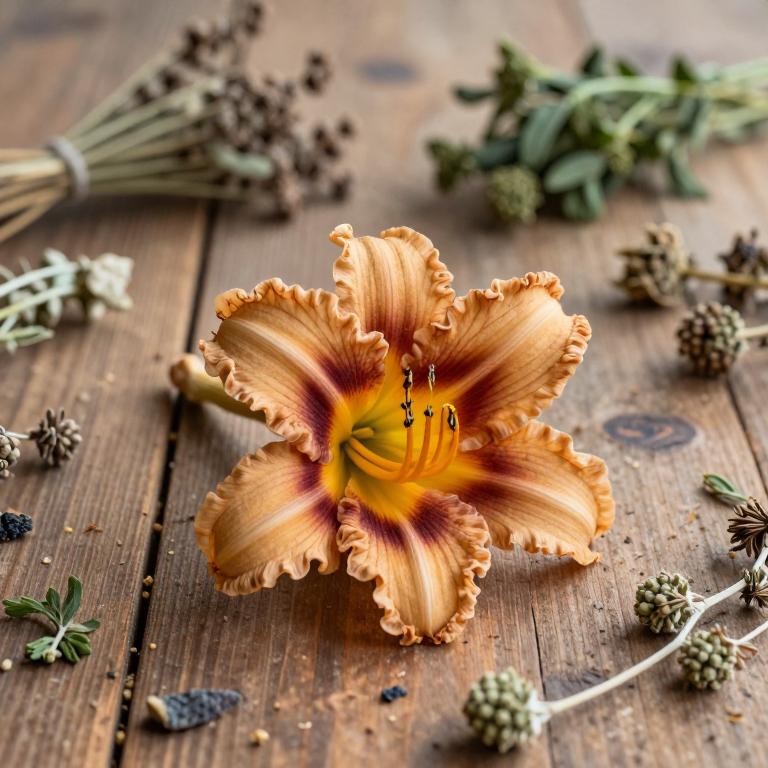
Daylilies, scientifically known as Hemerocallis, is a versatile genus celebrated both for its vibrant ornamental blooms and its traditional medicinal properties. Renowned in various cultures, different species offer therapeutic benefits, ranging from soothing digestive issues to reducing inflammation, making this resilient plant a fascinating subject for botanical study.
- Family
- Asphodelaceae
- Native range
- Europe
- Parts used
- Not available
- Common names
- Daylily · Day-Lily · 1 more
- Scientific synonyms
- Not available
Names and Synonyms
Common Names
- daylily
- day-lily
- day lilies
Scientific Names
Accepted name
HemerocallisRegional and Traditional Names
Spanish:
- Lirio de día
- Lirio de dia
- Lirios De Un Día
- Lirios de Día
German:
- Taglilien
- Taglilie
- Taglilie
- Tageslilien
- Taglilien
French:
- Hémérocalle
- Hemerocalle
- Hémérocalles
- Hémérocalle
Sources: Wikidata, Catalogue of Life
Taxonomical Classification
This plant belongs to the kingdom Plantae and the phylum Streptophyta, falling under the class Equisetopsida and subclass Magnoliidae. Within the order Asparagales and the family Asphodelaceae, it is classified under the genus Hemerocallis.
| Rank | Classification |
|---|---|
| Kingdom | Plantae |
| Phylum | Streptophyta |
| Class | Equisetopsida |
| Subclass | Magnoliidae |
| Order | Asparagales |
| Family | Asphodelaceae |
| Genus | Hemerocallis |
Sources: The World Checklist of Vascular Plants (WCVP)
Distribution
This plant exhibits a diverse geographical distribution across various regions of the European continent. In Northern Europe, its presence is documented in both Great Britain and Ireland. Moving toward the central regions, the species can also be found throughout Middle Europe. Specifically, it inhabits the landscapes of Austria and Belgium. Finally, its range extends further into the Middle European territories of Czechia and Slovakia.
| Region | Area |
|---|---|
| Northern Europe | Great Britain |
| Northern Europe | Ireland |
| Middle Europe | Austria |
| Middle Europe | Belgium |
| Middle Europe | Czechia-Slovakia |
| Middle Europe | Germany |
| Middle Europe | Hungary |
| Middle Europe | Switzerland |
| Southwestern Europe | France |
| Southwestern Europe | Spain |
Sources: The World Checklist of Vascular Plants (WCVP)
Chemicals
Hemerocallis has 3 reported phytochemicals identified across 0 scientific publications and several other databases. The most consistently reported chemicals include CHLOROGENIC ACID, Flavonoids, Quercetin 3-O-rutinoside.
| Chemical | Supporting sources | Consensus |
|---|---|---|
| CHLOROGENIC ACID | 1 supporting sources | ★☆☆☆☆ |
| Flavonoids | 1 supporting sources | ★☆☆☆☆ |
| Quercetin 3-O-rutinoside | 1 supporting sources | ★☆☆☆☆ |
CHLOROGENIC ACID
- Antioxidants (Basel, Switzerland)
Flavonoids
- Antioxidants (Basel, Switzerland)
Quercetin 3-O-rutinoside
- Antioxidants (Basel, Switzerland)
Activities
Hemerocallis has 2 reported activities identified across 0 scientific publications and several other databases. The most consistently reported activities include Antimicrobial, Antioxidant.
| Activity | Supporting sources | Consensus |
|---|---|---|
| Antimicrobial | 1 supporting sources | ★☆☆☆☆ |
| Antioxidant | 1 supporting sources | ★☆☆☆☆ |
Antimicrobial
- Antioxidants (Basel, Switzerland)
Antioxidant
- Antioxidants (Basel, Switzerland)
Conditions
Hemerocallis has 2 reported investigations on conditions identified across 0 scientific publications and several other databases. The most consistently reported conditions include depression, inflammation.
| Condition | Supporting sources | Consensus |
|---|---|---|
| Depression | 1 supporting sources | ★☆☆☆☆ |
| Inflammation | 1 supporting sources | ★☆☆☆☆ |
Depression
- Antioxidants (Basel, Switzerland)
Inflammation
- Antioxidants (Basel, Switzerland)