Hemerocallis fulva var. fulva
Hemerocallis fulva var. fulva · Accepted scientific name
Scientific literature: Very Sparse (9 studies) · ★☆☆☆☆
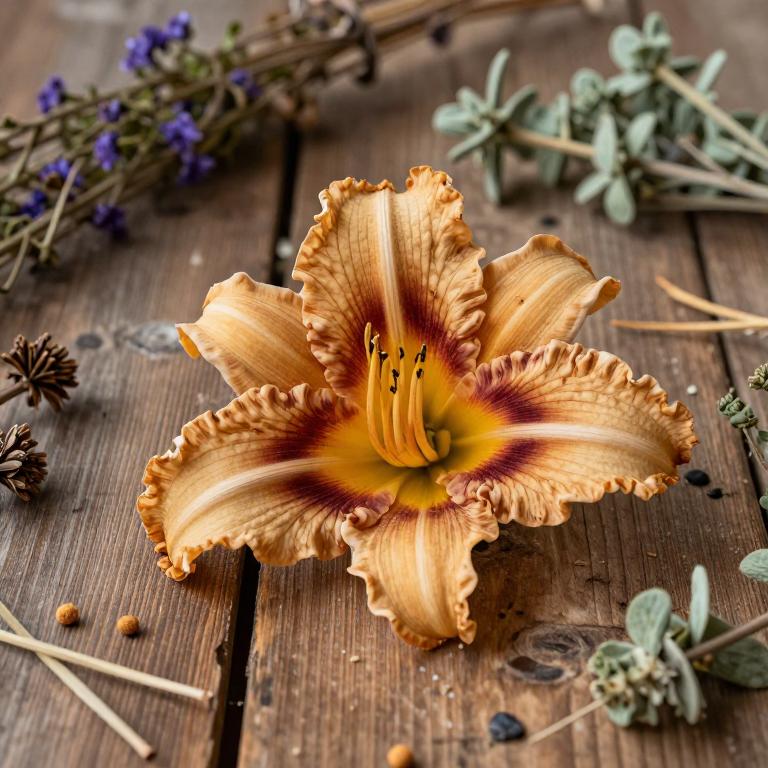
scientifically known as Hemerocallis fulva var. fulva, is a resilient perennial often referred to as the orange daylily. Beyond its ornamental beauty, this variety holds significant medicinal value in traditional practices, frequently utilized for its anti-inflammatory, diuretic, and cooling properties to support digestive health and alleviate various systemic ailments.
- Family
- Asphodelaceae
- Native range
- Europe
- Parts used
- Not available
- Common names
- Not available
- Scientific synonyms
- Hemerocallis Maculata · Hemerocallis Disticha Var. Kwanso · 8 more
Names and Synonyms
Scientific Names
Accepted name
Hemerocallis fulva var. fulvaSynonyms
- Hemerocallis maculata
- Hemerocallis disticha var. kwanso
- Hemerocallis kwanso
- Hemerocallis picta
- Hemerocallis fulva var. oppositibracteata
- Hemerocallis fulva var. kwanso
- Hemerocallis fulva var. rosea
- Hemerocallis fulva var. maculata
- Hemerocallis fulva f. kwanso
- Gloriosa luxurians
Sources: Wikidata, Catalogue of Life
Taxonomical Classification
This plant belongs to the kingdom Plantae within the phylum Streptophyta and the class Equisetopsida. It is further classified under the subclass Magnoliidae and the order Asparagales, falling into the family Asphodelaceae. Finally, it is identified by the genus Hemerocallis as the variety Hemerocallis fulva var. fulva.
| Rank | Classification |
|---|---|
| Kingdom | Plantae |
| Phylum | Streptophyta |
| Class | Equisetopsida |
| Subclass | Magnoliidae |
| Order | Asparagales |
| Family | Asphodelaceae |
| Genus | Hemerocallis |
Sources: The World Checklist of Vascular Plants (WCVP)
Distribution
This plant exhibits a broad presence across several key regions in Europe. In Northern Europe, its distribution can be found throughout Great Britain and Ireland. Moving into Middle Europe, the species is also established in Austria. It is further documented within the borders of Belgium. Finally, its range extends into the central territories of Czechia-Slovakia.
| Region | Area |
|---|---|
| Northern Europe | Great Britain |
| Northern Europe | Ireland |
| Middle Europe | Austria |
| Middle Europe | Belgium |
| Middle Europe | Czechia-Slovakia |
| Middle Europe | Germany |
| Middle Europe | Hungary |
| Middle Europe | Switzerland |
| Southwestern Europe | France |
| Southwestern Europe | Spain |
Sources: The World Checklist of Vascular Plants (WCVP)
Chemicals
Hemerocallis fulva var. fulva has 8 reported phytochemicals identified across 0 scientific publications and several other databases. The most consistently reported chemicals include 24S-hydroxy-neotokorogenin 1-O-alpha-L-arabinopyranosyl 24-O-beta-D-glucopyranoside, 5-hydroxyindole acetic acid, Hemeroside A, Hemeroside B, Homovanillic acid.
| Chemical | Supporting sources | Consensus |
|---|---|---|
| 24S-hydroxy-neotokorogenin 1-O-alpha-L-arabinopyranosyl 24-O-beta-D-glucopyranoside | 1 supporting sources | ★☆☆☆☆ |
| 5-hydroxyindole acetic acid | 1 supporting sources | ★☆☆☆☆ |
| Hemeroside A | 1 supporting sources | ★☆☆☆☆ |
| Hemeroside B | 1 supporting sources | ★☆☆☆☆ |
| Homovanillic acid | 1 supporting sources | ★☆☆☆☆ |
| dopamine | 1 supporting sources | ★☆☆☆☆ |
| serotonin | 1 supporting sources | ★☆☆☆☆ |
| vanilylmandelic acid | 1 supporting sources | ★☆☆☆☆ |
24S-hydroxy-neotokorogenin 1-O-alpha-L-arabinopyranosyl 24-O-beta-D-glucopyranoside
- Chemical & pharmaceutical bulletin
5-hydroxyindole acetic acid
- Journal of ethnopharmacology
Hemeroside A
- Chemical & pharmaceutical bulletin
Hemeroside B
- Chemical & pharmaceutical bulletin
Homovanillic acid
- Journal of ethnopharmacology
dopamine
- Journal of ethnopharmacology
serotonin
- Journal of ethnopharmacology
vanilylmandelic acid
- Journal of ethnopharmacology
Preparations
Hemerocallis fulva var. fulva has 1 reported preparations identified across 0 scientific publications and several other databases. The most consistently reported preparations include water fraction of the resuspended HF extract.
| Preparation | Supporting sources | Consensus |
|---|---|---|
| Water fraction of the resuspended hf extract | 1 supporting sources | ★☆☆☆☆ |
Water fraction of the resuspended hf extract
- Journal of ethnopharmacology