Helleborus purpurascens
Helleborus purpurascens · Accepted scientific name
Scientific literature: Very Sparse (3 studies) · ★☆☆☆☆
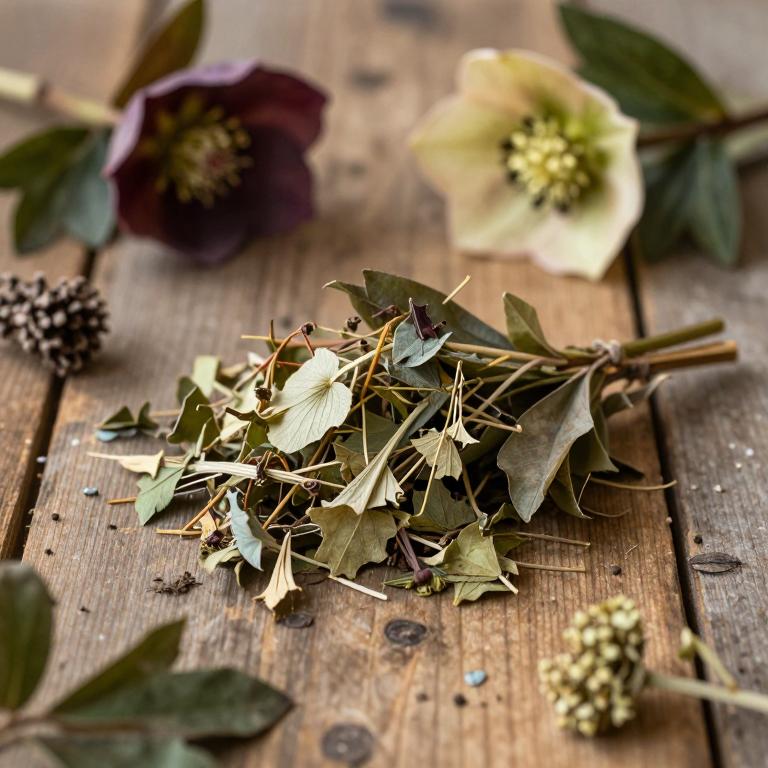
Helleborus purpurascens, scientifically known as Helleborus purpurascens, is a perennial herb native to the Appalachian Mountains. Renowned for its striking dark blooms, this plant holds significant historical importance in traditional medicine. However, due to its potent toxicity, it must be handled with extreme caution and professional guidance.
- Family
- Ranunculaceae
- Native range
- Europe
- Parts used
- Root
- Common names
- Not available
- Scientific synonyms
- Helleborus Purpurascens Var. Baumgartenii · Helleborus Purpurascens F. Baumgartenii · 14 more
Names and Synonyms
Scientific Names
Accepted name
Helleborus purpurascensSynonyms
- Helleborus purpurascens var. baumgartenii
- Helleborus purpurascens f. baumgartenii
- Helleborus purpurascens var. bocconei
- Helleborus viridis var. purpurascens
- Helleborus baumgartenii
- Helleborus purpurascens f. asper
- Helleborus purpurascens var. subflabellatus
- Helleborus purpurascens f. dniesterensis
- Helleborus purpurascens f. glabrescens
- Helleborus purpurascens f. grossedentatus
- Helleborus purpurascens f. nanus
- Helleborus purpurascens f. quadriflorus
- Helleborus purpurascens f. subdivisus
- Helleborus purpurascens f. tuzsonii
- Helleborus purpurascens var. viridiflorus
- Helleborus purpurascens f. viridiflorus
Regional and Traditional Names
German:
- Purpur- Nieswurz
French:
- Hellébore pourpre
Sources: Wikidata, Catalogue of Life
Taxonomical Classification
This plant belongs to the kingdom Plantae and is classified within the phylum Streptophyta and the class Equisetopsida. As a member of the subclass Magnoliidae and the order Ranunculales, it is further categorized under the family Ranunculaceae. Finally, it is identified by the genus Helleborus, specifically within the species Helleborus purpurascens.
| Rank | Classification |
|---|---|
| Kingdom | Plantae |
| Phylum | Streptophyta |
| Class | Equisetopsida |
| Subclass | Magnoliidae |
| Order | Ranunculales |
| Family | Ranunculaceae |
| Genus | Helleborus |
Sources: The World Checklist of Vascular Plants (WCVP)
Distribution
This plant exhibits a diverse presence across several regions in Europe. In Middle Europe, its range extends through the territories of Czechia and Slovakia. It is also commonly documented within the borders of Poland and Hungary. Moving toward Southeastern Europe, the species can be found growing in Italy. Finally, its geographical distribution includes the landscape of Romania.
| Region | Area |
|---|---|
| Middle Europe | Czechia-Slovakia |
| Middle Europe | Hungary |
| Middle Europe | Poland |
| Southeastern Europe | Italy |
| Southeastern Europe | Romania |
| Southeastern Europe | NW. Balkan Pen. |
| Eastern Europe | Ukraine |
Sources: The World Checklist of Vascular Plants (WCVP)
Botanical Identification
Ecology
The ecology of Helleborus purpurascens is fundamentally defined by its preference for forest environments, where it thrives under the protective canopy of deciduous and mixed woodlands. Within these forested ecosystems, the plant occupies the shaded understory, benefiting from the stabilized microclimate, moderated temperatures, and high humidity levels provided by the overhead tree cover. It is typically found in nutrient-rich, moist, yet well-drained soils, often associated with leaf litter that contributes to a slow release of organic matter. This woodland habitat provides the specific light conditions required for its growth cycle, allowing it to emerge in early spring when sunlight can penetrate the forest floor before the canopy fully closes.
- Habitat :
- forest
Life history
The life history of Helleborus purpurascens is characterized by its classification as a perennial, meaning it lives for multiple years and undergoes continuous growth cycles rather than completing its life cycle in a single season. As a long-lived herbaceous plant, it establishes a robust root system that allows it to persist through various seasonal changes, often re-emerging from the same rootstock year after year. Its developmental stages involve a period of vegetative growth followed by a flowering phase, which is typically synchronized with the late winter or early spring months. Over its lifespan, the plant undergoes periodic cycles of foliage production and dormancy, ensuring its long-term survival and ability to reproduce via seed production or vegetative spreading within its natural habitat.
- Lifecycle :
- perennial
Morphology
The morphology of Helleborus purpurascens is characterized by its stature as a low-growing herb with a non-woody structure. The plant exhibits a compact growth form, typically reaching a height ranging from a minimum of 0.1 m to a maximum of 0.15 m.
- Growth form :
- herb
- Plant height max:
- 0.15 m
- Plant height min:
- 0.1 m
- Woodiness :
- non-woody
Reproduction
The reproduction of Helleborus purpurascens is closely tied to its seasonal flowering cycle, which occurs during the late winter and early spring months. The flowering period typically begins in February, marking the onset of its reproductive phase, and continues until its conclusion in April. This specific window of time ensures that the plant's reproductive efforts are synchronized with the early seasonal transitions, providing a predictable timeframe for its bloom.
- Flowering time :
- Feb
- Flowering time :
- Apr
Sources: Global Inventory of Floras and Traits (GIFT)
Plant Parts
Helleborus purpurascens has 1 reported plant parts identified across 1 scientific publications and several other databases that are studied for medicinal purposes. The most consistently reported plant part include root.
| Plant part | Supporting sources | Consensus |
|---|---|---|
| Root | 1 supporting sources | ★☆☆☆☆ |
Root
- DTW. Deutsche tierarztliche Wochenschrift
Activities
Helleborus purpurascens has 1 reported activities identified across 1 scientific publications and several other databases. The most consistently reported activities include Antioxidant.
| Activity | Supporting sources | Consensus |
|---|---|---|
| Antioxidant | 1 supporting sources | ★☆☆☆☆ |
Antioxidant
- Plants (Basel, Switzerland)
Conditions
Helleborus purpurascens has 1 reported investigations on conditions identified across 1 scientific publications and several other databases. The most consistently reported conditions include tumor.
| Condition | Supporting sources | Consensus |
|---|---|---|
| Tumor | 1 supporting sources | ★☆☆☆☆ |
Tumor
- Plants (Basel, Switzerland)
Preparations
Helleborus purpurascens has 2 reported preparations identified across 1 scientific publications and several other databases. The most consistently reported preparations include chitosan nanocarriers, transcutaneous implantation of the root.
| Preparation | Supporting sources | Consensus |
|---|---|---|
| Chitosan nanocarriers | 1 supporting sources | ★☆☆☆☆ |
| Transcutaneous implantation of the root | 1 supporting sources | ★☆☆☆☆ |
Chitosan nanocarriers
- Plants (Basel, Switzerland)
Transcutaneous implantation of the root
- DTW. Deutsche tierarztliche Wochenschrift