Helleborus orientalis
Helleborus orientalis · Accepted scientific name
Scientific literature: Very Sparse (3 studies) · ★☆☆☆☆
, scientifically known as Helleborus orientalis, is a striking perennial celebrated for its elegant, nodding blooms. Often called the Lenten Rose, this hardy plant thrives in shade. While visually stunning, it contains toxic compounds, requiring careful handling and knowledge of its potent medicinal properties and potential toxicity in herbalism.
- Family
- Not available
- Native range
- Europe
- Parts used
- Rhizome
- Common names
- Not available
- Scientific synonyms
- Not available
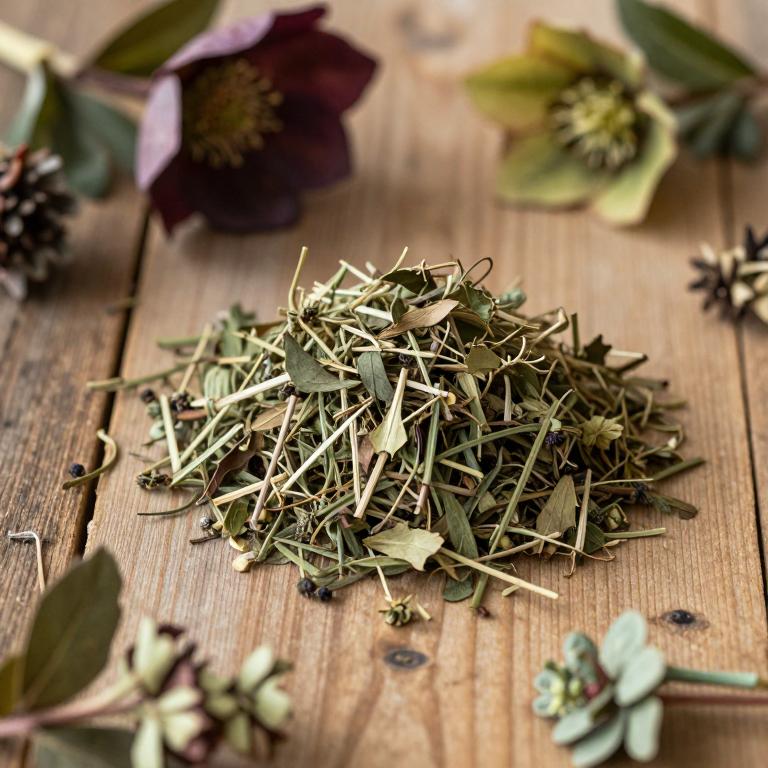
Names and Synonyms
Scientific Names
Accepted name
Helleborus orientalisRegional and Traditional Names
German:
- Orientalische Nieswurz
French:
- Rose de carême
Sources: Wikidata
Distribution
This plant exhibits a specific distribution pattern across several parts of the European continent. In Northern Europe, its presence is documented in Denmark, Sweden, Great Britain, and Ireland. Moving toward the center of the continent, the species is also found in Middle Europe. Specifically, its range extends into the country of Austria. Consequently, its natural habitat spans both northern maritime regions and central mountainous landscapes.
| Region | Area |
|---|---|
| Northern Europe | Denmark |
| Northern Europe | Great Britain |
| Northern Europe | Ireland |
| Northern Europe | Sweden |
| Middle Europe | Austria |
| Middle Europe | Czechia-Slovakia |
| Middle Europe | Germany |
| Southwestern Europe | France |
| Southeastern Europe | Greece |
| Southeastern Europe | Türkiye-in-Europe |
Sources: The World Checklist of Vascular Plants (WCVP)
Botanical Identification
Ecology
The ecology of Helleborus orientalis is characterized by its preference for shaded, nutrient-rich environments, primarily occurring within forest ecosystems. It thrives in the dappled light of deciduous woodlands, where the canopy provides the necessary protection from intense direct sunlight while maintaining a moist, temperate microclimate. Within these forest habitats, the plant typically occupies well-drained, humus-rich soils, often found on slopes or in woodland clearings where organic matter is abundant. This preference for forest settings allows it to benefit from the stable moisture levels and the seasonal nutrient cycling provided by leaf litter, which supports its perennial growth cycle and flowering patterns.
- Habitat :
- forest
Life history
The life history of Helleborus orientalis is characterized by its status as a perennial plant, meaning it survives for multiple years through successive growing seasons. As a hemicryptophyte, its perennating buds are located at the soil surface, protected by leaf litter or the upper layers of the substrate, which allows the plant to endure unfavorable environmental conditions such as winter dormancy. This life form enables the plant to re-emerge annually from its established root system, maintaining a consistent presence in its natural habitat through a continuous, long-term lifecycle.
- Life form :
- hemicryptophyte
- Lifecycle :
- perennial
Morphology
The morphology of Helleborus orientalis is characterized by a growth form classified as both a herb and a forb, exhibiting a non-woody structure throughout its development. As a self-supporting plant, it lacks any climbing or liana-like tendencies, maintaining an independent existence without being a parasite or an epiphyte, as it is strictly terrestrial in its habitat. The plant maintains a relatively low stature, with a plant height ranging from a minimum of 0.2 m to a maximum of 0.4 m.
- Aquatic :
- terrestrial
- Climber :
- self-supporting
- Epiphyte :
- terrestrial
- Growth form :
- herb
- Growth form :
- forb
- Parasite :
- independent
- Plant height max:
- 0.4 m
- Plant height min:
- 0.2 m
- Woodiness :
- non-woody
Physiology
The physiology of Helleborus orientalis is characterized by its adaptation to temperate, woodland environments, where it utilizes the C3 photosynthetic pathway to convert light energy into chemical energy. As a C3 plant, it fixes atmospheric carbon dioxide through the Calvin cycle using the enzyme RuBisCO, which is highly efficient under the cool, moist, and partially shaded conditions typical of its natural habitat. This metabolic strategy allows the plant to manage gas exchange and water use effectively within the forest understory, though it remains susceptible to photorespiration under high-temperature or high-light stress. The plant's physiological processes are also governed by its perennial life cycle, involving seasonal shifts in metabolic activity to support its early spring flowering period and the development of robust, evergreen-to-semi-evergreen foliage.
- Photosynthetic pathway :
- C3
Reproduction
The reproduction of Helleborus orientalis is characterized by a distinct seasonal flowering cycle and specific seed morphology. The flowering period typically commences in December and concludes around February, though the exact timing can be variable depending on environmental conditions. Following successful pollination, the plant produces seeds with a highly consistent mass profile; the average seed mass is approximately 0.01134 g, with individual seeds ranging from a minimum of 0.01046 g to a maximum of 0.01222 g.
- Flowering time :
- Dec
- Flowering time :
- Feb
- Seed mass max:
- 0.01222 g
- Seed mass mean:
- 0.01134 g
- Seed mass min:
- 0.01046 g
Sources: Global Inventory of Floras and Traits (GIFT)
Plant Parts
Helleborus orientalis has 1 reported plant parts identified across 2 scientific publications and several other databases that are studied for medicinal purposes. The most consistently reported plant part include rhizome.
| Plant part | Supporting sources | Consensus |
|---|---|---|
| Rhizome | 2 supporting sources | ★☆☆☆☆ |
Rhizome
- Journal of natural products
- Journal of natural medicines
Conditions
Helleborus orientalis has 1 reported investigations on conditions identified across 2 scientific publications and several other databases. The most consistently reported conditions include tumor.
| Condition | Supporting sources | Consensus |
|---|---|---|
| Tumor | 1 supporting sources | ★☆☆☆☆ |
Tumor
- Journal of natural products
Preparations
Helleborus orientalis has 2 reported preparations identified across 2 scientific publications and several other databases. The most consistently reported preparations include glycoside-enriched fraction, rhizomes.
| Preparation | Supporting sources | Consensus |
|---|---|---|
| Glycoside-enriched fraction | 1 supporting sources | ★☆☆☆☆ |
| Rhizomes | 1 supporting sources | ★☆☆☆☆ |
Glycoside-enriched fraction
- Journal of natural medicines
Rhizomes
- Journal of natural products