Kooigoed Everlasting
Helichrysum odoratissimum · Accepted scientific name
Scientific literature: Very Sparse (28 studies) · ★☆☆☆☆
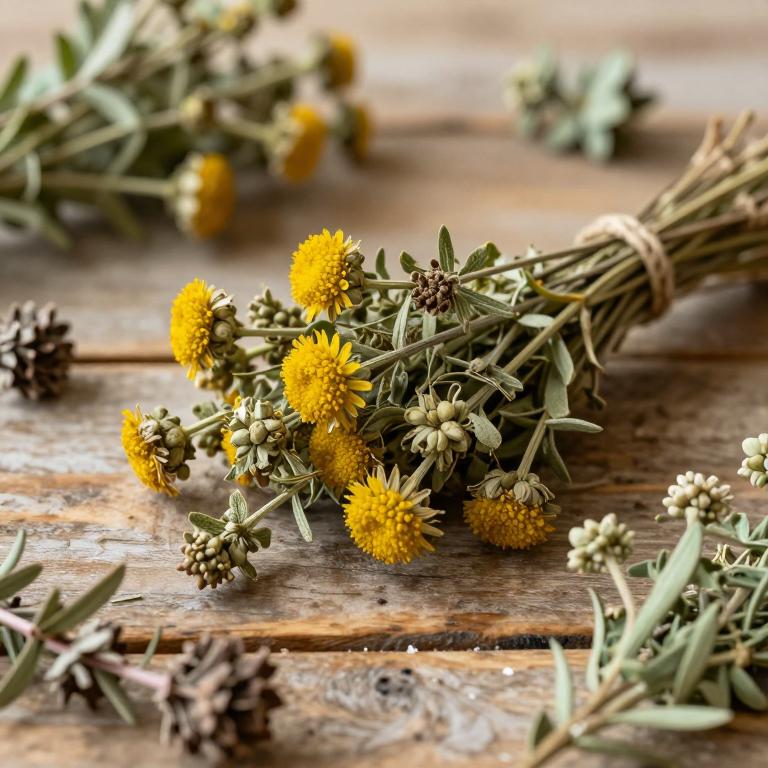
Kooigoed Everlasting, scientifically known as Helichrysum odoratissimum, is a resilient perennial herb native to South Africa. Renowned for its distinctively fragrant, golden blooms, this medicinal plant is prized in traditional healing. It possesses potent antioxidant and anti-inflammatory properties, often used to support respiratory health and skin vitality.
- Family
- Asteraceae
- Native range
- Europe
- Parts used
- Flower · Leaf
- Common names
- Kooigoed Everlasting · Everlasting
- Scientific synonyms
- Gnaphalium Odoratissimum · Achyrocline Hochstetteri · 7 more
Names and Synonyms
Common Names
- Kooigoed Everlasting
- Everlasting
Scientific Names
Accepted name
Helichrysum odoratissimumSynonyms
- Gnaphalium odoratissimum
- Achyrocline hochstetteri
- Gnaphalium strigosum
- Gnaphalium undulifolium
- Helichrysum engleri
- Helichrysum rosmarinum
- Gnaphalium aureofulvum
- Helichrysum butaguense
- Helichrysum roulingi
Regional and Traditional Names
Spanish:
- Helichrysum odoratissima
German:
- Helichrysum odoratissima
French:
- Helichrysum odoratissima
Sources: Wikidata, Catalogue of Life
Taxonomical Classification
This plant belongs to the kingdom Plantae and is classified within the phylum Streptophyta and the class Equisetopsida. Following its placement in the subclass Magnoliidae and the order Asterales, it is a member of the family Asteraceae. Ultimately, it is categorized under the genus Helichrysum as Helichrysum odoratisissimum.
| Rank | Classification |
|---|---|
| Kingdom | Plantae |
| Phylum | Streptophyta |
| Class | Equisetopsida |
| Subclass | Magnoliidae |
| Order | Asterales |
| Family | Asteraceae |
| Genus | Helichrysum |
Sources: The World Checklist of Vascular Plants (WCVP)
Distribution
This plant exhibits a broad geographical distribution that spans across multiple continents and diverse climates. In Northern Europe, its presence is specifically noted within Great Britain. The species also thrives in West Tropical Africa, with documented occurrences in Nigeria. Moving into West-Central Tropical Africa, it can be found in Cameroon, the Gulf of Guinea Islands, and the DR Congo. Together, these locations highlight the wide range of environments where the plant is naturally situated.
| Region | Area |
|---|---|
| Northern Europe | Great Britain |
| West Tropical Africa | Nigeria |
| West-Central Tropical Africa | Cameroon |
| West-Central Tropical Africa | Gulf of Guinea Is. |
| West-Central Tropical Africa | DR Congo |
| Northeast Tropical Africa | Sudan-South Sudan |
| East Tropical Africa | Tanzania |
| East Tropical Africa | Uganda |
| South Tropical Africa | Angola |
| South Tropical Africa | Mozambique |
Sources: The World Checklist of Vascular Plants (WCVP)
Botanical Identification
Ecology
The ecology of Helichrysum odoratissimum is characterized by its remarkable adaptability to diverse altitudinal gradients, allowing it to colonize a vast range of landscapes. This species thrives across a significant vertical span, with its distribution extending from low-lying areas as low as 5 m AMSL to high-altitude environments reaching up to a maximum of 3050 m AMSL. This broad elevational range suggests that the plant is capable of enduring various climatic conditions, from warmer, more humid lowland habitats to the cooler, more intense ultraviolet environments found in montane regions. Such ecological plasticity enables it to occupy diverse niches within its native range, likely interacting with a wide variety of soil types and microclimates found throughout these varying elevations.
- Elevational range max:
- 3050 m AMSL
- Elevational range min:
- 5 m AMSL
Life history
The life history of Helichrysum odoratissimum is characterized by its classification as a perennial plant, allowing it to persist through multiple growing seasons. In terms of its growth architecture and survival strategy, it functions as a therophyte, completing its reproductive cycle through seeds and existing primarily as ephemeral vegetation that may rely on seasonal germination or dormant stages. This life form dictates its ability to thrive in specific ecological niches, utilizing its annual growth cycles to maximize reproductive success within its habitat.
- Life form :
- therophyte
- Lifecycle :
- perennial
Morphology
The morphology of Helichrysum odoratissimum is characterized by its growth form as a non-woody herb, typically presenting as a self-supporting plant. It exhibits a terrestrial lifestyle, functioning as an independent organism rather than a parasite or an epiphyte. In terms of stature, the plant displays significant variability in its dimensions, with a minimum height of 0.2 m and reaching a maximum height of up to 1.75 m. Its physical structure is defined by a non-woodiness, maintaining a herbaceous habit across its various stages of development.
- Aquatic :
- terrestrial
- Climber :
- self-supporting
- Epiphyte :
- terrestrial
- Growth form :
- herb
- Parasite :
- independent
- Plant height max:
- 1.75 m
- Plant height min:
- 0.2 m
- Woodiness :
- non-woody
Reproduction
The reproduction of Helichrysum odoratissimum is characterized by the production of highly uniform seeds, with a mean, maximum, and minimum seed mass all recorded at $7 \times 10^{-5}$ g. This consistency in seed size suggests a specialized reproductive strategy aimed at optimizing seedling establishment. Regarding its dispersal mechanism, the plant exhibits an anemochorous syndrome, meaning its seeds are primarily dispersed by wind. This anemochorous trait allows the plant to utilize air currents to transport its progeny away from the parent plant, facilitating colonization of new habitats.
- Dispersal syndrome :
- anemochorous
- Seed mass mean:
- 7e-05 g
Sources: Global Inventory of Floras and Traits (GIFT)
Plant Parts
Helichrysum odoratissimum has 2 reported plant parts identified across 2 scientific publications and several other databases that are studied for medicinal purposes. The most consistently reported plant part include flower, leaf.
| Plant part | Supporting sources | Consensus |
|---|---|---|
| Flower | 1 supporting sources | ★☆☆☆☆ |
| Leaf | 1 supporting sources | ★☆☆☆☆ |
Flower
- Journal of natural products
Leaf
- Plants (Basel, Switzerland)
Chemicals
Helichrysum odoratissimum has 8 reported phytochemicals identified across 2 scientific publications and several other databases. The most consistently reported chemicals include 3',4',5,7-Tetrahydroxy-3-methoxyflavone, 5,6-dihydroxy-3,7,8-trimethoxyflavone, 5,7-Dihydroxy-3-methoxyflavone, Flavonoids, Flavonol.
| Chemical | Supporting sources | Consensus |
|---|---|---|
| 3',4',5,7-Tetrahydroxy-3-methoxyflavone | 1 supporting sources | ★☆☆☆☆ |
| 5,6-dihydroxy-3,7,8-trimethoxyflavone | 1 supporting sources | ★☆☆☆☆ |
| 5,7-Dihydroxy-3-methoxyflavone | 1 supporting sources | ★☆☆☆☆ |
| Flavonoids | 1 supporting sources | ★☆☆☆☆ |
| Flavonol | 1 supporting sources | ★☆☆☆☆ |
| Monoterpenes | 1 supporting sources | ★☆☆☆☆ |
| Sesquiterpenes | 1 supporting sources | ★☆☆☆☆ |
| Terpenes | 1 supporting sources | ★☆☆☆☆ |
3',4',5,7-Tetrahydroxy-3-methoxyflavone
- Natural product communications
5,6-dihydroxy-3,7,8-trimethoxyflavone
- Natural product communications
5,7-Dihydroxy-3-methoxyflavone
- Natural product communications
Flavonoids
- Plants (Basel, Switzerland)
Flavonol
- Plants (Basel, Switzerland)
Monoterpenes
- Plants (Basel, Switzerland)
Sesquiterpenes
- Plants (Basel, Switzerland)
Terpenes
- Plants (Basel, Switzerland)
Activities
Helichrysum odoratissimum has 6 reported activities identified across 2 scientific publications and several other databases. The most consistently reported activities include Antioxidant, Antibacterial, Antidiabetic, Antiinflammatory, Antimicrobial.
| Activity | Supporting sources | Consensus |
|---|---|---|
| Antioxidant | 2 supporting sources | ★☆☆☆☆ |
| Antibacterial | 1 supporting sources | ★☆☆☆☆ |
| Antidiabetic | 1 supporting sources | ★☆☆☆☆ |
| Antiinflammatory | 1 supporting sources | ★☆☆☆☆ |
| Antimicrobial | 1 supporting sources | ★☆☆☆☆ |
| Antiproliferative | 1 supporting sources | ★☆☆☆☆ |
Antioxidant
- Plants (Basel, Switzerland)
- Natural product communications
Antibacterial
- Plants (Basel, Switzerland)
Antidiabetic
- Plants (Basel, Switzerland)
Antiinflammatory
- Natural product communications
Antimicrobial
- Plants (Basel, Switzerland)
Antiproliferative
- Plants (Basel, Switzerland)
Conditions
Helichrysum odoratissimum has 10 reported investigations on conditions identified across 2 scientific publications and several other databases. The most consistently reported conditions include abdominal pains, antioxidant, coughs, dental caries, eczema.
| Condition | Supporting sources | Consensus |
|---|---|---|
| Abdominal pains | 1 supporting sources | ★☆☆☆☆ |
| Antioxidant | 1 supporting sources | ★☆☆☆☆ |
| Coughs | 1 supporting sources | ★☆☆☆☆ |
| Dental caries | 1 supporting sources | ★☆☆☆☆ |
| Eczema | 1 supporting sources | ★☆☆☆☆ |
| Female sterility | 1 supporting sources | ★☆☆☆☆ |
| Heartburn | 1 supporting sources | ★☆☆☆☆ |
| Periodontal diseases | 1 supporting sources | ★☆☆☆☆ |
| Tuberculosis | 1 supporting sources | ★☆☆☆☆ |
| Wounds | 1 supporting sources | ★☆☆☆☆ |
Abdominal pains
- Plants (Basel, Switzerland)
Antioxidant
- Natural product communications
Coughs
- Plants (Basel, Switzerland)
Dental caries
- Journal of ethnopharmacology
Eczema
- Plants (Basel, Switzerland)
Female sterility
- Plants (Basel, Switzerland)
Heartburn
- Plants (Basel, Switzerland)
Periodontal diseases
- Journal of ethnopharmacology
Tuberculosis
- Plants (Basel, Switzerland)
Wounds
- Plants (Basel, Switzerland)
Preparations
Helichrysum odoratissimum has 2 reported preparations identified across 2 scientific publications and several other databases. The most consistently reported preparations include Hexane extract from aerial part, essential oils.
| Preparation | Supporting sources | Consensus |
|---|---|---|
| Hexane extract from aerial part | 1 supporting sources | ★☆☆☆☆ |
| Essential oils | 1 supporting sources | ★☆☆☆☆ |
Hexane extract from aerial part
- Journal of ethnopharmacology
Essential oils
- Evidence-based complementary and alternative medicine : eCAM