Straw Everlasting
Helichrysum kraussii · Accepted scientific name
Scientific literature: Very Sparse (7 studies) · ★☆☆☆☆
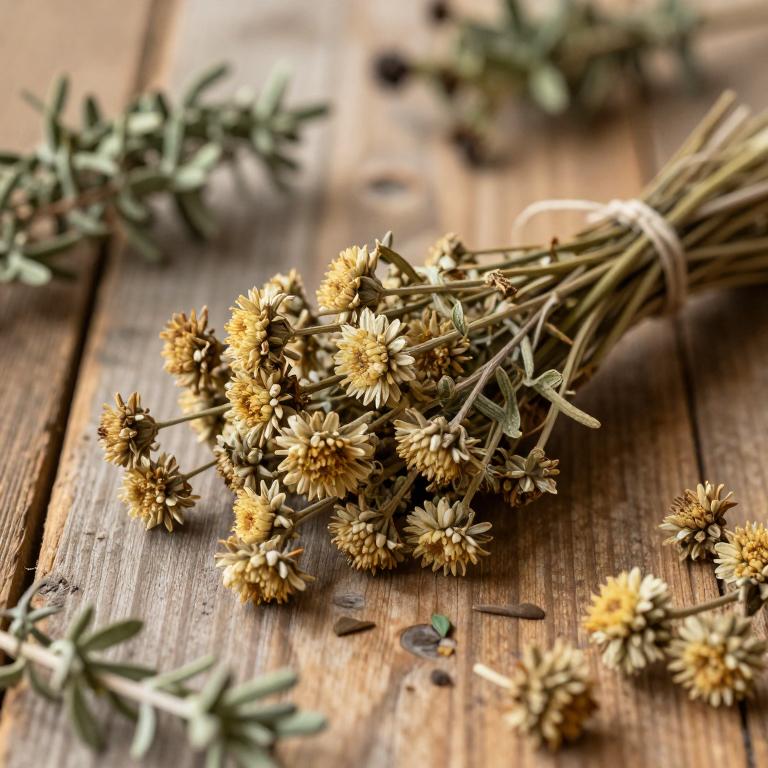
Straw Everlasting, scientifically known as Helicrysum kraussii, is a versatile medicinal shrub native to Southern Africa. Renowned for its vibrant, paper-like blooms, this plant is highly valued in traditional medicine. It possesses potent antioxidant, anti-inflammatory, and antimicrobial properties, often utilized in herbal teas and topical remedies for healing.
- Family
- Asteraceae
- Native range
- Africa
- Parts used
- Flower
- Common names
- Straw Everlasting
- Scientific synonyms
- Gnaphalium Kraussii · Helichrysum Steetzii · 2 more
Names and Synonyms
Common Names
- Straw Everlasting
Scientific Names
Accepted name
Helichrysum kraussiiSynonyms
- Gnaphalium kraussii
- Helichrysum steetzii
- Achyrocline batocana
- Achyrocline steetzii
Sources: Wikidata, Catalogue of Life
Taxonomical Classification
This plant belongs to the kingdom Plantae within the phylum Streptophyta and is classified under the class Equisetopsida. Following its placement in the subclass Magnoliidae and order Asterales, it is a member of the family Asteraceae. Specifically, it is identified by the genus Helichrysum.
| Rank | Classification |
|---|---|
| Kingdom | Plantae |
| Phylum | Streptophyta |
| Class | Equisetopsida |
| Subclass | Magnoliidae |
| Order | Asterales |
| Family | Asteraceae |
| Genus | Helichrysum |
Sources: The World Checklist of Vascular Plants (WCVP)
Distribution
This plant exhibits a wide geographical distribution across several regions of the African continent. It can be found throughout South Tropical Africa, specifically inhabiting the territories of Angola, Mozambique, and Zambia. Additionally, its presence extends into Zimbabwe within the same South Tropical Africa classification. Moving further south, the species is also well-established in the Southern African region of Botswana. Together, these locations highlight the plant's ability to thrive in diverse environments across these southern nations.
| Region | Area |
|---|---|
| South Tropical Africa | Angola |
| South Tropical Africa | Mozambique |
| South Tropical Africa | Zambia |
| South Tropical Africa | Zimbabwe |
| Southern Africa | Botswana |
| Southern Africa | KwaZulu-Natal |
| Southern Africa | Free State |
| Southern Africa | Eswatini |
| Southern Africa | Northern Provinces |
Sources: The World Checklist of Vascular Plants (WCVP)
Botanical Identification
Ecology
The ecology of Helichrysum kraussii is characterized by its broad adaptability across diverse altitudinal gradients and specific environmental niches. This species thrives within a wide elevational range, extending from low-lying areas at just 5 m AMSL up to higher altitudes reaching a maximum of 1850 m AMSL. Within these varying elevations, it is notably found inhabiting forest environments, where it integrates into the local ecosystem, likely benefiting from the specific light, moisture, and soil conditions provided by forest structures. This wide altitudinal distribution suggests a high degree of ecological plasticity, allowing the plant to persist across a diverse spectrum of climatic zones.
- Elevational range max:
- 1850 m AMSL
- Elevational range min:
- 5 m AMSL
- Habitat :
- forest
Life history
The life history of Helichrysum kraussii is characterized by its nature as a perennial plant, allowing it to persist through multiple growing seasons rather than completing its cycle within a single year. As a long-lived species, it maintains a continuous presence in its natural habitat, often developing robust root systems that facilitate survival across varying environmental conditions. This perennial lifecycle enables the plant to establish a stable population, undergoing seasonal cycles of vegetative growth and reproductive phases that contribute to its long-term ecological endurance.
- Lifecycle :
- perennial
Morphology
The morphology of Helichrysum kraussii is characterized by its growth form as a woody shrub, which functions as a self-supporting plant rather than a climber, liana, or vine. This species is strictly terrestrial in its habitat, lacking any aquatic, semiaquatic, or epiphytic tendencies, and it grows as an independent organism without parasitic behavior. The plant maintains a relatively compact stature, with a height ranging from a minimum of 0.1 m to a maximum of 1.5 m.
- Aquatic :
- terrestrial
- Climber :
- self-supporting
- Epiphyte :
- terrestrial
- Growth form :
- shrub
- Parasite :
- independent
- Plant height max:
- 1.5 m
- Plant height min:
- 0.1 m
- Woodiness :
- woody
Sources: Global Inventory of Floras and Traits (GIFT)
Plant Parts
Helichrysum kraussii has 1 reported plant parts identified across 1 scientific publications and several other databases that are studied for medicinal purposes. The most consistently reported plant part include flower.
| Plant part | Supporting sources | Consensus |
|---|---|---|
| Flower | 1 supporting sources | ★☆☆☆☆ |
Flower
- Natural product communications
Chemicals
Helichrysum kraussii has 3 reported phytochemicals identified across 1 scientific publications and several other databases. The most consistently reported chemicals include 3',4',5,7-Tetrahydroxy-3-methoxyflavone, 5,6-dihydroxy-3,7,8-trimethoxyflavone, 5,7-Dihydroxy-3-methoxyflavone.
| Chemical | Supporting sources | Consensus |
|---|---|---|
| 3',4',5,7-Tetrahydroxy-3-methoxyflavone | 1 supporting sources | ★☆☆☆☆ |
| 5,6-dihydroxy-3,7,8-trimethoxyflavone | 1 supporting sources | ★☆☆☆☆ |
| 5,7-Dihydroxy-3-methoxyflavone | 1 supporting sources | ★☆☆☆☆ |
3',4',5,7-Tetrahydroxy-3-methoxyflavone
- Natural product communications
5,6-dihydroxy-3,7,8-trimethoxyflavone
- Natural product communications
5,7-Dihydroxy-3-methoxyflavone
- Natural product communications
Activities
Helichrysum kraussii has 2 reported activities identified across 1 scientific publications and several other databases. The most consistently reported activities include Antiinflammatory, Antioxidant.
| Activity | Supporting sources | Consensus |
|---|---|---|
| Antiinflammatory | 1 supporting sources | ★☆☆☆☆ |
| Antioxidant | 1 supporting sources | ★☆☆☆☆ |
Antiinflammatory
- Natural product communications
Antioxidant
- Natural product communications
Conditions
Helichrysum kraussii has 1 reported investigations on conditions identified across 1 scientific publications and several other databases. The most consistently reported conditions include antioxidant.
| Condition | Supporting sources | Consensus |
|---|---|---|
| Antioxidant | 1 supporting sources | ★☆☆☆☆ |
Antioxidant
- Natural product communications
Preparations
Helichrysum kraussii has 1 reported preparations identified across 1 scientific publications and several other databases. The most consistently reported preparations include Organic extracts of the flowers.
| Preparation | Supporting sources | Consensus |
|---|---|---|
| Organic extracts of the flowers | 1 supporting sources | ★☆☆☆☆ |
Organic extracts of the flowers
- Natural product communications