Helichrysum graveolens
Helichrysum graveolens · Accepted scientific name
Scientific literature: Very Sparse (3 studies) · ★☆☆☆☆
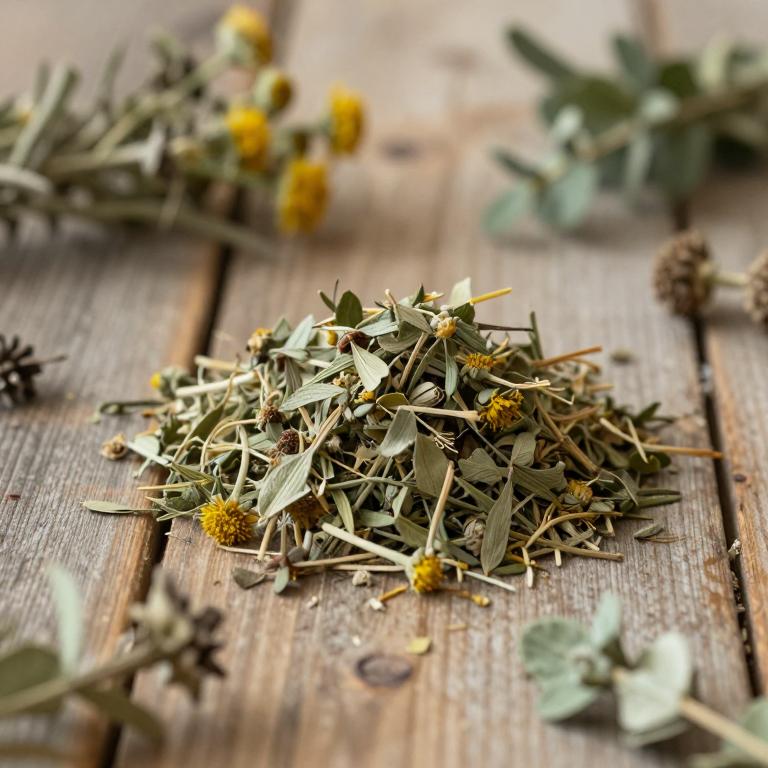
, scientifically known as Helicrysum graveolens, is a versatile medicinal herb prized in traditional healing. Often called Everlasting or Curry Plant, it possesses potent antioxidant and anti-inflammatory properties. Commonly used to support digestive health and soothe skin irritations, this resilient plant offers a natural approach to holistic wellness.
- Family
- Asteraceae
- Native range
- Europe
- Parts used
- Not available
- Common names
- Not available
- Scientific synonyms
- Helichrysum Commixtum
Names and Synonyms
Scientific Names
Accepted name
Helichrysum graveolensSynonyms
- Helichrysum commixtum
Sources: Wikidata
Taxonomical Classification
This plant belongs to the kingdom Plantae and the phylum Streptophyta, falling under the class Equisetopsida and subclass Magnoliidae. Within the order Asterales, it is classified under the family Asteraceae and the genus Helichrysum.
| Rank | Classification |
|---|---|
| Kingdom | Plantae |
| Phylum | Streptophyta |
| Class | Equisetopsida |
| Subclass | Magnoliidae |
| Order | Asterales |
| Family | Asteraceae |
| Genus | Helichrysum |
Sources: The World Checklist of Vascular Plants (WCVP)
Distribution
This plant exhibits a diverse geographical distribution across several key regions of Eurasia. Within Eastern Europe, it can be found growing in the Crimean peninsula and throughout Ukraine. Its range extends into the Caucasus region, specifically inhabiting the Transcaucasus area. Furthermore, the species is widely distributed across Western Asia. Within this western territory, it is documented to grow in both Iran and Iraq.
| Region | Area |
|---|---|
| Eastern Europe | Krym |
| Eastern Europe | Ukraine |
| Caucasus | Transcaucasus |
| Western Asia | Iran |
| Western Asia | Iraq |
| Western Asia | Türkiye |
Sources: The World Checklist of Vascular Plants (WCVP)
Botanical Identification
Ecology
The ecology of Helichrysum graveolens is characterized by its ability to thrive in diverse and often challenging terrain, ranging from fertile meadows to rugged mountainous landscapes. It demonstrates a high degree of adaptability by colonizing varied environments, including the riparian zones near rivers and exposed, stony places where soil may be thin or rocky. This ability to inhabit both nutrient-rich grasslands and more austere, lithic substrates suggests a resilient physiological profile capable of managing varying moisture levels and substrate compositions across its natural range.
- Habitat :
- meadows, mountains, rivers, stony places
Life history
The life history of Helichrysum graveolens is characterized by its status as a perennial plant, meaning it lives for more than two years and maintains its presence in its habitat through multiple growing seasons. This long-lived life cycle allows the species to establish robust root systems and develop a stable physiological structure capable of withstanding environmental fluctuations. Throughout its life, the plant undergoes recurring vegetative growth and reproductive phases, typically flowering during specific seasonal windows to ensure the propagation of its species. By adhering to a perennial growth pattern, Helichrysum graveolens can invest energy into long-term survival and structural complexity rather than the rapid, single-season turnover seen in annual or biennial species.
- Lifecycle :
- perennial
Morphology
The morphology of Helichrysum graveolens is characterized by a non-woody, herb growth form that is entirely self-supporting, rather than functioning as a liana, vine, or climber. This independent, non-parasitic plant maintains a terrestrial habit, existing neither as an aquatic, semiaquatic, nor epiphytic organism. Structurally, it is a low-growing species with a plant height that typically ranges from a minimum of 0.07 m to a maximum of 0.35 m.
- Aquatic :
- terrestrial
- Climber :
- self-supporting
- Epiphyte :
- terrestrial
- Growth form :
- herb
- Parasite :
- independent
- Plant height max:
- 0.35 m
- Plant height min:
- 0.07 m
- Woodiness :
- non-woody
Reproduction
The reproduction of Helichrysum graveolens is characterized by a specific seasonal flowering window and the production of extremely lightweight seeds. The flowering period typically begins in June and continues through August, though the timing can be variable depending on environmental conditions. During this reproductive phase, the plant produces seeds that exhibit remarkable uniformity in size; the seed mass is consistently measured at a mean, minimum, and maximum value of 0.00018 g, indicating a highly standardized seed morphology essential for its dispersal and propagation.
- Flowering time :
- Jun
- Flowering time :
- Aug
- Seed mass mean:
- 0.00018 g
Sources: Global Inventory of Floras and Traits (GIFT)
Activities
Helichrysum graveolens has 1 reported activities identified across 0 scientific publications and several other databases. The most consistently reported activities include Diuretic.
| Activity | Supporting sources | Consensus |
|---|---|---|
| Diuretic | 1 supporting sources | ★☆☆☆☆ |
Diuretic
- Journal of ethnopharmacology
Conditions
Helichrysum graveolens has 2 reported investigations on conditions identified across 0 scientific publications and several other databases. The most consistently reported conditions include kidney stones, urolithiasis.
| Condition | Supporting sources | Consensus |
|---|---|---|
| Kidney stones | 1 supporting sources | ★☆☆☆☆ |
| Urolithiasis | 1 supporting sources | ★☆☆☆☆ |
Kidney stones
- Journal of ethnopharmacology
Urolithiasis
- Journal of ethnopharmacology