Haplophyllum tuberculatum
Haplophyllum tuberculatum · Accepted scientific name
Scientific literature: Sparse (64 studies) · ★★☆☆☆
Haplophyllum tuberculatum, scientifically known as Haplophyllum tuberculatum, is a medicinal shrub native to various tropical regions. Renowned for its diverse therapeutic properties, it is frequently utilized in traditional medicine to treat ailments ranging from skin infections to digestive issues, offering a natural resource for holistic wellness and pharmacology.
- Family
- Rutaceae
- Native range
- Africa
- Parts used
- Leaf · Root
- Common names
- Not available
- Scientific synonyms
- Ruta Kotschyi · Ruta Stocksiana · 28 more
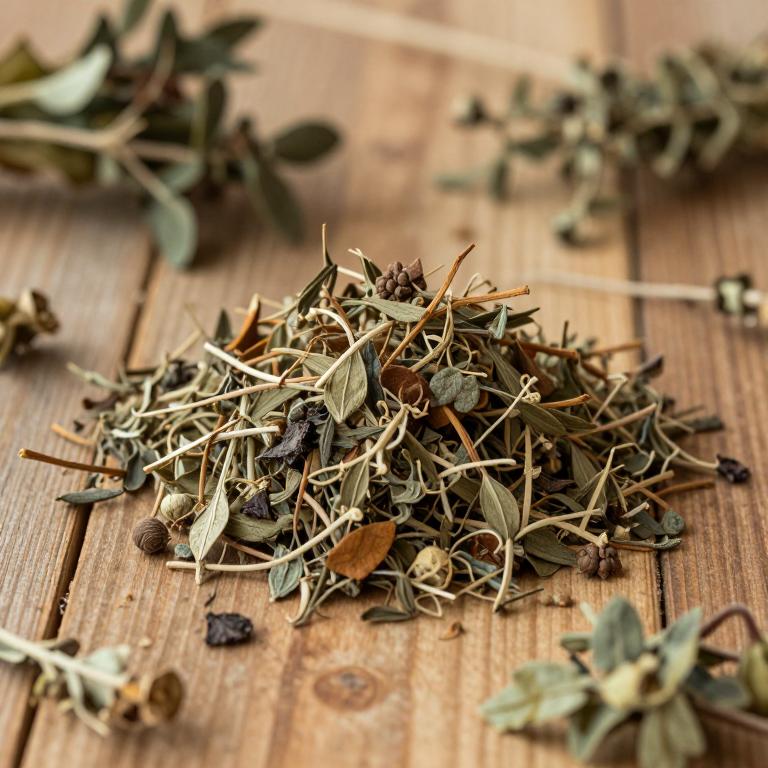
Names and Synonyms
Scientific Names
Accepted name
Haplophyllum tuberculatumSynonyms
- Ruta kotschyi
- Ruta stocksiana
- Haplophyllum glabrum
- Haplophyllum obovatum
- Haplophyllum tuberculatum subsp. vermiculare
- Haplophyllum tuberculatum var. arabicum
- Ruta montbretii
- Ruta tuberculata var. montbretti
- Ruta dichotoma
- Ruta tuberculata
- Haplophyllum trichostylum
- Haplophyllum vermiculare
- Ruta glabra
- Haplophyllum stocksianum
- Ruta telephiifolia
- Haplophyllum villosulum
- Ruta propinqua
- Haplophyllum propinquum
- Haplophyllum longifolium
- Ruta obovata
- Haplophyllum haussknechtii
- Haplophyllum kotschyi
- Haplophyllum tuberculatum var. leiocalycinum
- Haplophyllum filifolium
- Haplophyllum vermiculare var. cyrenaicum
- Haplophyllum eremophilum
- Haplophyllum tuberculatum var. obovatum
- Haplophyllum chesneyanum
- Haplophyllum candolleanum
- Haplophyllum arabicum
Sources: Wikidata, Catalogue of Life
Taxonomical Classification
This plant belongs to the kingdom Plantae and the phylum Streptophyta, falling under the class Equisetopsida and subclass Magnoliidae. It is classified within the order Sapindales and the family Rutaceae. Ultimately, its taxonomic identity is defined by its placement in the genus Haplophyllum.
| Rank | Classification |
|---|---|
| Kingdom | Plantae |
| Phylum | Streptophyta |
| Class | Equisetopsida |
| Subclass | Magnoliidae |
| Order | Sapindales |
| Family | Rutaceae |
| Genus | Haplophyllum |
Sources: The World Checklist of Vascular Plants (WCVP)
Distribution
This plant is primarily found across the diverse landscapes of Northern Africa. Its geographical range includes the coastal and inland regions of Algeria. It is also widely distributed throughout the territories of Egypt and Libya. Furthermore, the species can be located within the borders of Morocco. Finally, its presence is well-documented across the terrain of Tunisia.
| Region | Area |
|---|---|
| Northern Africa | Algeria |
| Northern Africa | Egypt |
| Northern Africa | Libya |
| Northern Africa | Morocco |
| Northern Africa | Tunisia |
| Northeast Tropical Africa | Chad |
| Northeast Tropical Africa | Somalia |
| Northeast Tropical Africa | Sudan-South Sudan |
| Western Asia | Afghanistan |
| Western Asia | Iran |
Sources: The World Checklist of Vascular Plants (WCVP)
Botanical Identification
Ecology
The ecology of Haplophyllum tuberculatum is characterized by its specific distribution within montane environments, where it occupies a defined altitudinal niche. This species thrives within a mid-to-high elevation belt, specifically ranging from a minimum of 800 m AMSL to a maximum of 1600 m AMSL. This elevational range suggests an adaptation to the temperate or subtropical montane climates found in these specific vertical zones, where environmental factors such as temperature fluctuations, moisture availability, and atmospheric pressure are distinct from lowland tropical habitats. The plant's presence within this 800 to 1600 m AMSL bracket indicates a specialized ecological requirement for the soil types and microclimates unique to these mountain elevations.
- Elevational range max:
- 1600 m AMSL
- Elevational range min:
- 800 m AMSL
Life history
The life history of Haplophyllum tuberculatum is characterized by its status as a perennial organism, allowing it to persist in its environment through multiple growing seasons. In terms of its structural growth strategy, the plant exhibits a chamaephyte life form, meaning its perennable buds are located close to the soil surface, typically just above the ground level. This combination of a long-lived lifecycle and a low-growing stature enables the species to maintain stability and endure varying environmental conditions within its natural habitat.
- Life form :
- chamaephyte
- Lifecycle :
- perennial
Morphology
The morphology of Haplophyllum tuberculatum is characterized by a growth form that transitions between a herb and a subshrub, exhibiting a predominantly non-woody structure. This plant is non-parasitic and functions as an independent organism within its ecosystem. In terms of its habitat and structural habit, it is classified as a terrestrial species, though it may occupy environments ranging from aquatic to semiaquatic zones. Furthermore, it possesses a self-supporting growth habit, meaning it does not require external structures for climbing or attachment.
- Aquatic :
- terrestrial
- Climber :
- self-supporting
- Growth form :
- herb
- Growth form :
- subshrub
- Parasite :
- independent
- Woodiness :
- non-woody
Physiology
The physiology of Haplophyllum tuberculatum is characterized by a metabolic framework utilizing the C3 photosynthetic pathway, which dictates its carbon fixation processes and water-use efficiency. Within this C3 mechanism, the plant fixes atmospheric carbon dioxide directly through the enzyme Rubisco during the Calvin cycle, a process that occurs primarily within the mesophyll cells. Because it lacks the specialized Kranz anatomy associated with C4 metabolism or the nocturnal acid accumulation seen in CAM plants, its physiological performance is highly sensitive to environmental factors such as light intensity, temperature, and moisture availability. The reliance on the C3 pathway implies that the plant's gas exchange and transpiration rates are tightly coupled to stomatal conductance, necessitating specific adaptations to manage photorespiration and maintain hydration during periods of thermal stress.
- Photosynthetic pathway :
- C3
Reproduction
The reproduction of Haplophyllum tuberculatum is characterized by a specific flowering phenology and distinct seed morphology. The flowering period typically commences in March and concludes in April, although the reproductive cycle can be variable across different seasonal contexts. The resulting seeds are exceptionally lightweight and uniform in size, with a recorded mean seed mass of 0.00118 g. This consistency is reflected in the seed data, as both the maximum and minimum recorded seed masses are identical at 0.00118 g, indicating a highly standardized seed production process.
- Flowering time :
- Mar
- Flowering time :
- Apr
- Seed mass mean:
- 0.00118 g
Sources: Global Inventory of Floras and Traits (GIFT)
Plant Parts
Haplophyllum tuberculatum has 3 reported plant parts identified across 4 scientific publications and several other databases that are studied for medicinal purposes. The most consistently reported plant part include leaf, root, stem.
| Plant part | Supporting sources | Consensus |
|---|---|---|
| Leaf | 2 supporting sources | ★☆☆☆☆ |
| Root | 1 supporting sources | ★☆☆☆☆ |
| Stem | 1 supporting sources | ★☆☆☆☆ |
Leaf
- Journal of ethnopharmacology
- BMC complementary and alternative medicine
Root
- Molecules (Basel, Switzerland)
Stem
- BMC complementary and alternative medicine
Chemicals
Haplophyllum tuberculatum has 28 reported phytochemicals identified across 4 scientific publications and several other databases. The most consistently reported chemicals include (+)-Tuberine, (e)-n-feruloyltyramine, BORNYL ACETATE, Condensed Tannins, Diphyllin.
| Chemical | Supporting sources | Consensus |
|---|---|---|
| (+)-Tuberine | 1 supporting sources | ★☆☆☆☆ |
| (e)-n-feruloyltyramine | 1 supporting sources | ★☆☆☆☆ |
| BORNYL ACETATE | 1 supporting sources | ★☆☆☆☆ |
| Condensed Tannins | 1 supporting sources | ★☆☆☆☆ |
| Diphyllin | 1 supporting sources | ★☆☆☆☆ |
| ERUCIC ACID | 1 supporting sources | ★☆☆☆☆ |
| Flavonoids | 1 supporting sources | ★☆☆☆☆ |
| Fragransin B1 | 1 supporting sources | ★☆☆☆☆ |
| Fragransin B2 | 1 supporting sources | ★☆☆☆☆ |
| Furoguaiaoxidin | 1 supporting sources | ★☆☆☆☆ |
(+)-Tuberine
- Journal of food protection
(e)-n-feruloyltyramine
- Molecules (Basel, Switzerland)
BORNYL ACETATE
- Journal of oleo science
Condensed Tannins
- Chemistry & biodiversity
Diphyllin
- Phytochemistry
ERUCIC ACID
- Journal of ethnopharmacology
Flavonoids
- Chemistry & biodiversity
Fragransin B1
- Molecules (Basel, Switzerland)
Fragransin B2
- Molecules (Basel, Switzerland)
Furoguaiaoxidin
- Molecules (Basel, Switzerland)
Activities
Haplophyllum tuberculatum has 6 reported activities identified across 4 scientific publications and several other databases. The most consistently reported activities include Antioxidant, Analgesic, Antibacterial, Antifungal, Cytoprotective.
| Activity | Supporting sources | Consensus |
|---|---|---|
| Antioxidant | 3 supporting sources | ★★☆☆☆ |
| Analgesic | 2 supporting sources | ★☆☆☆☆ |
| Antibacterial | 2 supporting sources | ★☆☆☆☆ |
| Antifungal | 1 supporting sources | ★☆☆☆☆ |
| Cytoprotective | 1 supporting sources | ★☆☆☆☆ |
| Gastroprotective | 1 supporting sources | ★☆☆☆☆ |
Antioxidant
- Life (Basel, Switzerland)
- Pharmaceutical biology
- Chemistry & biodiversity
Analgesic
- Life (Basel, Switzerland)
- Journal of ethnopharmacology
Antibacterial
- Journal of oleo science
- Chemistry & biodiversity
Antifungal
- Journal of oleo science
Cytoprotective
- Pharmaceutical biology
Gastroprotective
- Journal of ethnopharmacology
Conditions
Haplophyllum tuberculatum has 13 reported investigations on conditions identified across 4 scientific publications and several other databases. The most consistently reported conditions include inflammation, oxidative stress, pain, Leishmania donovani, cell death.
| Condition | Supporting sources | Consensus |
|---|---|---|
| Inflammation | 2 supporting sources | ★☆☆☆☆ |
| Oxidative stress | 2 supporting sources | ★☆☆☆☆ |
| Pain | 2 supporting sources | ★☆☆☆☆ |
| Leishmania donovani | 1 supporting sources | ★☆☆☆☆ |
| Cell death | 1 supporting sources | ★☆☆☆☆ |
| Fatigue | 1 supporting sources | ★☆☆☆☆ |
| Gastric ulcer | 1 supporting sources | ★☆☆☆☆ |
| Leishmaniasis | 1 supporting sources | ★☆☆☆☆ |
| Leukemia | 1 supporting sources | ★☆☆☆☆ |
| Malaria | 1 supporting sources | ★☆☆☆☆ |
Inflammation
- Life (Basel, Switzerland)
- Journal of ethnopharmacology
Oxidative stress
- Pharmaceutical biology
- Natural product communications
Pain
- Life (Basel, Switzerland)
- Journal of ethnopharmacology
Leishmania donovani
- Molecules (Basel, Switzerland)
Cell death
- Natural product communications
Fatigue
- Journal of oleo science
Gastric ulcer
- Journal of ethnopharmacology
Leishmaniasis
- BMC complementary and alternative medicine
Leukemia
- BMC complementary and alternative medicine
Malaria
- BMC complementary and alternative medicine
Preparations
Haplophyllum tuberculatum has 8 reported preparations identified across 4 scientific publications and several other databases. The most consistently reported preparations include essential oils, aqueous extract, ethanol extract from the aerial parts, ethanol extract of Haplophyllum tuberculatum aerial parts, ethanolic root extract.
| Preparation | Supporting sources | Consensus |
|---|---|---|
| Essential oils | 2 supporting sources | ★☆☆☆☆ |
| Aqueous extract | 1 supporting sources | ★☆☆☆☆ |
| Ethanol extract from the aerial parts | 1 supporting sources | ★☆☆☆☆ |
| Ethanol extract of haplophyllum tuberculatum aerial parts | 1 supporting sources | ★☆☆☆☆ |
| Ethanolic root extract | 1 supporting sources | ★☆☆☆☆ |
| Petroleum ether extract | 1 supporting sources | ★☆☆☆☆ |
| Plant extracts | 1 supporting sources | ★☆☆☆☆ |
| Volatile oils | 1 supporting sources | ★☆☆☆☆ |
Essential oils
- BMC complementary and alternative medicine
- Natural product communications
Aqueous extract
- Chemistry & biodiversity
Ethanol extract from the aerial parts
- Pharmaceutical biology
Ethanol extract of haplophyllum tuberculatum aerial parts
- Pharmaceutical biology
Ethanolic root extract
- Molecules (Basel, Switzerland)
Petroleum ether extract
- Journal of ethnopharmacology
Plant extracts
- Phytotherapy research : PTR
Volatile oils
- BMC complementary and alternative medicine