babys breath
Gypsophila · Accepted scientific name
Scientific literature: Very Sparse (8 studies) · ★☆☆☆☆
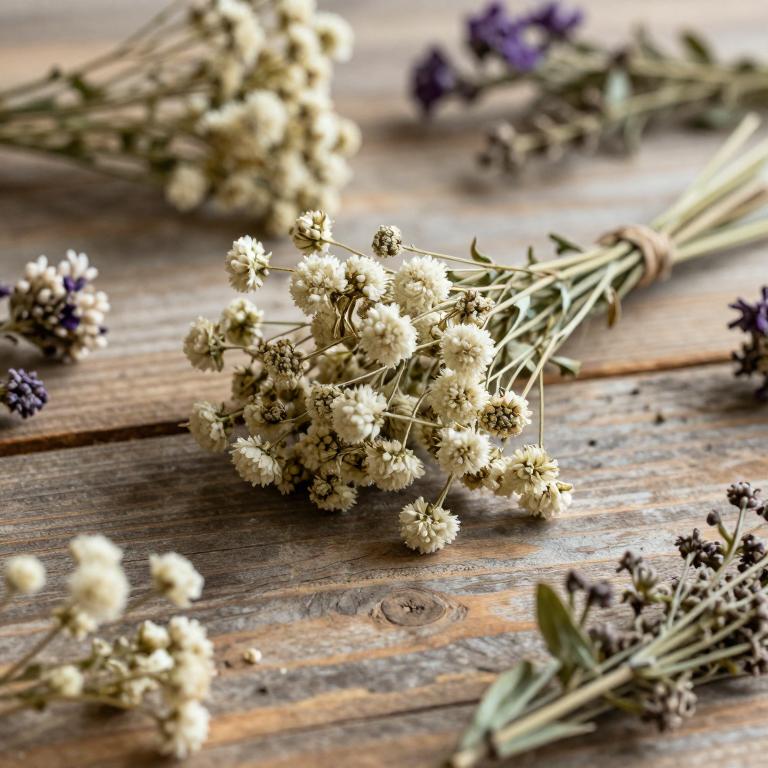
Baby's breath, scientifically known as Gypsophila, is a versatile plant celebrated for its delicate, cloud-like white blossoms. While primarily cherished in floral arrangements, various species hold significant medicinal potential. Traditionally used in herbal practices, Gypsophila is explored for its antioxidant properties and its ability to support respiratory wellness.
- Family
- Caryophyllaceae
- Native range
- Europe
- Parts used
- Not available
- Common names
- Gypsophila Wren-Babblers · Baby'S-Breath
- Scientific synonyms
- Gypsophytum · Arrostia · 8 more
Names and Synonyms
Common Names
- Gypsophila Wren-Babblers
- baby's-breath
Scientific Names
Accepted name
GypsophilaSynonyms
- Gypsophytum
- Arrostia
- Dichoglottis
- Acosmia
- Bolbosaponaria
- Ankyropetalum
- Vaccaria
- Pseudosaponaria
- Banffya
- Rokejeka
Regional and Traditional Names
Spanish:
- Arrostia
- Dichoglottis
- Banffya
- Pseudosaponaria
- Nubes
German:
- Gipskräuter
- Gipskraut
- Kuhkraut
- Gipskräuter
Sources: Wikidata, Catalogue of Life
Taxonomical Classification
This plant belongs to the kingdom Plantae and the phylum Streptophyta, placing it within the class Equisetopsida and subclass Magnoliidae. It is further classified under the order Caryophyllales and the family Caryophyllaceae. Ultimately, its specific taxonomic identity is defined by the genus Gypsophila.
| Rank | Classification |
|---|---|
| Kingdom | Plantae |
| Phylum | Streptophyta |
| Class | Equisetopsida |
| Subclass | Magnoliidae |
| Order | Caryophyllales |
| Family | Caryophyllaceae |
| Genus | Gypsophila |
Sources: The World Checklist of Vascular Plants (WCVP)
Distribution
This plant exhibits a specific geographical distribution concentrated within the regions of Northern Europe. It can be found growing naturally in the country of Denmark. Its presence extends further north into the landscapes of Finland. Additionally, the species is documented across the islands of Great Britain and Ireland. Finally, the distribution includes the mountainous and coastal terrains of Norway.
| Region | Area |
|---|---|
| Northern Europe | Denmark |
| Northern Europe | Finland |
| Northern Europe | Great Britain |
| Northern Europe | Ireland |
| Northern Europe | Norway |
| Northern Europe | Sweden |
| Middle Europe | Austria |
| Middle Europe | Belgium |
| Middle Europe | Czechia-Slovakia |
| Middle Europe | Germany |
Sources: The World Checklist of Vascular Plants (WCVP)
Chemicals
Gypsophila has 2 reported phytochemicals identified across 0 scientific publications and several other databases. The most consistently reported chemicals include Gypsogenin, SAPONIN.
| Chemical | Supporting sources | Consensus |
|---|---|---|
| Gypsogenin | 1 supporting sources | ★☆☆☆☆ |
| SAPONIN | 1 supporting sources | ★☆☆☆☆ |
Gypsogenin
- Journal of natural products
SAPONIN
- Journal of natural products
Activities
Gypsophila has 5 reported activities identified across 0 scientific publications and several other databases. The most consistently reported activities include Antioxidant, Cytotoxic, Diuretic, Hepatoprotective, Neuroprotective.
| Activity | Supporting sources | Consensus |
|---|---|---|
| Antioxidant | 1 supporting sources | ★☆☆☆☆ |
| Cytotoxic | 1 supporting sources | ★☆☆☆☆ |
| Diuretic | 1 supporting sources | ★☆☆☆☆ |
| Hepatoprotective | 1 supporting sources | ★☆☆☆☆ |
| Neuroprotective | 1 supporting sources | ★☆☆☆☆ |
Antioxidant
- Fitoterapia
Cytotoxic
- Fitoterapia
Diuretic
- Fitoterapia
Hepatoprotective
- Fitoterapia
Neuroprotective
- Fitoterapia
Conditions
Gypsophila has 1 reported investigations on conditions identified across 0 scientific publications and several other databases. The most consistently reported conditions include kidney stones.
| Condition | Supporting sources | Consensus |
|---|---|---|
| Kidney stones | 1 supporting sources | ★☆☆☆☆ |
Kidney stones
- Fitoterapia