perfoliate baby's-breath
Gypsophila perfoliata · Accepted scientific name
Scientific literature: Very Sparse (5 studies) · ★☆☆☆☆
perfoliate baby's-breath, scientifically known as Gypsophila perfoliata, is a unique medicinal herb valued for its diverse therapeutic properties. Characterized by its distinctive leaf structure, this plant is traditionally utilized in herbal medicine to address various ailments, offering significant potential for pharmacological research and natural healing through its bioactive compounds.
- Family
- Caryophyllaceae
- Native range
- Europe
- Parts used
- Root
- Common names
- Perfoliate Baby'S-Breath
- Scientific synonyms
- Gypsophila Hygrophila · Gypsophila Paulii · 9 more
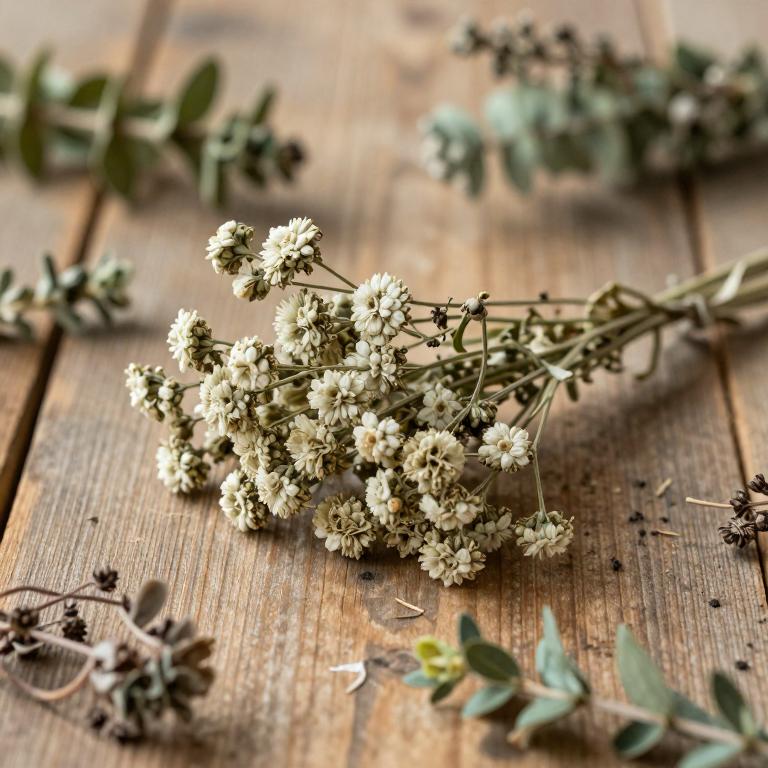
Names and Synonyms
Common Names
- perfoliate baby's-breath
Scientific Names
Accepted name
Gypsophila perfoliataSynonyms
- Gypsophila hygrophila
- Gypsophila paulii
- Gypsophila trichotoma var. glabra
- Gypsophila tekirae
- Gypsophila trichotoma
- Gypsophila perfoliata var. araratica
- Gypsophila perfoliata var. glabra
- Gypsophila perfoliata var. pubescens
- Gypsophila perfoliata var. tomentosa
- Gypsophila sabulosa
- Gypsophila anatolica var. bertonii
Regional and Traditional Names
German:
- Durchwachsenblättriges Gipskraut
- Durchwachsenblättriges Gipskraut
Sources: Wikidata, Catalogue of Life
Taxonomical Classification
This plant belongs to the kingdom Plantae within the phylum Streptophyta and the class Equisetopsida. As a member of the subclass Magnoliidae, it is classified under the order Caryophyllales and the family Caryophyllaceae. It is further categorized into the genus Gypsophila, specifically known as Gypsophila perfoliata.
| Rank | Classification |
|---|---|
| Kingdom | Plantae |
| Phylum | Streptophyta |
| Class | Equisetopsida |
| Subclass | Magnoliidae |
| Order | Caryophyllales |
| Family | Caryophyllaceae |
| Genus | Gypsophila |
Sources: The World Checklist of Vascular Plants (WCVP)
Distribution
This plant exhibits a specific geographical distribution across several parts of the European continent. In Middle Europe, its presence is documented in Germany, Hungary, and Poland. Moving toward the southeast, the species can also be found within the borders of Bulgaria. Furthermore, its range extends into Romania, marking another key location in Southeastern Europe. Collectively, these regions define the known natural habitat for Gypsophila perfoliata.
| Region | Area |
|---|---|
| Middle Europe | Germany |
| Middle Europe | Hungary |
| Middle Europe | Poland |
| Southeastern Europe | Bulgaria |
| Southeastern Europe | Romania |
| Eastern Europe | Baltic States |
| Eastern Europe | Krym |
| Eastern Europe | Central European Russia |
| Eastern Europe | East European Russia |
| Eastern Europe | South European Russia |
Sources: The World Checklist of Vascular Plants (WCVP)
Botanical Identification
Ecology
The ecology of Gypsophila perfoliata is characterized by its preference for specific open landscapes, primarily thriving in meadows, old fields, and sandy substrates. This species occupies a distinct altitudinal niche, with its distribution spanning an elevational range from a minimum of 500 m AMSL to a maximum of 1000 m AMSL. Throughout its natural range, it maintains a mean elevation of approximately 750 m AMSL, where the combination of its preferred soil types and moderate altitude supports its growth patterns.
- Elevational range max:
- 1000 m AMSL
- Elevational range mean:
- 750 m AMSL
- Elevational range min:
- 500 m AMSL
- Habitat :
- meadows, old fields, sand
Life history
The life history of Gypsophila perfoliata is characterized by its status as a perennial plant, allowing it to persist through multiple growing seasons. In terms of its structural growth strategy, the species functions as a hemicryptophyte, meaning its perennial buds are located at or just below the soil surface, protected by leaf litter or the substrate during unfavorable periods. This hemicryptophytic life form enables the plant to navigate seasonal environmental shifts, maintaining its presence in its ecological niche through sustained vegetative cycles.
- Life form :
- hemicryptophyte
- Lifecycle :
- perennial
Morphology
The morphology of Gypsophila perfoliata is characterized by its growth form as a non-woody herb and forb. This terrestrial species is strictly independent, functioning neither as a parasite nor as an epiphyte. The plant exhibits an ascending shoot orientation and is self-supporting, lacking any climbing or vine-like tendencies. In terms of stature, it is a relatively small plant, with a height ranging from a minimum of 0.4 m to a maximum of 1 m, maintaining an average plant height of approximately 0.55 m.
- Aquatic :
- terrestrial
- Climber :
- self-supporting
- Epiphyte :
- terrestrial
- Growth form :
- herb
- Growth form :
- forb
- Parasite :
- independent
- Plant height max:
- 1 m
- Plant height mean:
- 0.55 m
- Plant height min:
- 0.4 m
- Shoot orientation :
- ascending
- Woodiness :
- non-woody
Physiology
The physiology of Gypsophila perfoliata is characterized by a C3 photosynthetic pathway, which dictates its carbon fixation processes and metabolic efficiency. The leaf morphology plays a critical role in its resource acquisition and light interception, with leaf sizes averaging approximately 12.3 cm². The foliage exhibits significant variability in dimensions, featuring leaf lengths that typically mean 5 cm, though they can range from a minimum of 3 cm to a maximum of 7 cm. Correspondingly, the leaf width fluctuates between a minimum of 1 cm and a maximum of 3 cm. Furthermore, the plant maintains a mean Specific Leaf Area (SLA) of 162.2 cm²/g, reflecting its physiological investment in leaf tissue density and surface area optimization for gas exchange and light harvesting.
- Leaf length max:
- 7 cm
- Leaf length mean:
- 5 cm
- Leaf length min:
- 3 cm
- Leaf size mean:
- 12.3 cm²
- Leaf width max:
- 3 cm
- Leaf width min:
- 1 cm
- Photosynthetic pathway :
- C3
- Specific Leaf Area (SLA) mean:
- 162.2 cm²/g
Reproduction
The reproduction of Gypsophila perfoliata is characterized by a specific seasonal flowering cycle and specialized biological mechanisms for pollination and seed distribution. The flowering period typically begins in July and concludes in August. During this time, the plant utilizes a biotic pollination syndrome, specifically relying on insects to facilitate the transfer of pollen. Notably, self-fertilization is absent in this species, necessitating external biotic agents for successful sexual reproduction. Following fertilization, the plant produces very small seeds, with a consistent mean, minimum, and maximum seed mass of 0.00051 g. These seeds are dispersed via an anemochorous syndrome, meaning they are primarily spread by the wind, ensuring the colonization of new habitats through aerial movement.
- Dispersal syndrome :
- anemochorous
- Flowering time :
- Jul
- Flowering time :
- Aug
- Pollination syndrome :
- insect
- Pollination syndrome :
- biotic
- Seed mass mean:
- 0.00051 g
- Self fertilization :
- absent
Sources: Global Inventory of Floras and Traits (GIFT)
Plant Parts
Gypsophila perfoliata has 1 reported plant parts identified across 2 scientific publications and several other databases that are studied for medicinal purposes. The most consistently reported plant part include root.
| Plant part | Supporting sources | Consensus |
|---|---|---|
| Root | 2 supporting sources | ★☆☆☆☆ |
Root
- Pharmacognosy magazine
- Natural product communications
Chemicals
Gypsophila perfoliata has 3 reported phytochemicals identified across 2 scientific publications and several other databases. The most consistently reported chemicals include Flavonoids, Sterols, gypsogenic acid.
| Chemical | Supporting sources | Consensus |
|---|---|---|
| Flavonoids | 1 supporting sources | ★☆☆☆☆ |
| Sterols | 1 supporting sources | ★☆☆☆☆ |
| gypsogenic acid | 1 supporting sources | ★☆☆☆☆ |
Flavonoids
- Pharmacognosy magazine
Sterols
- Pharmacognosy magazine
gypsogenic acid
- Pharmacognosy magazine