coin-leaf desmodium
Grona styracifolia · Accepted scientific name
Scientific literature: Very Sparse (37 studies) · ★☆☆☆☆
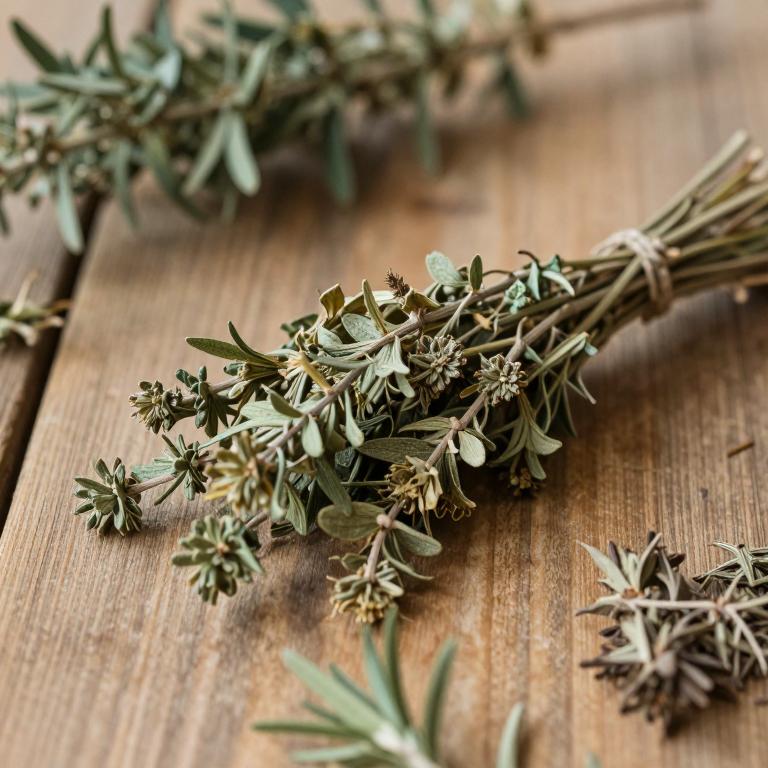
Coin-leaf desmodium, scientifically known as Grona styraciifolia, is a resilient Australian legume valued for its traditional medicinal properties. Characterized by its distinctive rounded leaves, this shrub plays a vital role in local ecosystems. It is frequently studied for its potential bioactive compounds and its significance in indigenous healing practices.
- Family
- Fabaceae
- Native range
- Asia-Temperate
- Parts used
- Leaf · Stem
- Common names
- Coin-Leaf Desmodium
- Scientific synonyms
- Desmodium Strigillosum Subsp. Celebicum · Hedysarum Variegatum · 6 more
Names and Synonyms
Common Names
- coin-leaf desmodium
Scientific Names
Accepted name
Grona styracifoliaSynonyms
- Desmodium strigillosum subsp. celebicum
- Hedysarum variegatum
- Hedysarum conicum
- Hedysarum decumbens
- Desmodium celebicum
- Desmodium styracifolium
- Uraria styracifolia
- Nicolsonia styracifolia
Sources: Wikidata, Catalogue of Life
Taxonomical Classification
This plant belongs to the kingdom Plantae and is classified within the phylum Streptophyta and class Equisetopsida. It is further organized under the subclass Magnoliidae and the order Fabales. Finally, its taxonomic hierarchy concludes within the family Fabaceae and the genus Grona.
| Rank | Classification |
|---|---|
| Kingdom | Plantae |
| Phylum | Streptophyta |
| Class | Equisetopsida |
| Subclass | Magnoliidae |
| Order | Fabales |
| Family | Fabaceae |
| Genus | Grona |
Sources: The World Checklist of Vascular Plants (WCVP)
Distribution
This plant exhibits a wide geographical distribution across several key regions in Asia. Within China, its presence is documented in the South-Central, Southeast, and Hainan provinces. The species also extends into the Indian Subcontinent, where it can be found in the state of Assam. Additionally, its range reaches into the neighboring country of Bangladesh. Together, these locations highlight the diverse subtropical habitats preferred by the species.
| Region | Area |
|---|---|
| China | China South-Central |
| China | Hainan |
| China | China Southeast |
| Indian Subcontinent | Assam |
| Indian Subcontinent | Bangladesh |
| Indian Subcontinent | East Himalaya |
| Indian Subcontinent | India |
| Indian Subcontinent | Sri Lanka |
| Indo-China | Cambodia |
| Indo-China | Myanmar |
Sources: The World Checklist of Vascular Plants (WCVP)
Botanical Identification
Life history
The life history of Grona styraciifolia is characterized by its specific survival strategy as a hemicryptophyte, a classification that defines how the plant manages its regenerative organs during unfavorable seasons. According to its biological profile, the species functions both as a hemicryptophyte and a nanophanerophyte, indicating that its perennating buds are located at or just below the soil surface, protected by leaf litter or surface debris. This life form allows the plant to endure seasonal fluctuations by keeping its vital growth points shielded from environmental extremes, facilitating regrowth once favorable conditions return. By maintaining these buds at the ground level, the plant balances the structural stability of a perennial with the protective advantages of low-lying vegetation, ensuring its persistence within its ecological niche.
- Life form :
- hemicryptophyte
Morphology
The morphology of Grona styraciifolia is characterized by its growth form as a herb, exhibiting a non-woody structure throughout its development. As a climbing plant, it functions as a self-supporting climber, utilizing its structural characteristics to ascend without the requirement for external hosts or specialized tendril mechanisms.
- Climber :
- self-supporting
- Growth form :
- herb
- Woodiness :
- non-woody
Reproduction
The reproduction of Grona styraciifolia is characterized by its specific seed production profiles, which exhibit a highly uniform distribution in terms of weight. The reproductive output yields seeds with a consistent seed mass, where both the mean, maximum, and minimum values are measured at exactly 0.0136 g. This lack of variance in seed mass suggests a highly standardized developmental process during the maturation of the seeds, ensuring that each individual propagule maintains a precise weight of 0.0136 g.
- Seed mass mean:
- 0.0136 g
Sources: Global Inventory of Floras and Traits (GIFT)
Plant Parts
Grona styracifolia has 2 reported plant parts identified across 3 scientific publications and several other databases that are studied for medicinal purposes. The most consistently reported plant part include leaf, stem.
| Plant part | Supporting sources | Consensus |
|---|---|---|
| Leaf | 2 supporting sources | ★☆☆☆☆ |
| Stem | 1 supporting sources | ★☆☆☆☆ |
Leaf
- BMC plant biology
- Zhong yao cai = Zhongyaocai = Journal of Chinese medicinal materials
Stem
- Zhong yao cai = Zhongyaocai = Journal of Chinese medicinal materials
Chemicals
Grona styracifolia has 20 reported phytochemicals identified across 3 scientific publications and several other databases. The most consistently reported chemicals include Schaftoside, Flavonoids, Isoschaftoside, Isovitexin, 5,7-dihydroxy-2',3',4'-trimethoxy-isoflavanone.
| Chemical | Supporting sources | Consensus |
|---|---|---|
| Schaftoside | 4 supporting sources | ★★☆☆☆ |
| Flavonoids | 3 supporting sources | ★★☆☆☆ |
| Isoschaftoside | 2 supporting sources | ★☆☆☆☆ |
| Isovitexin | 2 supporting sources | ★☆☆☆☆ |
| 5,7-dihydroxy-2',3',4'-trimethoxy-isoflavanone | 1 supporting sources | ★☆☆☆☆ |
| 5,7-dihydroxy-2'-methoxy-3',4'-methylenedioxy-isoflavanone | 1 supporting sources | ★☆☆☆☆ |
| 6-C-glycopyranosyl luteolin | 1 supporting sources | ★☆☆☆☆ |
| 6-C-glycopyranosyl-8-C-arabinosyl apigenin | 1 supporting sources | ★☆☆☆☆ |
| B-Sitosterol | 1 supporting sources | ★☆☆☆☆ |
| Flavonoid | 1 supporting sources | ★☆☆☆☆ |
Schaftoside
- Zhongguo Zhong yao za zhi = Zhongguo zhongyao zazhi = China journal of Chinese materia medica
- Journal of chromatographic science
- Horticulture research
- Die Pharmazie
Flavonoids
- BMC plant biology
- Heliyon
- Frontiers in plant science
Isoschaftoside
- Journal of chromatographic science
- Die Pharmazie
Isovitexin
- Journal of chromatographic science
- Die Pharmazie
5,7-dihydroxy-2',3',4'-trimethoxy-isoflavanone
- Phytochemistry
5,7-dihydroxy-2'-methoxy-3',4'-methylenedioxy-isoflavanone
- Phytochemistry
6-C-glycopyranosyl luteolin
- Zhong yao cai = Zhongyaocai = Journal of Chinese medicinal materials
6-C-glycopyranosyl-8-C-arabinosyl apigenin
- Zhong yao cai = Zhongyaocai = Journal of Chinese medicinal materials
B-Sitosterol
- Zhong yao cai = Zhongyaocai = Journal of Chinese medicinal materials
Flavonoid
- Frontiers in plant science
Activities
Grona styracifolia has 3 reported activities identified across 3 scientific publications and several other databases. The most consistently reported activities include Antioxidant, Choleretic, Hepatoprotective.
| Activity | Supporting sources | Consensus |
|---|---|---|
| Antioxidant | 1 supporting sources | ★☆☆☆☆ |
| Choleretic | 1 supporting sources | ★☆☆☆☆ |
| Hepatoprotective | 1 supporting sources | ★☆☆☆☆ |
Antioxidant
- Heliyon
Choleretic
- Heliyon
Hepatoprotective
- Heliyon
Conditions
Grona styracifolia has 1 reported investigations on conditions identified across 3 scientific publications and several other databases. The most consistently reported conditions include COVID-19.
| Condition | Supporting sources | Consensus |
|---|---|---|
| Covid-19 | 1 supporting sources | ★☆☆☆☆ |
Covid-19
- Horticulture research
Preparations
Grona styracifolia has 2 reported preparations identified across 3 scientific publications and several other databases. The most consistently reported preparations include Chinese medicine, aqueous extracts.
| Preparation | Supporting sources | Consensus |
|---|---|---|
| Chinese medicine | 1 supporting sources | ★☆☆☆☆ |
| Aqueous extracts | 1 supporting sources | ★☆☆☆☆ |
Chinese medicine
- Heliyon
Aqueous extracts
- The American journal of Chinese medicine