ghost plant
Graptopetalum paraguayense · Accepted scientific name
Scientific literature: Very Sparse (11 studies) · ★☆☆☆☆
Ghost plant, scientifically known as Graptophyllum paraguyanense, is a versatile medicinal shrub prized for its therapeutic properties. Often utilized in traditional herbalism, it is renowned for its potential to treat various ailments, including inflammatory conditions and digestive issues, making it a significant subject of interest in ethnobotanical studies.
Names and Synonyms
Common Names
- ghostplant
- mother-of-pearl-plant
- Ghost-plant
Scientific Names
Accepted name
Graptopetalum paraguayenseSynonyms
- Sedum weinbergii
- Byrnesia weinbergii
- Graptopetalum weinbergii
- Sedum paraguayense
- Cotyledon paraguayensis
- Echeveria weinbergii
Regional and Traditional Names
Spanish:
- Sedum weinbergii
- Madreperla
Sources: Wikidata, Catalogue of Life
Taxonomical Classification
This plant belongs to the kingdom Plantae and the phylum Streptophyta, falling under the class Equisetopsida and subclass Magnoliidae. Within the order Saxifragales, it is classified under the family Crassulaceae. Specifically, it is identified by the genus Graptopetalum and the species Graptopetalum paraguayense.
| Rank | Classification |
|---|---|
| Kingdom | Plantae |
| Phylum | Streptophyta |
| Class | Equisetopsida |
| Subclass | Magnoliidae |
| Order | Saxifragales |
| Family | Crassulaceae |
| Genus | Graptopetalum |
Sources: The World Checklist of Vascular Plants (WCVP)
Distribution
This plant exhibits a diverse geographical distribution that spans across multiple continents. In Southwestern Europe, its presence is documented within the borders of both Portugal and Spain. Moving toward Southeastern Europe, the species can also be found in Italy. Its range extends to the Americas, specifically inhabiting the northeast region of Mexico. Finally, the plant has established itself in the Southern Hemisphere within Queensland, Australia.
| Region | Area |
|---|---|
| Southwestern Europe | Portugal |
| Southwestern Europe | Spain |
| Southeastern Europe | Italy |
| Australia | Queensland |
| Mexico | Mexico Northeast |
Sources: The World Checklist of Vascular Plants (WCVP)
Botanical Identification
Life history
The life history of Graptopetalum paraguayense is characterized by its nature as a perennial plant, allowing it to persist through multiple growing seasons rather than completing its cycle in a single year. As a succulent, its longevity is supported by specialized tissues designed for water storage, which enable it to survive periods of environmental stress and dormancy. Throughout its life cycle, the plant undergoes phases of vegetative growth, where it expands through the production of fleshy, rosette-shaped leaves, and reproductive phases, where it produces elongated inflorescences bearing small, star-shaped flowers. Because it is a perennial, it can establish a robust root system and accumulate significant energy reserves, facilitating repeated flowering cycles and the ability to propagate effectively through both sexual reproduction and vegetative offsets.
- Lifecycle :
- perennial
Morphology
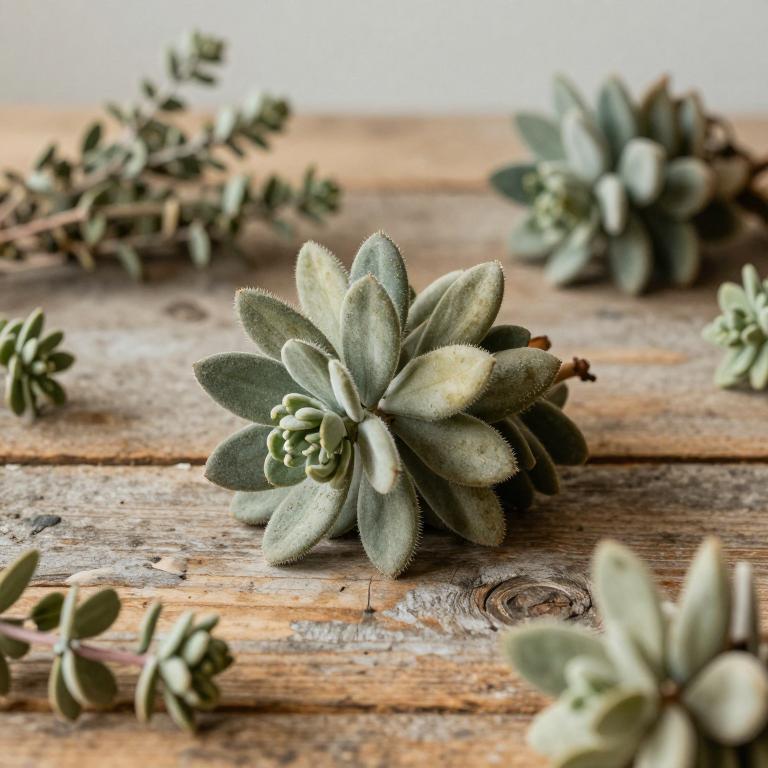
The morphology of Graptopetalum paraguayense is characterized by its succulent, compact growth habit, typically reaching a plant height ranging from a minimum of 0.15 m to a maximum of 0.25 m. The plant features fleshy, thickened leaves that are arranged in a rosette pattern, a structural adaptation designed for water storage. These leaves are generally lanceolate to ovate in shape, possessing a smooth texture and a pale, glaucous coloration often tinged with pinkish or purplish hues. The stems are short and largely obscured by the dense arrangement of the succulent foliage, contributing to its low-growing, mounding appearance within its specified height range.
- Plant height max:
- 0.25 m
- Plant height min:
- 0.15 m
Physiology
The physiology of Graptopedalum paraguayense is characterized by specialized adaptations for water conservation and efficient resource management within its structural morphology. As a succulent organism, the plant employs specialized parenchymatous tissues to facilitate significant water storage, a physiological trait essential for maintaining turgor pressure during periods of environmental stress. The vegetative structure is defined by an arrangement of leaves in a rosette pattern, a configuration that optimizes light interception and directs moisture toward the central meristem. The leaves exhibit an elliptic form, with individual dimensions typically ranging from a minimum length of 5 cm to a maximum length of 7 cm, while maintaining a relatively narrow width that reaches a maximum of 2 cm. This leaf geometry, combined with its succulent nature, supports a metabolic strategy focused on minimizing transpiration while maximizing the storage of essential fluids within the leaf lamina.
- Leaf arrangement :
- rosette
- Leaf form :
- elliptic
- Leaf length max:
- 7 cm
- Leaf length min:
- 5 cm
- Leaf width max:
- 2 cm
- Succulence :
- yes
Reproduction
The reproduction of Graptopetalum paraguayense is characterized by its distinctive flowering cycle and floral morphology. The plant enters its flowering period typically starting in February, with the blooming phase concluding around April, although the specific timing can be variable throughout the year. During this reproductive stage, the plant produces flowers that feature a maximum width of approximately 2 cm. These blossoms are notable for their vibrant red color, serving as a key visual component of its reproductive cycle.
- Flower colour :
- red
- Flower width max:
- 2 cm
- Flowering time :
- Feb
- Flowering time :
- Apr
Sources: Global Inventory of Floras and Traits (GIFT)
Chemicals
Graptopetalum paraguayense has 1 reported phytochemicals identified across 0 scientific publications and several other databases. The most consistently reported chemicals include polyphenols.
| Chemical | Supporting sources | Consensus |
|---|---|---|
| polyphenols | 1 supporting sources | ★☆☆☆☆ |
polyphenols
- Plants (Basel, Switzerland)
Activities
Graptopetalum paraguayense has 7 reported activities identified across 0 scientific publications and several other databases. The most consistently reported activities include Antibacterial, Anticancer, Antihypertensive, Antioxidant, Antiviral.
| Activity | Supporting sources | Consensus |
|---|---|---|
| Antibacterial | 1 supporting sources | ★☆☆☆☆ |
| Anticancer | 1 supporting sources | ★☆☆☆☆ |
| Antihypertensive | 1 supporting sources | ★☆☆☆☆ |
| Antioxidant | 1 supporting sources | ★☆☆☆☆ |
| Antiviral | 1 supporting sources | ★☆☆☆☆ |
| Hepatoprotective | 1 supporting sources | ★☆☆☆☆ |
| Neuroprotective | 1 supporting sources | ★☆☆☆☆ |
Antibacterial
- Plants (Basel, Switzerland)
Anticancer
- Plants (Basel, Switzerland)
Antihypertensive
- Plants (Basel, Switzerland)
Antioxidant
- Plants (Basel, Switzerland)
Antiviral
- Plants (Basel, Switzerland)
Hepatoprotective
- Plants (Basel, Switzerland)
Neuroprotective
- Plants (Basel, Switzerland)
Conditions
Graptopetalum paraguayense has 3 reported investigations on conditions identified across 0 scientific publications and several other databases. The most consistently reported conditions include antihypertensive, antiviral, asthma.
| Condition | Supporting sources | Consensus |
|---|---|---|
| Antihypertensive | 1 supporting sources | ★☆☆☆☆ |
| Antiviral | 1 supporting sources | ★☆☆☆☆ |
| Asthma | 1 supporting sources | ★☆☆☆☆ |
Antihypertensive
- Plants (Basel, Switzerland)
Antiviral
- Plants (Basel, Switzerland)
Asthma
- Plants (Basel, Switzerland)
Preparations
Graptopetalum paraguayense has 4 reported preparations identified across 0 scientific publications and several other databases. The most consistently reported preparations include GP, GP extracts, edible vegetable, extract.
| Preparation | Supporting sources | Consensus |
|---|---|---|
| Gp | 1 supporting sources | ★☆☆☆☆ |
| Gp extracts | 1 supporting sources | ★☆☆☆☆ |
| Edible vegetable | 1 supporting sources | ★☆☆☆☆ |
| Extract | 1 supporting sources | ★☆☆☆☆ |
Gp
- PloS one
Gp extracts
- PloS one
Edible vegetable
- Plants (Basel, Switzerland)
Extract
- PloS one