Globularia alypum
Globularia alypum · Accepted scientific name
Scientific literature: Very Sparse (17 studies) · ★☆☆☆☆
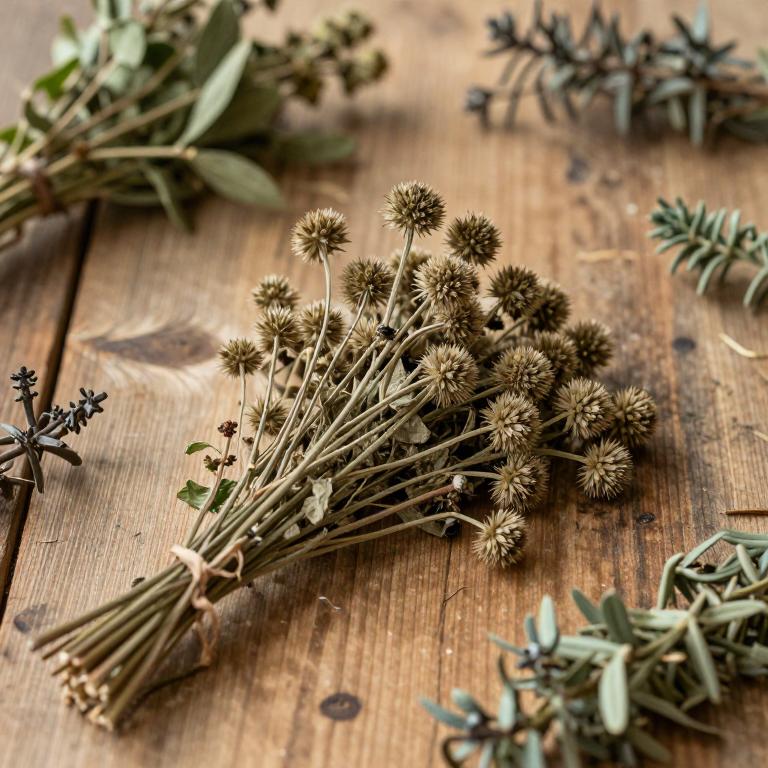
, scientifically known as Globularia alypum, is a resilient Mediterranean perennial valued for its unique medicinal properties. Characterized by its distinct blue flower clusters, this plant is traditionally utilized in herbal remedies to support various therapeutic needs. Its presence in rocky habitats highlights its remarkable ability to thrive in challenging environments.
- Family
- Plantaginaceae
- Native range
- Europe
- Parts used
- Leaf
- Common names
- Not available
- Scientific synonyms
- Alypum Monspeliensium · Alypum Salicifolium · 1 more
Names and Synonyms
Scientific Names
Accepted name
Globularia alypumSynonyms
- Alypum monspeliensium
- Alypum salicifolium
- Globularia alypum var. pycnantha
Regional and Traditional Names
German:
- Strauchige Kugelblume
French:
- Globulaire buissonnante
Sources: Wikidata, Catalogue of Life
Taxonomical Classification
This plant belongs to the kingdom Plantae and the phylum Streptophyta, falling under the class Equisetopsida and subclass Magnoliidae. Within the order Lamiales, it is classified under the family Plantaginaceae. Finally, it is identified by the genus Globularia.
| Rank | Classification |
|---|---|
| Kingdom | Plantae |
| Phylum | Streptophyta |
| Class | Equisetopsida |
| Subclass | Magnoliidae |
| Order | Lamiales |
| Family | Plantaginaceae |
| Genus | Globularia |
Sources: The World Checklist of Vascular Plants (WCVP)
Distribution
This plant is primarily distributed across several key regions within Southwestern Europe. It can be found growing in the Balearic Islands, which are part of the Baleares archipelago. Additionally, its habitat extends to the island of Corsica and the island of Sardinia. The species is also well-established on the mainland in France. Finally, it is widely documented throughout the various territories of Spain.
| Region | Area |
|---|---|
| Southwestern Europe | Baleares |
| Southwestern Europe | Corse |
| Southwestern Europe | France |
| Southwestern Europe | Sardegna |
| Southwestern Europe | Spain |
| Southeastern Europe | Albania |
| Southeastern Europe | Greece |
| Southeastern Europe | Italy |
| Southeastern Europe | Kriti |
| Southeastern Europe | Sicilia |
Sources: The World Checklist of Vascular Plants (WCVP)
Botanical Identification
Life history
The life history of Globularia alypum is characterized by its long-term survival strategy as a perennial species, allowing it to persist in its habitat through multiple growing seasons. Structurally, the plant exhibits a complex life form, functioning both as a chamaephyte and a hemicryptophyte. As a chamaephyte, its buds are located close to the ground, often protected by the soil surface or leaf litter, which aids in resilience against environmental stressors. Simultaneously, its hemicryptophytic nature indicates that its perennating buds are situated at the soil surface, ensuring that the plant can effectively regenerate and thrive following periods of dormancy or unfavorable climatic conditions.
- Life form :
- chamaephyte
- Life form :
- hemicryptophyte
- Lifecycle :
- perennial
Morphology
The morphology of Globularia alypum is characterized by its growth form as a woody subshrub, which allows it to maintain a stable structure. It is a self-supporting plant that does not function as a climber, liana, or vine, nor does it require external support to grow. This species is an independent organism, functioning neither as a parasite nor as an epiphyte, as it maintains a strictly terrestrial existence rather than occupying aquatic or semiaquatic habitats. Its structural integrity is defined by its woody nature, distinguishing it from purely non-woody herbaceous plants.
- Aquatic :
- terrestrial
- Climber :
- self-supporting
- Epiphyte :
- terrestrial
- Growth form :
- herb
- Growth form :
- subshrub
- Parasite :
- independent
- Woodiness :
- woody
Physiology
The physiology of Globularia alypum is characterized by a C3 photosynthetic pathway, which dictates its carbon fixation processes and metabolic efficiency within its Mediterranean habitat. As a C3 plant, it utilizes the Calvin cycle to fix atmospheric carbon dioxide directly through the enzyme RuBisCO, a process that is highly efficient under moderate temperatures and sufficient moisture levels. This metabolic strategy influences the plant's water-use efficiency and transpiration rates, as the stomata must remain open for gas exchange, potentially exposing the plant to photorespiration during periods of high thermal stress. The physiological regulation of its gas exchange and nutrient uptake is closely tied to its environmental adaptation, allowing it to maintain biomass production and metabolic homeostasis within its specific ecological niche.
- Photosynthetic pathway :
- C3
Reproduction
The reproduction of Globularia alypum is characterized by the production of specialized fruit and seeds optimized for its ecological niche. The plant produces fruit that is categorized as dry rather than fleshy, a trait that influences its dispersal mechanisms. The reproductive output is defined by highly uniform seed dimensions, with a recorded seed mass that remains constant across its range; specifically, the seed mass mean, maximum, and minimum are all precisely measured at 0.00019 g. This consistency in seed mass suggests a highly stabilized reproductive strategy within the species.
- Fruit dryness :
- dry
- Seed mass mean:
- 0.00019 g
Sources: Global Inventory of Floras and Traits (GIFT)
Plant Parts
Globularia alypum has 1 reported plant parts identified across 2 scientific publications and several other databases that are studied for medicinal purposes. The most consistently reported plant part include leaf.
| Plant part | Supporting sources | Consensus |
|---|---|---|
| Leaf | 2 supporting sources | ★☆☆☆☆ |
Leaf
- Journal of ethnopharmacology
- Molecules (Basel, Switzerland)
Chemicals
Globularia alypum has 10 reported phytochemicals identified across 2 scientific publications and several other databases. The most consistently reported chemicals include 6-hydroxyluteolin 7-O-laminaribioside, Acteoside, Asperuloside, Eriodictyol 7-O-sophoroside, Flavonoid.
| Chemical | Supporting sources | Consensus |
|---|---|---|
| 6-hydroxyluteolin 7-O-laminaribioside | 1 supporting sources | ★☆☆☆☆ |
| Acteoside | 1 supporting sources | ★☆☆☆☆ |
| Asperuloside | 1 supporting sources | ★☆☆☆☆ |
| Eriodictyol 7-O-sophoroside | 1 supporting sources | ★☆☆☆☆ |
| Flavonoid | 1 supporting sources | ★☆☆☆☆ |
| Forsythiaside | 1 supporting sources | ★☆☆☆☆ |
| GLOBULARIFOLIN | 1 supporting sources | ★☆☆☆☆ |
| Globularin | 1 supporting sources | ★☆☆☆☆ |
| Isoacteoside | 1 supporting sources | ★☆☆☆☆ |
| n-Hexadecanoic acid | 1 supporting sources | ★☆☆☆☆ |
6-hydroxyluteolin 7-O-laminaribioside
- Journal of natural products
Acteoside
- Journal of natural products
Asperuloside
- Journal of mass spectrometry : JMS
Eriodictyol 7-O-sophoroside
- Journal of natural products
Flavonoid
- Molecules (Basel, Switzerland)
Forsythiaside
- Journal of natural products
GLOBULARIFOLIN
- Journal of mass spectrometry : JMS
Globularin
- Journal of mass spectrometry : JMS
Isoacteoside
- Journal of natural products
n-Hexadecanoic acid
- Molecules (Basel, Switzerland)
Activities
Globularia alypum has 1 reported activities identified across 2 scientific publications and several other databases. The most consistently reported activities include Antioxidant.
| Activity | Supporting sources | Consensus |
|---|---|---|
| Antioxidant | 1 supporting sources | ★☆☆☆☆ |
Antioxidant
- International journal of environmental health research
Conditions
Globularia alypum has 2 reported investigations on conditions identified across 2 scientific publications and several other databases. The most consistently reported conditions include Escherichia coli, Staphylococcus aureus.
| Condition | Supporting sources | Consensus |
|---|---|---|
| Escherichia coli | 1 supporting sources | ★☆☆☆☆ |
| Staphylococcus aureus | 1 supporting sources | ★☆☆☆☆ |
Escherichia coli
- International journal of environmental health research
Staphylococcus aureus
- International journal of environmental health research
Preparations
Globularia alypum has 5 reported preparations identified across 2 scientific publications and several other databases. The most consistently reported preparations include aerial parts, ethanolic extracts, ethanolic extracts of Globularia alypum dried leaves, infusions, leaves.
| Preparation | Supporting sources | Consensus |
|---|---|---|
| Aerial parts | 1 supporting sources | ★☆☆☆☆ |
| Ethanolic extracts | 1 supporting sources | ★☆☆☆☆ |
| Ethanolic extracts of globularia alypum dried leaves | 1 supporting sources | ★☆☆☆☆ |
| Infusions | 1 supporting sources | ★☆☆☆☆ |
| Leaves | 1 supporting sources | ★☆☆☆☆ |
Aerial parts
- Molecules (Basel, Switzerland)
Ethanolic extracts
- International journal of environmental health research
Ethanolic extracts of globularia alypum dried leaves
- Journal of ethnopharmacology
Infusions
- Therapie
Leaves
- Molecules (Basel, Switzerland)