Wallich Geranium
Geranium wallichianum · Accepted scientific name
Scientific literature: Very Sparse (5 studies) · ★☆☆☆☆
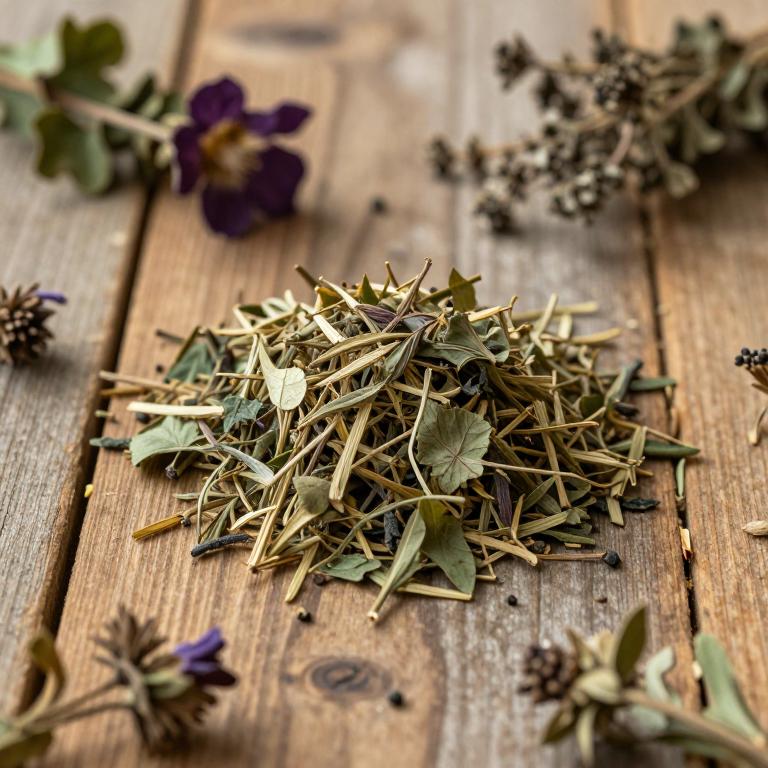
Wallich Geranium, scientifically known as Geranium wallichianum, is a resilient medicinal herb native to the Himalayan regions. Renowned for its therapeutic properties, this plant is traditionally utilized in folk medicine to treat inflammatory conditions, skin ailments, and digestive issues, offering a natural approach to holistic healing and wellness.
- Family
- Geraniaceae
- Native range
- Asia-Temperate
- Parts used
- Leaf
- Common names
- Buxton'S Blue · Purple-Vein Geranium · 2 more
- Scientific synonyms
- Geranium Scullyi
Names and Synonyms
Common Names
- Buxton's Blue
- Purple-vein geranium
- Wallich cranesbill
- Wallich geranium
Scientific Names
Accepted name
Geranium wallichianumSynonyms
- Geranium scullyi
Regional and Traditional Names
German:
- Storchschnabel
French:
- Géranium de Wallich
Sources: Wikidata, Catalogue of Life
Taxonomical Classification
This plant, Geranium wallichianum, belongs to the kingdom Plantae and is classified under the phylum Streptophyta and class Equisetopsida. Within the subclass Magnoliidae, it is situated in the order Geraniales and the family Geraniaceae. Finally, its taxonomic identity is defined by its placement within the genus Geranium.
| Rank | Classification |
|---|---|
| Kingdom | Plantae |
| Phylum | Streptophyta |
| Class | Equisetopsida |
| Subclass | Magnoliidae |
| Order | Geraniales |
| Family | Geraniaceae |
| Genus | Geranium |
Sources: The World Checklist of Vascular Plants (WCVP)
Distribution
This plant exhibits a diverse geographical range extending across several prominent Asian regions. Within the Indian Subcontinent, it is commonly found inhabiting the East Himalaya, Nepal, and Pakistan. Its distribution also reaches into Western Asia, specifically within the borders of Afghanistan. Furthermore, the species can be located in the high-altitude regions of China, specifically in Tibet. Together, these locations highlight the wide montane habitat preferred by Geranium wallichianum.
| Region | Area |
|---|---|
| Western Asia | Afghanistan |
| China | Tibet |
| Indian Subcontinent | East Himalaya |
| Indian Subcontinent | Nepal |
| Indian Subcontinent | Pakistan |
| Indian Subcontinent | West Himalaya |
Sources: The World Checklist of Vascular Plants (WCVP)
Botanical Identification
Ecology
The ecology of Geranium wallichianum is characterized by its preference for high-altitude montane environments, where it occupies a specific vertical niche within its habitat. This species is primarily found across an elevational range that begins at a minimum of 2200 m AMSL and extends up to a maximum of 3500 m AMSL. Within this altitudinal gradient, the plant maintains a mean elevation of approximately 3400 m AMSL, suggesting a strong ecological affinity for the subalpine or alpine zones. Such positioning indicates that the species is adapted to the specific climatic conditions, soil compositions, and moisture levels typical of these high-elevation ecosystems.
- Elevational range max:
- 3500 m AMSL
- Elevational range mean:
- 3400 m AMSL
- Elevational range min:
- 2200 m AMSL
Life history
The life history of Geranium wallichianum is characterized by its nature as a perennial plant, allowing it to persist through multiple growing seasons within its natural habitat. As a perennial species, it does not complete its life cycle in a single year like annuals or two years like biennials, but instead maintains a continuous presence, often developing robust root systems that facilitate long-term survival and regrowth. This lifecycle enables the plant to establish itself steadily in its ecological niche, frequently reappearing to flower and produce seeds in successive years. Throughout its life, the plant undergoes seasonal cycles of vegetative growth and reproductive phases, utilizing its perennial structure to withstand environmental fluctuations and ensure the long-term stability of its population.
- Lifecycle :
- perennial
Morphology
The morphology of Geranium wallichianum is characterized by its growth form as a non-woody herb, specifically presenting as a forb. It functions as an independent organism, exhibiting a terrestrial lifestyle rather than an epiphytic or parasitic existence. In terms of its climbing habit, the plant is categorized as a self-supporting clamberer, possessing the ability to grow through its own structural means without requiring obligatory support, behaving as a facultative or self-supporting vine or liana.
- Climber :
- self-supporting
- Epiphyte :
- terrestrial
- Growth form :
- herb
- Parasite :
- independent
- Woodiness :
- non-woody
Reproduction
The reproduction of Geranium wallichianum is characterized by a distinct flowering season and specific morphological traits in its reproductive structures. The flowering period typically commences in June and extends through October, though the timing can be variable depending on environmental conditions. Following pollination, the plant develops fruits that exhibit a highly consistent size, with both the mean and the full range of length measured at exactly 2.5 cm. The resulting seeds are remarkably uniform in their mass, maintaining a constant weight of 0.00836 g, which serves as both the minimum, mean, and maximum recorded seed mass for this species.
- Flowering time :
- Jun
- Flowering time :
- Oct
- Fruit length max:
- 2.5 cm
- Seed mass mean:
- 0.00836 g
Sources: Global Inventory of Floras and Traits (GIFT)
Plant Parts
Geranium wallichianum has 1 reported plant parts identified across 1 scientific publications and several other databases that are studied for medicinal purposes. The most consistently reported plant part include leaf.
| Plant part | Supporting sources | Consensus |
|---|---|---|
| Leaf | 1 supporting sources | ★☆☆☆☆ |
Leaf
- Biomolecules
Chemicals
Geranium wallichianum has 2 reported phytochemicals identified across 1 scientific publications and several other databases. The most consistently reported chemicals include germacrene a, kaempferol.
| Chemical | Supporting sources | Consensus |
|---|---|---|
| germacrene a | 1 supporting sources | ★☆☆☆☆ |
| kaempferol | 1 supporting sources | ★☆☆☆☆ |
germacrene a
- Scientific reports
kaempferol
- Scientific reports
Activities
Geranium wallichianum has 1 reported activities identified across 1 scientific publications and several other databases. The most consistently reported activities include Antimicrobial.
| Activity | Supporting sources | Consensus |
|---|---|---|
| Antimicrobial | 1 supporting sources | ★☆☆☆☆ |
Antimicrobial
- Scientific reports
Conditions
Geranium wallichianum has 1 reported investigations on conditions identified across 1 scientific publications and several other databases. The most consistently reported conditions include toothache.
| Condition | Supporting sources | Consensus |
|---|---|---|
| Toothache | 1 supporting sources | ★☆☆☆☆ |
Toothache
- Journal of ethnopharmacology
Preparations
Geranium wallichianum has 1 reported preparations identified across 1 scientific publications and several other databases. The most consistently reported preparations include leaf extracts.
| Preparation | Supporting sources | Consensus |
|---|---|---|
| Leaf extracts | 1 supporting sources | ★☆☆☆☆ |
Leaf extracts
- Biomolecules