black widow
Geranium phaeum · Accepted scientific name
Scientific literature: Very Sparse (1 studies) · ★☆☆☆☆
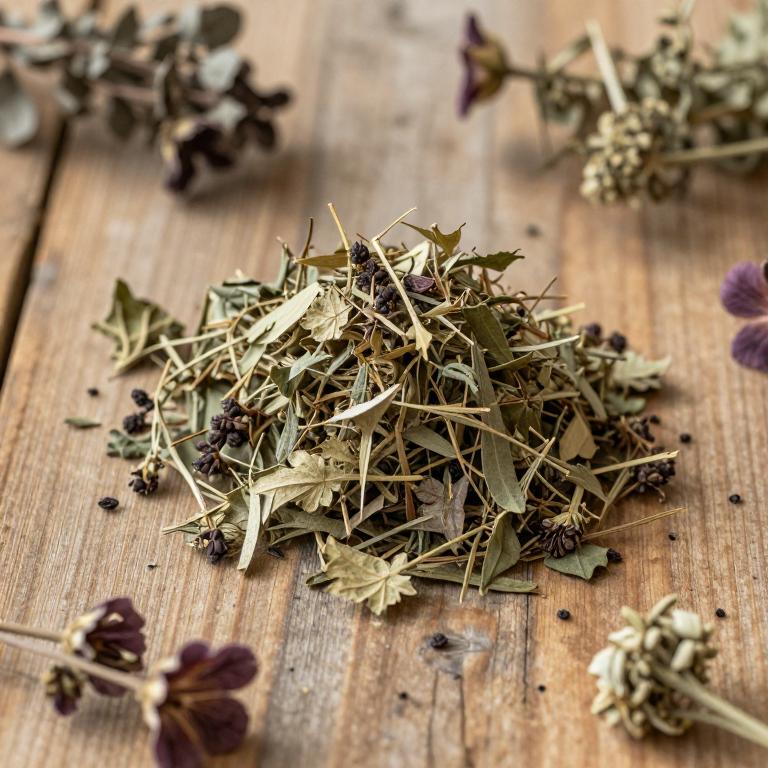
Black widow, scientifically known as Geranium phaeum, is a captivating perennial valued for its striking dark foliage and deep crimson blooms. Beyond its ornamental beauty, this plant holds significant place in traditional herbalism, often utilized for its soothing properties and potential medicinal applications in treating various skin ailments.
Names and Synonyms
Common Names
- Dusky Crane's-Bill
- Mourning Widow
- black-widow
- black widow
Scientific Names
Accepted name
Geranium phaeumSynonyms
- Geranium phaeum var. lividum
- Geranium phaeum var. patulum
- Geranium austriacum
- Geranium phaeum var. maculatum
- Geranium phaeum var. nodosum
- Geranium patulum
- Geranium lividum
- Geranium lividum var. caerulescens
- Geranium fuscum
- Geranium hungaricum
- Geranium phaeum var. atropurpureum
- Geranium phaeum subsp. austriacum
- Geranium phaeum var. balcanicum
- Geranium phaeum f. hungaricum
- Geranium phaeum f. pallidum
- Geranium planipetalum
- Geranium subcoeruleum
- Geranium phaeum var. fuscum
- Geranium phaeum subvar. fuscum
- Geranium phaeum subsp. lividum
Regional and Traditional Names
Spanish:
- Geranium lividum var caerulescens
- Geranium bosniacum
- Geranium montanum
- Geranium lividum
- Geranium subcoeruleum
- Geranium planipetalum
- Geranium lividum var. caerulescens
- Geranium hungaricum
- Geranium fuscum
- Geranium patulum
German:
- Brauner Storchschnabel
- Géranium brun
- Brauner Storchschnabel
- Brauner Storchschnabel i.w.S.
French:
- Géranium livide
- géranium brun
- Geranium brun
- Géranium brun
- Géranium livide
Sources: Wikidata, Catalogue of Life
Taxonomical Classification
This plant belongs to the kingdom Plantae and the phylum Streptophyta, falling under the class Equisetopsida and subclass Magnoliidae. Within the order Geraniales and the family Geraniaceae, it is classified under the genus Geraunium.
| Rank | Classification |
|---|---|
| Kingdom | Plantae |
| Phylum | Streptophyta |
| Class | Equisetopsida |
| Subclass | Magnoliidae |
| Order | Geraniales |
| Family | Geraniaceae |
| Genus | Geranium |
Sources: The World Checklist of Vascular Plants (WCVP)
Distribution
This plant, Geranium phaeum, exhibits a specific geographical distribution across the northern regions of Europe. It can be found growing within the natural landscapes of Denmark. Its presence extends further north into the territories of Finland. Additionally, this species is documented throughout Great Britain. Finally, its range includes the coastal and inland areas of Ireland and Sweden.
| Region | Area |
|---|---|
| Northern Europe | Denmark |
| Northern Europe | Finland |
| Northern Europe | Great Britain |
| Northern Europe | Ireland |
| Northern Europe | Sweden |
| Middle Europe | Austria |
| Middle Europe | Belgium |
| Middle Europe | Czechia-Slovakia |
| Middle Europe | Germany |
| Middle Europe | Hungary |
Sources: The World Checklist of Vascular Plants (WCVP)
Botanical Identification
Ecology
The ecology of Geranium phaeum is characterized by its preference for diverse, semi-shaded environments where it can thrive within the complex structures of forests, meadows, and shrubberies. It typically colonizes the understory of deciduous woodlands or the margins of open grasslands, benefiting from the transitional light conditions found in these ecotones. In forest settings, it occupies the herb layer where soil moisture is relatively consistent and organic matter is abundant, while in meadows and shrubby habitats, it seeks out niches that provide a balance between sunlight exposure and protection from extreme desiccation. Its ability to inhabit these varied settings allows it to integrate into different community compositions, often acting as a stabilizing component of the ground flora in temperate ecosystems.
- Habitat :
- forest, meadows, shrubberies
Life history
The life history of Geranium phaeum is characterized by its existence as a perennial species, allowing it to persist through multiple growing seasons. As a hemicryptophyte, its perennating buds are located at or just below the soil surface, protected by leaf litter or ground cover during unfavorable periods. This plant exhibits a deciduous nature, shedding its foliage in response to seasonal changes before entering a period of dormancy.
- Deciduousness :
- deciduous
- Life form :
- hemicryptophyte
- Lifecycle :
- perennial
Morphology
The morphology of Geranium phaeum is characterized by its herbaceous growth form, functioning as a non-woody, self-supporting herb. As an independent organism, it does not exhibit parasitic behavior. The plant maintains a relatively modest stature, with a recorded plant height ranging from a minimum of 0.3 m to a maximum of 0.7 m, resulting in an average plant height of approximately 0.392 m.
- Climber :
- self-supporting
- Growth form :
- herb
- Parasite :
- independent
- Plant height max:
- 0.7 m
- Plant height mean:
- 0.392 m
- Plant height min:
- 0.3 m
- Woodiness :
- non-woody
Physiology
The physiology of Geranium phaeum is characterized by a C3 photosynthetic pathway, a common metabolic strategy for plants in temperate environments to facilitate carbon fixation. The plant exhibits a non-carnivorous nutritional strategy, relying entirely on soil-based nutrient uptake rather than the capture of prey. Morphologically, it possesses a mean leaf size of 106.1 cm², which contributes to its overall canopy structure and light interception capabilities. Furthermore, the species maintains a mean Specific Leaf Area (SLA) of 343.7 cm²/g, a metric that reflects the efficiency of its leaf mass distribution and its physiological adaptation to optimize gas exchange and light harvesting relative to its biomass.
- Carnivory :
- non-carnivorous
- Leaf size mean:
- 106.1 cm²
- Photosynthetic pathway :
- C3
- Specific Leaf Area (SLA) mean:
- 343.7 cm²/g
Reproduction
The reproduction of Geranium phaeum is characterized by a sexual reproductive cycle driven by biotic pollination mechanisms. The flowering period typically begins in May and concludes in June, during which the plant utilizes an insect-based pollination syndrome. This biotic approach to pollination is facilitated by insects, ensuring the transfer of genetic material. The species is capable of self-fertilization, which assists in reproductive success. Regarding seed characteristics, the plant produces relatively small seeds with a mean mass of 0.00388 g, ranging from a minimum of 0.00326 g to a maximum of 0.0045 g. Once the seeds are mature, they are distributed via an autochorous dispersal syndrome, meaning the plant employs a mechanism for self-dispersal. Notably, asexual reproduction is absent in this species, making sexual processes the primary driver of its life cycle.
- Dispersal syndrome :
- autochorous
- Flowering time :
- May
- Flowering time :
- Jun
- Pollination syndrome :
- insect
- Pollination syndrome :
- biotic
- Reproduction asexual :
- absent
- Seed mass max:
- 0.0045 g
- Seed mass mean:
- 0.00388 g
- Seed mass min:
- 0.00326 g
- Self fertilization :
- present
Sources: Global Inventory of Floras and Traits (GIFT)
Chemicals
Geranium phaeum has 1 reported phytochemicals identified across 0 scientific publications and several other databases. The most consistently reported chemicals include Tannins.
| Chemical | Supporting sources | Consensus |
|---|---|---|
| Tannins | 1 supporting sources | ★☆☆☆☆ |
Tannins
- Die Pharmazie