hardy geranium
Geranium macrorrhizum · Accepted scientific name
Scientific literature: Very Sparse (14 studies) · ★☆☆☆☆
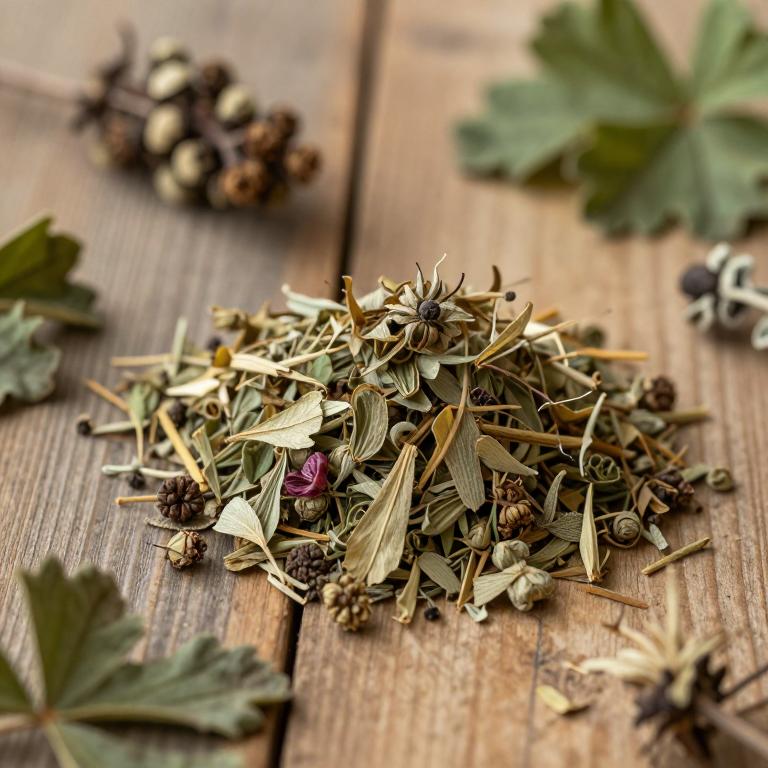
Hardy geranium, scientifically known as Geranium macrorhizum, is a resilient perennial celebrated for its robust growth and striking foliage. Prized in traditional medicine, this plant offers diverse therapeutic potential. Its ability to thrive in challenging environments makes it both a practical choice for gardeners and a valuable botanical resource.
Names and Synonyms
Common Names
- big-rooted geranium
- rock crane's-bill
- Bulgarian geranium
- bigroot geranium
- cranesbill
- hardy geranium
Scientific Names
Accepted name
Geranium macrorrhizumSynonyms
- Robertium macrorrhizum
- Geranium macrorrhizum var. parnassicum
- Geranium balkanum
- Geranium lugubre
Regional and Traditional Names
German:
- Balkan-Storchschnabel
- Felsen-Storchschnabel
- Großwurzeliger Storchschnabel
- Felsen-Storchschnabel
- Grosswurzliger Storchenschnabel
- Balkan-Storchschnabel
- Großwurzeliger Storchschnabel
French:
- Géranium à grosses racines
- Geranium a gros rhizome
- Géranium à gros rhizome
- Géranium à grosses racines
Sources: Wikidata, Catalogue of Life
Taxonomical Classification
This plant belongs to the kingdom Plantae and is classified within the phylum Streptophyta and the class Equisetopsida. Under the subclass Magnoliidae, it falls into the order Geraniales and the family Geraniaceae. Finally, it is categorized under the genus Geranium.
| Rank | Classification |
|---|---|
| Kingdom | Plantae |
| Phylum | Streptophyta |
| Class | Equisetopsida |
| Subclass | Magnoliidae |
| Order | Geraniales |
| Family | Geraniaceae |
| Genus | Geranium |
Sources: The World Checklist of Vascular Plants (WCVP)
Distribution
This plant exhibits a broad presence across several regions within the European continent. In Northern Europe, its range extends to include both Great Britain and Ireland. Moving toward Middle Europe, the species can be found growing in Austria and Belgium. Its distribution also covers the central territories of Czechia and Slovakia. Consequently, these locations highlight the diverse geographical spread of Geranium macrorhizum.
| Region | Area |
|---|---|
| Northern Europe | Great Britain |
| Northern Europe | Ireland |
| Middle Europe | Austria |
| Middle Europe | Belgium |
| Middle Europe | Czechia-Slovakia |
| Middle Europe | Germany |
| Middle Europe | Poland |
| Southwestern Europe | France |
| Southeastern Europe | Albania |
| Southeastern Europe | Bulgaria |
Sources: The World Checklist of Vascular Plants (WCVP)
Botanical Identification
Life history
The life history of Geranium macrorhizum is characterized by its status as a perennial plant, allowing it to persist through multiple growing seasons. In terms of its structural adaptation to seasonal changes, it is classified as a hemicryptophyte, meaning its perennating buds are located at or just below the soil surface, protected by leaf litter or debris. This hemicryptophytic life form, consistent across its biological classification, enables the species to survive unfavorable conditions while maintaining the capacity for vigorous regrowth during favorable periods.
- Life form :
- hemicryptophyte
- Lifecycle :
- perennial
Morphology
The morphology of Geranium macrorhizum is characterized by its growth form as a non-woody herb and forb. As an independent plant, it does not function as a parasite or an epiphyte, maintaining a primarily terrestrial existence. The plant is self-supporting rather than acting as a climber, liana, or vine. In terms of stature, it is a relatively small species, with a plant height ranging from a minimum of 0.2 m to a maximum of 0.5 m.
- Aquatic :
- terrestrial
- Climber :
- self-supporting
- Epiphyte :
- terrestrial
- Growth form :
- herb
- Parasite :
- independent
- Plant height max:
- 0.5 m
- Plant height min:
- 0.2 m
- Woodiness :
- non-woody
Physiology
The physiology of Geranium macrorhizum is characterized by a metabolic framework driven by the C3 photosynthetic pathway, which serves as the primary mechanism for carbon fixation and energy production. In this C3 process, carbon dioxide is fixed directly from the atmosphere through the Calvin cycle, utilizing the enzyme RuBisCO to catalyze the carboxylation of ribulose-1,5-bisphosphate. This metabolic strategy is typical for plants inhabiting temperate or shaded environments where the efficiency of light harvesting and gas exchange is optimized under moderate temperatures. Beyond its photosynthetic characteristics, the plant's physiological vigor is closely linked to its robust rhizomatous structure, which functions as a specialized organ for nutrient storage and long-term metabolic regulation, facilitating survival through varying seasonal cycles.
- Photosynthetic pathway :
- C3
Reproduction
The reproduction of Geranium macrorhizum is characterized by a specific phenological window and unique dispersal mechanisms. The flowering period is concentrated primarily in June, marking both the start and the end of its reproductive cycle for the season. Following successful pollination, the plant produces seeds with a mean mass of approximately 0.00252 g. Regarding the movement of its progeny, the species exhibits an anthropochorous dispersal syndrome, meaning its seeds are primarily spread through human activity.
- Dispersal syndrome :
- anthropochorous
- Flowering time :
- Jun
- Seed mass mean:
- 0.00252 g
Sources: Global Inventory of Floras and Traits (GIFT)
Chemicals
Geranium macrorrhizum has 3 reported phytochemicals identified across 0 scientific publications and several other databases. The most consistently reported chemicals include catechins, rosmarinic acid, salicylic acid.
| Chemical | Supporting sources | Consensus |
|---|---|---|
| catechins | 1 supporting sources | ★☆☆☆☆ |
| rosmarinic acid | 1 supporting sources | ★☆☆☆☆ |
| salicylic acid | 1 supporting sources | ★☆☆☆☆ |
catechins
- Pharmaceuticals (Basel, Switzerland)
rosmarinic acid
- Pharmaceuticals (Basel, Switzerland)
salicylic acid
- Pharmaceuticals (Basel, Switzerland)
Activities
Geranium macrorrhizum has 2 reported activities identified across 0 scientific publications and several other databases. The most consistently reported activities include Antimicrobial, Antioxidant.
| Activity | Supporting sources | Consensus |
|---|---|---|
| Antimicrobial | 1 supporting sources | ★☆☆☆☆ |
| Antioxidant | 1 supporting sources | ★☆☆☆☆ |
Antimicrobial
- Pharmaceuticals (Basel, Switzerland)
Antioxidant
- Pharmaceuticals (Basel, Switzerland)
Conditions
Geranium macrorrhizum has 8 reported investigations on conditions identified across 0 scientific publications and several other databases. The most consistently reported conditions include Candida albicans, Escherichia coli, Klebsiella pneumoniae, Proteus vulgaris, Pseudomonas aeruginosa.
| Condition | Supporting sources | Consensus |
|---|---|---|
| Candida albicans | 1 supporting sources | ★☆☆☆☆ |
| Escherichia coli | 1 supporting sources | ★☆☆☆☆ |
| Klebsiella pneumoniae | 1 supporting sources | ★☆☆☆☆ |
| Proteus vulgaris | 1 supporting sources | ★☆☆☆☆ |
| Pseudomonas aeruginosa | 1 supporting sources | ★☆☆☆☆ |
| Staphylococcus aureus | 1 supporting sources | ★☆☆☆☆ |
| Antioxidant | 1 supporting sources | ★☆☆☆☆ |
| Wound-healing | 1 supporting sources | ★☆☆☆☆ |
Candida albicans
- Basic life sciences
Escherichia coli
- Basic life sciences
Klebsiella pneumoniae
- Basic life sciences
Proteus vulgaris
- Basic life sciences
Pseudomonas aeruginosa
- Basic life sciences
Staphylococcus aureus
- Basic life sciences
Antioxidant
- Pharmaceuticals (Basel, Switzerland)
Wound-healing
- Pharmaceuticals (Basel, Switzerland)
Preparations
Geranium macrorrhizum has 2 reported preparations identified across 0 scientific publications and several other databases. The most consistently reported preparations include Essential oils, ethanol extracts.
| Preparation | Supporting sources | Consensus |
|---|---|---|
| Essential oils | 1 supporting sources | ★☆☆☆☆ |
| Ethanol extracts | 1 supporting sources | ★☆☆☆☆ |
Essential oils
- Pharmaceuticals (Basel, Switzerland)
Ethanol extracts
- Pharmaceuticals (Basel, Switzerland)