Namaqua Oxtongue
Gasteria pillansii · Accepted scientific name
Scientific literature: Very Sparse (1 studies) · ★☆☆☆☆
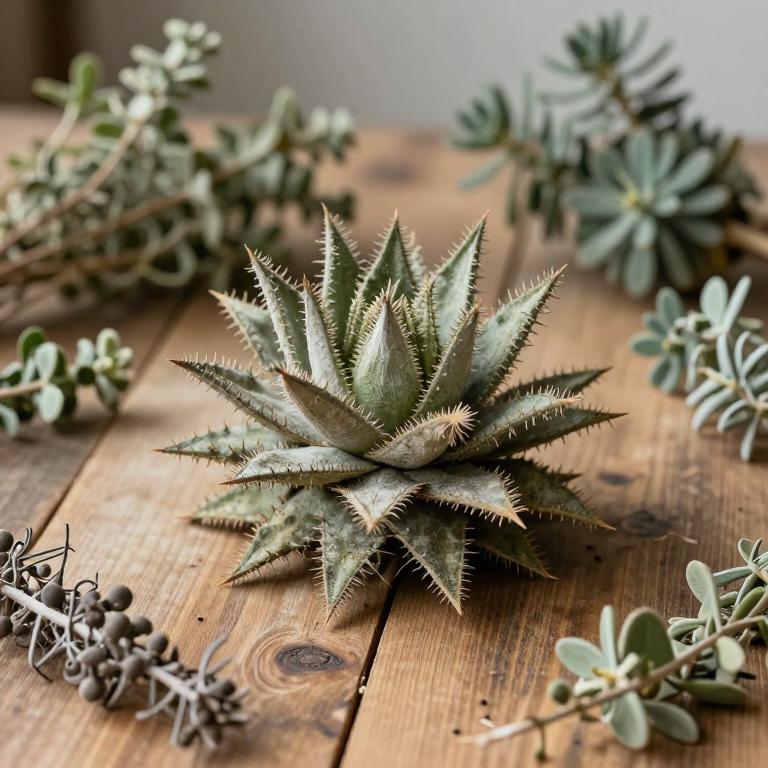
Namaqua Oxtongue, scientifically known as Gasteria pillansii, is a fascinating succulent endemic to South Africa's arid landscapes. Characterized by its distinctive fleshy leaves and striking floral displays, this resilient plant holds significant botanical interest. It is valued for its unique adaptations to extreme drought and specialized ecological roles.
- Family
- Asphodelaceae
- Native range
- Africa
- Parts used
- Not available
- Common names
- Namaqua Oxtongue
- Scientific synonyms
- Not available
Names and Synonyms
Common Names
- Namaqua Oxtongue
Scientific Names
Accepted name
Gasteria pillansiiSources: Wikidata, Catalogue of Life
Taxonomical Classification
This plant, Gasteria pillansii, belongs to the kingdom Plantae and is classified within the phylum Streptophyta and the class Equisetopsida. It is further categorized under the subclass Magnoliidae and the order Asparagales. Finally, it is a member of the family Asphodelaceae within the genus Gasteria.
| Rank | Classification |
|---|---|
| Kingdom | Plantae |
| Phylum | Streptophyta |
| Class | Equisetopsida |
| Subclass | Magnoliidae |
| Order | Asparagales |
| Family | Asphodelaceae |
| Genus | Gasteria |
Sources: The World Checklist of Vascular Plants (WCVP)
Distribution
This plant is primarily found within the diverse landscapes of Southern Africa. Its natural range specifically encompasses the various Cape Provinces. Additionally, the distribution extends northward into the territory of Namibia. These regions provide the necessary environmental conditions for its growth and survival. Consequently, its presence is concentrated within these specific southern African locales.
| Region | Area |
|---|---|
| Southern Africa | Cape Provinces |
| Southern Africa | Namibia |
Sources: The World Checklist of Vascular Plants (WCVP)
Botanical Identification
Ecology
The ecology of Gasteria pillansii is characterized by its adaptability across a diverse range of altitudinal gradients, allowing it to inhabit varied environmental niches. This species is found at elevations starting from sea level (0 m AMSL) and extending up to a maximum altitude of 1000 m AMSL. This broad elevational range suggests that the plant can tolerate a variety of microclimates, from lowland tropical or subtropical conditions to the slightly cooler, more temperate environments found in mid-elevation habitats. Its ability to persist across this 1000-meter vertical span indicates a resilience to fluctuations in temperature, atmospheric pressure, and moisture availability typical of these transitional zones.
- Elevational range max:
- 1000 m AMSL
- Elevational range min:
- 0 m AMSL
Life history
The life history of Gasteria pillansii is characterized by its status as a perennial plant, allowing it to persist through multiple growing seasons. Structurally, it adopts a hemicryptophyte life form, meaning its perennation buds are located at or just below the soil surface, typically protected by leaf litter or surface debris. This specific growth habit, categorized under both hemicryptophyte classifications, ensures its survival and ability to regenerate within its ecological niche across successive years.
- Life form :
- hemicryptophyte
- Lifecycle :
- perennial
Morphology
The morphology of Gasteria pillansii is characterized by its growth as a small, non-woody herb, exhibiting a growth form consistent with a herbaceous plant. It is a self-supporting species that does not function as a climber, epiphyte, or parasite, maintaining an independent lifestyle. The plant's habit is primarily terrestrial, though it can be categorized within the spectrum of aquatic, semiaquatic, or terrestrial environments. In terms of stature, it is a diminutive species, with a plant height ranging from a minimum of 0.01 m to a maximum of 0.2 m.
- Aquatic :
- terrestrial
- Climber :
- self-supporting
- Epiphyte :
- terrestrial
- Growth form :
- herb
- Parasite :
- independent
- Plant height max:
- 0.2 m
- Plant height min:
- 0.01 m
- Woodiness :
- non-woody
Sources: Global Inventory of Floras and Traits (GIFT)
Chemicals
Gasteria pillansii has 1 reported phytochemicals identified across 0 scientific publications and several other databases. The most consistently reported chemicals include quercitrin.
| Chemical | Supporting sources | Consensus |
|---|---|---|
| quercitrin | 1 supporting sources | ★☆☆☆☆ |
quercitrin
- Evidence-based complementary and alternative medicine : eCAM