Gardenia coronaria
Gardenia coronaria · Accepted scientific name
Scientific literature: Very Sparse (3 studies) · ★☆☆☆☆
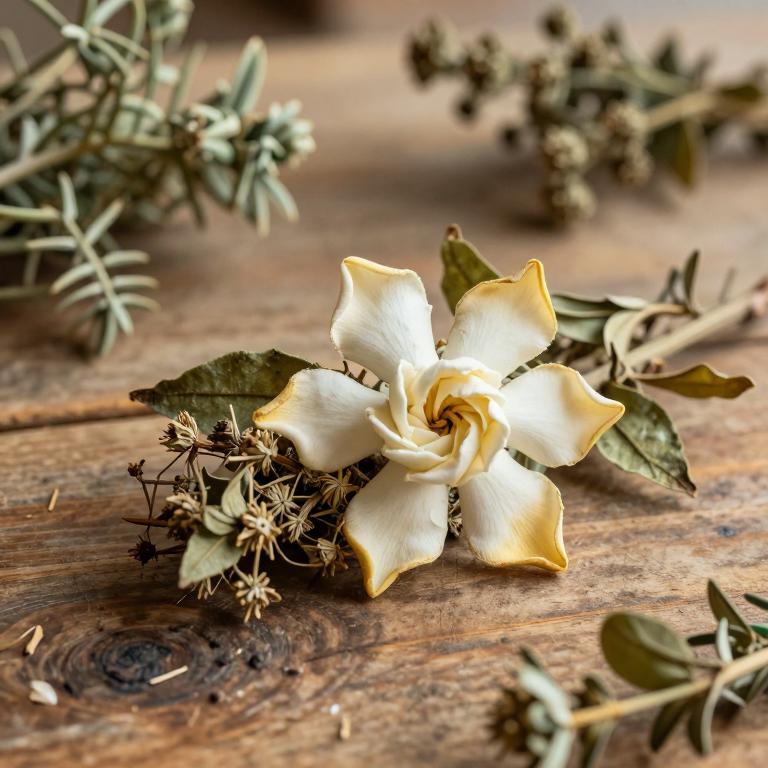
, scientifically known as Gardenia coronaria, is a captivating evergreen shrub prized for its fragrant, creamy-white blooms. Native to tropical regions, this botanical treasure is widely utilized in traditional medicine to alleviate inflammation and skin ailments. Its lush foliage and intoxicating scent make it both medicinal and aesthetically stunning.
- Family
- Rubiaceae
- Native range
- Asia-Tropical
- Parts used
- Not available
- Common names
- Not available
- Scientific synonyms
- Yangapa Flava · Gardenia Costata
Names and Synonyms
Scientific Names
Accepted name
Gardenia coronariaSynonyms
- Yangapa flava
- Gardenia costata
Sources: Wikidata, Catalogue of Life
Taxonomical Classification
This plant, Gardenia coronaria, belongs to the kingdom Plantae within the phylum Streptophyta and the class Equisetopsida. It is further classified under the subclass Magnoliidae and the order Gentianaales. Finally, it is a member of the family Rubiaceae and is categorized under the genus Gardenia.
| Rank | Classification |
|---|---|
| Kingdom | Plantae |
| Phylum | Streptophyta |
| Class | Equisetopsida |
| Subclass | Magnoliidae |
| Order | Gentianales |
| Family | Rubiaceae |
| Genus | Gardenia |
Sources: The World Checklist of Vascular Plants (WCVP)
Distribution
This plant exhibits a broad distribution across several key regions in Asia. Within the Indian Subcontinent, it can be found growing in both Bangladesh and India. Its range also extends into the Indo-China region, specifically encompassing the Andaman Islands. Furthermore, the species is documented to inhabit parts of Cambodia. Finally, its geographical presence includes the territories of Myanmar.
| Region | Area |
|---|---|
| Indian Subcontinent | Bangladesh |
| Indian Subcontinent | India |
| Indo-China | Andaman Is. |
| Indo-China | Cambodia |
| Indo-China | Myanmar |
| Indo-China | Thailand |
| Malesia | Malaya |
Sources: The World Checklist of Vascular Plants (WCVP)
Botanical Identification
Life history
The life history of Gardenia coronaeae (often referred to in botanical contexts as Gardenia corona) is characterized by its classification as a phanerophyte, a growth form where the perennating buds are located well above the ground on aerial shoots. Within the specific nuances of its life strategy, it is identified as both a phanerophyte and a nanophanerophyte, indicating that while it maintains woody structures above the soil surface, its stature remains relatively low or shrub-like compared to larger arborescent species. This perennial life cycle allows the plant to persist through seasonal changes by maintaining its regenerative buds on its woody stems, ensuring long-term survival and the ability to re-sprout or continue vegetative growth once favorable environmental conditions return.
- Life form :
- phanerophyte
Morphology
The morphology of Gardenia coronaia is characterized by a woody growth form, specifically categorized as a tree. This species typically reaches an average height of approximately 3.048 meters. In terms of its structural habit, it is classified as a self-supporting plant, functioning as a liana or vine that does not require external support to maintain its upright posture. As a non-parasitic organism, it is entirely independent in its nutrient acquisition and is strictly terrestrial in its ecological positioning, growing in soil rather than as an epiphyte.
- Climber :
- self-supporting
- Epiphyte :
- terrestrial
- Growth form :
- tree
- Parasite :
- independent
- Plant height mean:
- 3.048 m
- Woodiness :
- woody
Sources: Global Inventory of Floras and Traits (GIFT)
Chemicals
Gardenia coronaria has 3 reported phytochemicals identified across 0 scientific publications and several other databases. The most consistently reported chemicals include Saponins, Steroids, Terpenes.
| Chemical | Supporting sources | Consensus |
|---|---|---|
| Saponins | 1 supporting sources | ★☆☆☆☆ |
| Steroids | 1 supporting sources | ★☆☆☆☆ |
| Terpenes | 1 supporting sources | ★☆☆☆☆ |
Saponins
- The Indian journal of medical research
Steroids
- The Indian journal of medical research
Terpenes
- The Indian journal of medical research