Frankenia thymifolia
Frankenia thymifolia · Accepted scientific name
Scientific literature: Very Sparse (10 studies) · ★☆☆☆☆
Frankenia thymifolia, scientifically known as Frankenia thymifolia, is a resilient medicinal shrub valued in traditional herbal medicine. Primarily found in arid regions, it possesses potent antioxidant and anti-inflammatory properties. This plant is frequently utilized to treat various ailments, including skin disorders and digestive issues, through its bioactive compounds.
- Family
- Frankeniaceae
- Native range
- Europe
- Parts used
- Root
- Common names
- Not available
- Scientific synonyms
- Frankenia Reuteri
Names and Synonyms
Scientific Names
Accepted name
Frankenia thymifoliaSynonyms
- Frankenia reuteri
Sources: Wikidata
Taxonomical Classification
This plant, known scientifically as Frankenia thymifolia, belongs to the kingdom Plantae and the phylum Streptophyta. Within the class Equisetopsida and subclass Magnoliidae, it is classified under the order Caryophyllales. It is further categorized into the family Frankeniaceae and the genus Frankenia.
| Rank | Classification |
|---|---|
| Kingdom | Plantae |
| Phylum | Streptophyta |
| Class | Equisetopsida |
| Subclass | Magnoliidae |
| Order | Caryophyllales |
| Family | Frankeniaceae |
| Genus | Frankenia |
Sources: The World Checklist of Vascular Plants (WCVP)
Distribution
This plant exhibits a specific geographical range that spans across parts of Southern Europe and Northern Africa. In Southwestern Europe, its presence is notably recorded in Spain. Moving across the Mediterranean, it can be found throughout various regions of Northern Africa. Specifically, it inhabits the territories of Algeria, Morocco, and Tunisia. Additionally, its distribution extends into the area of Western Sahara.
| Region | Area |
|---|---|
| Southwestern Europe | Spain |
| Northern Africa | Algeria |
| Northern Africa | Morocco |
| Northern Africa | Tunisia |
| Northern Africa | Western Sahara |
Sources: The World Checklist of Vascular Plants (WCVP)
Botanical Identification
Morphology
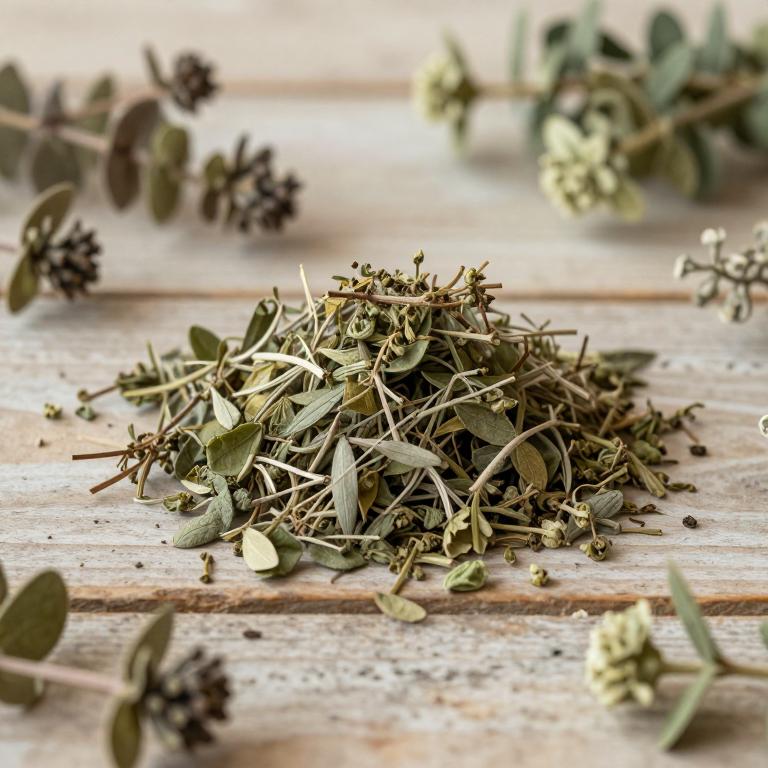
The morphology of Frankenia thymifolia is characterized by its distinct growth form as a shrub, exhibiting a structural habit that often presents as a low-growing, spreading plant. In terms of its physical composition, the species is classified as woody, possessing a lignified stem structure that supports its perennial life cycle and contributes to its resilient, bushy appearance.
- Growth form :
- shrub
- Woodiness :
- woody
Sources: Global Inventory of Floras and Traits (GIFT)
Plant Parts
Frankenia thymifolia has 1 reported plant parts identified across 1 scientific publications and several other databases that are studied for medicinal purposes. The most consistently reported plant part include root.
| Plant part | Supporting sources | Consensus |
|---|---|---|
| Root | 1 supporting sources | ★☆☆☆☆ |
Root
- Evidence-based complementary and alternative medicine : eCAM
Chemicals
Frankenia thymifolia has 3 reported phytochemicals identified across 1 scientific publications and several other databases. The most consistently reported chemicals include Ellagitannin, Gallic acid, Pinoresinol.
| Chemical | Supporting sources | Consensus |
|---|---|---|
| Ellagitannin | 1 supporting sources | ★☆☆☆☆ |
| Gallic acid | 1 supporting sources | ★☆☆☆☆ |
| Pinoresinol | 1 supporting sources | ★☆☆☆☆ |
Ellagitannin
- Evidence-based complementary and alternative medicine : eCAM
Gallic acid
- Evidence-based complementary and alternative medicine : eCAM
Pinoresinol
- Evidence-based complementary and alternative medicine : eCAM
Activities
Frankenia thymifolia has 2 reported activities identified across 1 scientific publications and several other databases. The most consistently reported activities include Antioxidant, Neuroprotective.
| Activity | Supporting sources | Consensus |
|---|---|---|
| Antioxidant | 1 supporting sources | ★☆☆☆☆ |
| Neuroprotective | 1 supporting sources | ★☆☆☆☆ |
Antioxidant
- Evidence-based complementary and alternative medicine : eCAM
Neuroprotective
- Evidence-based complementary and alternative medicine : eCAM
Preparations
Frankenia thymifolia has 2 reported preparations identified across 1 scientific publications and several other databases. The most consistently reported preparations include EtOAc fraction, ethyl acetate (EtOAc) shoot and root fractions.
| Preparation | Supporting sources | Consensus |
|---|---|---|
| Etoac fraction | 1 supporting sources | ★☆☆☆☆ |
| Ethyl acetate (etoac) shoot and root fractions | 1 supporting sources | ★☆☆☆☆ |
Etoac fraction
- Evidence-based complementary and alternative medicine : eCAM
Ethyl acetate (etoac) shoot and root fractions
- Evidence-based complementary and alternative medicine : eCAM