gaenari
Forsythia koreana · Accepted scientific name
Scientific literature: Very Sparse (17 studies) · ★☆☆☆☆
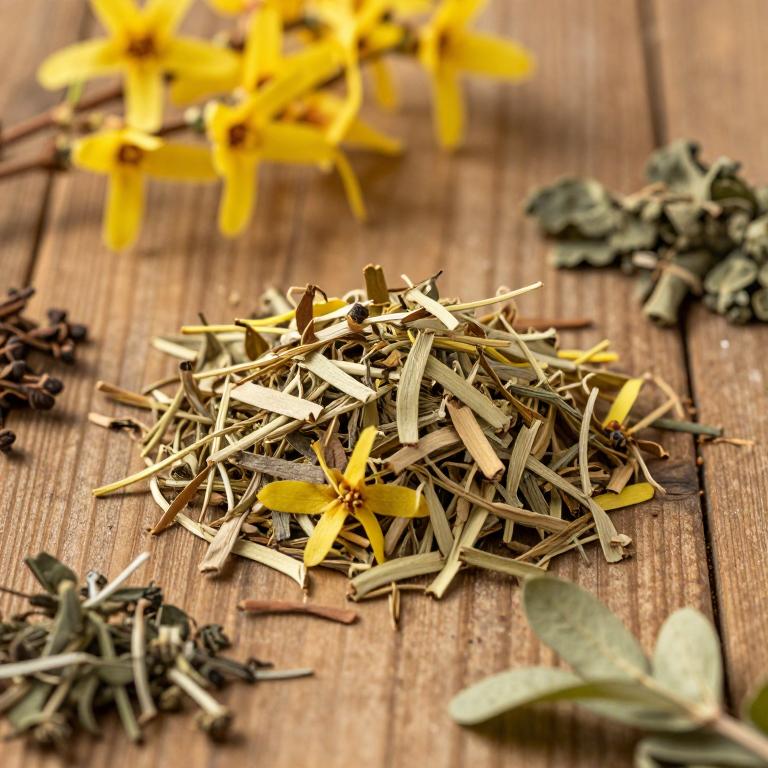
Gaenari, scientifically known as Forsythia koreana, is a resilient deciduous shrub celebrated for its brilliant golden blooms. Beyond its ornamental beauty, this medicinal plant holds significant value in traditional practices, often utilized for its therapeutic properties in treating respiratory ailments and supporting overall wellness through its potent natural compounds.
- Family
- Oleaceae
- Native range
- Asia-Temperate
- Parts used
- Fruit
- Common names
- Gaenari · Korean Goldenbell Tree
- Scientific synonyms
- Rangium Koreanum · Forsythia Koreana F. Autumnalis · 5 more
Names and Synonyms
Common Names
- Gaenari
- Korean goldenbell tree
Scientific Names
Accepted name
Forsythia koreanaSynonyms
- Rangium koreanum
- Forsythia koreana f. autumnalis
- Forsythia viridissima var. koreana
- Forsythia koreana f. pilosa
- Rangium koreanum var. autumnalis
- Forsythia koreana var. autumnalis
- Forsythia pilosa
Sources: Wikidata, Catalogue of Life
Taxonomical Classification
This plant belongs to the kingdom Plantae within the phylum Streptophyta and the class Equisetopsida. It is further classified under the subclass Magnoliidae and the order Lamiales, falling into the family Oleaceae. Finally, its taxonomic identity is defined by the genus Forsythia, specifically the species Forsythia koreana.
| Rank | Classification |
|---|---|
| Kingdom | Plantae |
| Phylum | Streptophyta |
| Class | Equisetopsida |
| Subclass | Magnoliidae |
| Order | Lamiales |
| Family | Oleaceae |
| Genus | Forsythia |
Sources: The World Checklist of Vascular Plants (WCVP)
Distribution
This plant is native to a very specific region within the continent of Eastern Asia. Its primary geographical distribution is centered exclusively within the country of Korea. Because of this limited range, it is considered an endemic species to the Korean peninsula. This localized habitat means that the plant thrives under the particular climatic conditions found in that area. Consequently, its natural occurrence is highly concentrated rather than being widespread across the globe.
| Region | Area |
|---|---|
| Eastern Asia | Korea |
Sources: The World Checklist of Vascular Plants (WCVP)
Botanical Identification
Life history
The life history of Forsythia koreana is characterized by its perennial nature and a growth habit categorized under two distinct life form classifications depending on environmental conditions and seasonal changes: it is primarily a phanerophyte, as it maintains its buds above the ground level during the dormant season, and it can also be described as a nanophanerophyte when considering its relatively compact shrubby stature. As a woody deciduous shrub, its life cycle begins with the emergence of bright yellow flowers in early spring, often appearing before the foliage develops, which facilitates early pollination. Following flowering, the plant undergoes a period of vigorous vegetative growth, developing opposite leaves that facilitate photosynthesis to store energy in its woody stems and root systems. During the autumn, the plant prepares for dormancy as temperatures drop, transitioning into its phanerophyte phase where the perennating buds remain elevated on the branches to survive winter frost. The life history concludes each annual cycle with a period of metabolic quiescence, waiting for the increasing photoperiod and warmth of the following spring to restart the reproductive and vegetative processes.
- Life form :
- nanophanerophyte
- Life form :
- phanerophyte
Morphology
The morphology of Forsythia koreana is characterized by a woody growth habit, forming robust, perennial shrubs. As a terrestrial plant, it grows directly in the soil rather than functioning as an epiphyte, and it maintains an independent life cycle without being a parasite on other organisms. Unlike climbing species, it is not a climber; it lacks the mechanisms for being obligatory, facultative, or self-supporting in a climbing sense, instead establishing a sturdy, upright, and spreading structure through its woody stems.
- Climber :
- self-supporting
- Epiphyte :
- terrestrial
- Parasite :
- independent
- Woodiness :
- woody
Sources: Global Inventory of Floras and Traits (GIFT)
Plant Parts
Forsythia koreana has 1 reported plant parts identified across 1 scientific publications and several other databases that are studied for medicinal purposes. The most consistently reported plant part include fruit.
| Plant part | Supporting sources | Consensus |
|---|---|---|
| Fruit | 1 supporting sources | ★☆☆☆☆ |
Fruit
- Journal of ethnopharmacology
Chemicals
Forsythia koreana has 11 reported phytochemicals identified across 1 scientific publications and several other databases. The most consistently reported chemicals include Acteoside, Arctigenin, Forsythin, Forsythoside A, Lignans.
| Chemical | Supporting sources | Consensus |
|---|---|---|
| Acteoside | 1 supporting sources | ★☆☆☆☆ |
| Arctigenin | 1 supporting sources | ★☆☆☆☆ |
| Forsythin | 1 supporting sources | ★☆☆☆☆ |
| Forsythoside A | 1 supporting sources | ★☆☆☆☆ |
| Lignans | 1 supporting sources | ★☆☆☆☆ |
| MYRISTIC ACID | 1 supporting sources | ★☆☆☆☆ |
| Phylligenin | 1 supporting sources | ★☆☆☆☆ |
| RUTIN | 1 supporting sources | ★☆☆☆☆ |
| n-Heneicosane | 1 supporting sources | ★☆☆☆☆ |
| n-Tetracosane | 1 supporting sources | ★☆☆☆☆ |
Acteoside
- Journal of natural medicines
Arctigenin
- Journal of natural medicines
Forsythin
- Journal of natural medicines
Forsythoside A
- Journal of natural medicines
Lignans
- Journal of natural medicines
MYRISTIC ACID
- Natural product research
Phylligenin
- Journal of ethnopharmacology
RUTIN
- Journal of natural medicines
n-Heneicosane
- Natural product research
n-Tetracosane
- Natural product research
Activities
Forsythia koreana has 1 reported activities identified across 1 scientific publications and several other databases. The most consistently reported activities include Antitumor.
| Activity | Supporting sources | Consensus |
|---|---|---|
| Antitumor | 1 supporting sources | ★☆☆☆☆ |
Antitumor
- PloS one
Conditions
Forsythia koreana has 1 reported investigations on conditions identified across 1 scientific publications and several other databases. The most consistently reported conditions include inflammation.
| Condition | Supporting sources | Consensus |
|---|---|---|
| Inflammation | 1 supporting sources | ★☆☆☆☆ |
Inflammation
- Natural product research
Preparations
Forsythia koreana has 1 reported preparations identified across 1 scientific publications and several other databases. The most consistently reported preparations include methanol extract of Forsythia koreana fruits.
| Preparation | Supporting sources | Consensus |
|---|---|---|
| Methanol extract of forsythia koreana fruits | 1 supporting sources | ★☆☆☆☆ |
Methanol extract of forsythia koreana fruits
- Journal of ethnopharmacology