Emory's barrel cactus
Ferocactus echidne · Accepted scientific name
Scientific literature: Very Sparse (9 studies) · ★☆☆☆☆
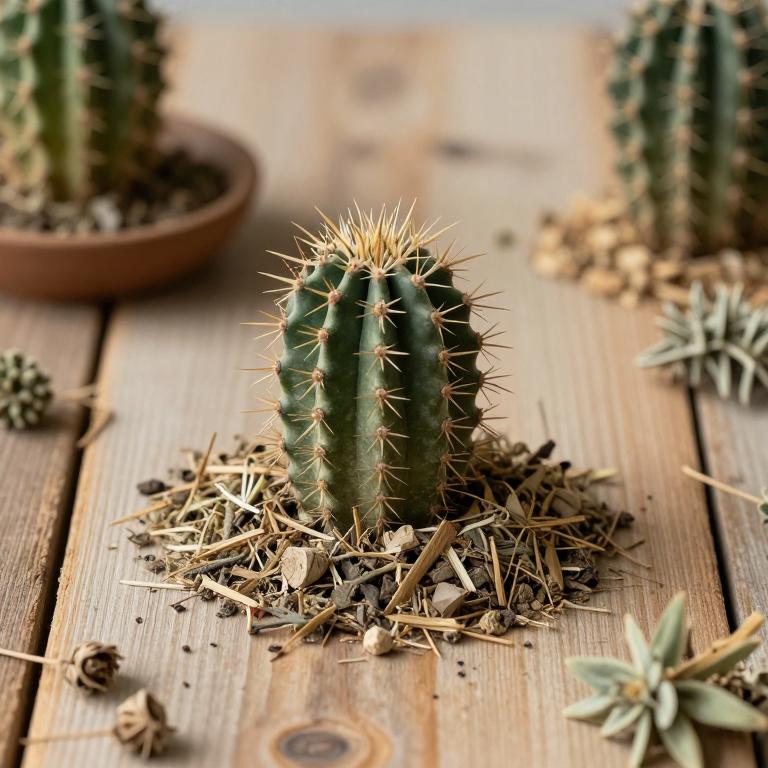
Emory's barrel cactus, scientifically known as Ferocactus echidne, is a resilient succulent native to the arid Southwestern deserts. Renowned for its cylindrical shape and protective spines, this plant holds significant ethnobotanical importance. Historically, indigenous cultures utilized its moisture-rich interior and specialized properties for various traditional medicinal applications.
- Family
- Cactaceae
- Native range
- Northern America
- Parts used
- Not available
- Common names
- Emory'S Barrel Cactus
- Scientific synonyms
- Parrycactus Echidne · Echinocactus Echidne Var. Gilvus · 16 more
Names and Synonyms
Common Names
- Emory's barrel cactus
Scientific Names
Accepted name
Ferocactus echidneSynonyms
- Parrycactus echidne
- Echinocactus echidne var. gilvus
- Ferocactus rafaelensis
- Ferocactus victoriensis
- Ferocactus echidne subsp. victoriensis
- Echinofossulocactus vanderaeyi
- Echinofossulocactus vanderaeyi var. ignotus-longispinus
- Echinocactus echidne
- Echinocactus rafaelensis
- Echinocactus victoriensis
- Echinocactus vanderaeyi
- Echinocactus gilvus
- Echinocactus dolichacanthus
- Echinocactus dolichacanthus var. minor
- Ferocactus echidne var. rhodanthus
- Ferocactus echidne var. victoriensis
- Echinocactus echidne f. gilvus
- Echinofossulocactus echidne
Regional and Traditional Names
Spanish:
- Ferocactus victoriensis
- Echinocactus dolichacanthus var. minor
- Echinofossulocactus echidne
- Echinocactus dolichacanthus
- Ferocactus echidne var. victoriensis
- Echinocactus echidne
- Echinocactus echidne var. gilvus
- Echinofossulocactus vanderaeyi
- Ferocactus rafaelensis
- Echinocactus victoriensis
- Echinocactus vanderaeyi
- Echinocactus echidne f. gilvus
- Echinocactus gilvus
- Ferocactus echidne var. rhodanthus
- Ferocactus rhodanthus
- Echinocactus rafaelensis
- Biznaga barril espinosa
Sources: Wikidata, Catalogue of Life
Taxonomical Classification
This plant belongs to the kingdom Plantae and is classified within the phylum Streptophyta and the class Equisetopsida. It is further organized under the subclass Magnoliidae and the order Caryophyllales. Finally, it is a member of the family Cactaceae and falls under the genus Ferocactus.
| Rank | Classification |
|---|---|
| Kingdom | Plantae |
| Phylum | Streptophyta |
| Class | Equisetopsida |
| Subclass | Magnoliidae |
| Order | Caryophyllales |
| Family | Cactaceae |
| Genus | Ferocactus |
Sources: The World Checklist of Vascular Plants (WCVP)
Distribution
This plant, Ferocactus echidne, exhibits a specific regional presence within the country of Mexico. Its natural habitat is primarily concentrated in the northeastern portions of the nation. Additionally, the species can be found extending into the coastal areas of the Mexican Gulf. These distinct zones define the core boundaries of its existing wild population. Consequently, its distribution is limited to these specific northeastern and gulf-side territories.
| Region | Area |
|---|---|
| Mexico | Mexico Northeast |
| Mexico | Mexico Gulf |
Sources: The World Checklist of Vascular Plants (WCVP)
Chemicals
Ferocactus echidne has 6 reported phytochemicals identified across 0 scientific publications and several other databases. The most consistently reported chemicals include CHLOROGENIC ACID, Diosmetin, Saponins, Tannins, gentisic acid.
| Chemical | Supporting sources | Consensus |
|---|---|---|
| CHLOROGENIC ACID | 1 supporting sources | ★☆☆☆☆ |
| Diosmetin | 1 supporting sources | ★☆☆☆☆ |
| Saponins | 1 supporting sources | ★☆☆☆☆ |
| Tannins | 1 supporting sources | ★☆☆☆☆ |
| gentisic acid | 1 supporting sources | ★☆☆☆☆ |
| nicotinic acid | 1 supporting sources | ★☆☆☆☆ |
CHLOROGENIC ACID
- Plants (Basel, Switzerland)
Diosmetin
- Plants (Basel, Switzerland)
Saponins
- Plants (Basel, Switzerland)
Tannins
- Plants (Basel, Switzerland)
gentisic acid
- Plants (Basel, Switzerland)
nicotinic acid
- Plants (Basel, Switzerland)
Activities
Ferocactus echidne has 3 reported activities identified across 0 scientific publications and several other databases. The most consistently reported activities include Antimicrobial, Antioxidant, Cytotoxic.
| Activity | Supporting sources | Consensus |
|---|---|---|
| Antimicrobial | 1 supporting sources | ★☆☆☆☆ |
| Antioxidant | 1 supporting sources | ★☆☆☆☆ |
| Cytotoxic | 1 supporting sources | ★☆☆☆☆ |
Antimicrobial
- Plants (Basel, Switzerland)
Antioxidant
- Plants (Basel, Switzerland)
Cytotoxic
- Plants (Basel, Switzerland)
Preparations
Ferocactus echidne has 1 reported preparations identified across 0 scientific publications and several other databases. The most consistently reported preparations include ethanol extracts.
| Preparation | Supporting sources | Consensus |
|---|---|---|
| Ethanol extracts | 1 supporting sources | ★☆☆☆☆ |
Ethanol extracts
- Plants (Basel, Switzerland)