Wild Aster
Felicia muricata · Accepted scientific name
Scientific literature: Very Sparse (5 studies) · ★☆☆☆☆
Wild Aster, scientifically known as Felicia muricata, is a resilient perennial herb native to southern Africa. Renowned for its vibrant blue daisy-like blooms, this plant is valued in traditional medicine for its soothing properties. It serves as a hardy addition to gardens, offering both aesthetic beauty and therapeutic potential.
- Family
- Asteraceae
- Native range
- Africa
- Parts used
- Leaf
- Common names
- Pale Felicia · Taai Felicia · 2 more
- Scientific synonyms
- Aster Muricatus
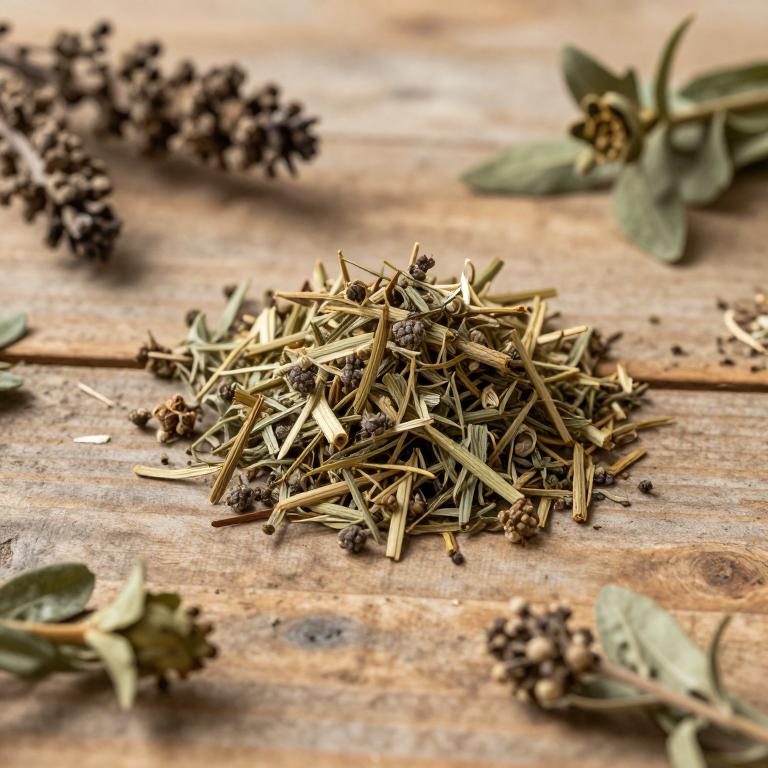
Names and Synonyms
Common Names
- Pale Felicia
- Taai Felicia
- White Felicia
- Wild Aster
Scientific Names
Accepted name
Felicia muricataSynonyms
- Aster muricatus
Sources: Wikidata, Catalogue of Life
Taxonomical Classification
This plant belongs to the kingdom Plantae within the phylum Streptophyta and is classified under the class Equisetopsida. Following the subclass Magnoliidae, it falls under the order Asterales and the family Asteraceae. Ultimately, its taxonomic identity is defined by the genus Felicia.
| Rank | Classification |
|---|---|
| Kingdom | Plantae |
| Phylum | Streptophyta |
| Class | Equisetopsida |
| Subclass | Magnoliidae |
| Order | Asterales |
| Family | Asteraceae |
| Genus | Felicia |
Sources: The World Checklist of Vascular Plants (WCVP)
Distribution
This plant exhibits a diverse range of habitats across several different regions of the African continent. In East Tropical Africa, it can be found growing within the borders of Kenya. Its presence extends into South Tropical Africa, specifically within the territories of Angola and Zimbabwe. Moving further south, the species is also distributed throughout Botswana in Southern Africa. Finally, its geographical reach includes the Cape Provinces of the Southern African region.
| Region | Area |
|---|---|
| East Tropical Africa | Kenya |
| South Tropical Africa | Angola |
| South Tropical Africa | Zimbabwe |
| Southern Africa | Botswana |
| Southern Africa | Cape Provinces |
| Southern Africa | Lesotho |
| Southern Africa | Namibia |
| Southern Africa | KwaZulu-Natal |
| Southern Africa | Free State |
| Southern Africa | Eswatini |
Sources: The World Checklist of Vascular Plants (WCVP)
Botanical Identification
Ecology
The ecology of Felicia muriata is characterized by a remarkably broad altitudinal distribution, allowing it to inhabit diverse topographical landscapes. This species demonstrates significant environmental plasticity, thriving across an expansive elevational range that spans from as low as 10 m AMSL to a maximum altitude of 2600 m AMSL. This vast vertical gradient suggests an ability to adapt to a variety of climatic conditions, ranging from lowland tropical or subtropical environments to cooler, high-altitude montane ecosystems. Such a wide ecological niche enables the plant to colonize multiple life zones, making it resilient to varying temperature regimes and atmospheric pressures throughout its natural habitat.
- Elevational range max:
- 2600 m AMSL
- Elevational range min:
- 10 m AMSL
Life history
The life history of Felicia muricata is characterized by its status as a perennial species, allowing the plant to persist through multiple growing seasons. As a perennial, it maintains a continuous presence in its habitat, often developing a robust root system that supports regrowth after seasonal changes. Its developmental cycle allows it to navigate varying environmental conditions, demonstrating a biological strategy focused on long-term survival rather than the single-season completion seen in annuals. Through its extended lifespan, the plant can undergo multiple reproductive phases, contributing to the stability and longevity of its population within its native ecological niche.
- Lifecycle :
- perennial
Morphology
The morphology of Felicia muricata is characterized by a growth form that transitions between a herb and a shrub, manifesting as a non-woody, self-supporting plant. It functions as an independent organism, neither acting as a parasite nor an epiphyte, as it maintains a terrestrial lifestyle. The plant exhibits a relatively low stature, with a height ranging from a minimum of 0.01 m to a maximum of 0.69 m. Its ecological habit is primarily terrestrial, although it can occupy habitats spanning aquatic, semiaquatic, and terrestrial environments.
- Aquatic :
- terrestrial
- Climber :
- self-supporting
- Epiphyte :
- terrestrial
- Growth form :
- herb
- Growth form :
- shrub
- Parasite :
- independent
- Plant height max:
- 0.69 m
- Plant height min:
- 0.01 m
- Woodiness :
- non-woody
Reproduction
Reproduction in Felicia muriata is characterized by the production of highly uniform seeds, which play a critical role in the dispersal and establishment of new individuals. Quantitative analysis of the seed characteristics reveals a remarkably consistent seed mass across the population, with no observed variance between the minimum and maximum recorded values. Specifically, the seed mass remains constant at a mean, maximum, and minimum value of 0.00011 g. This extreme uniformity in mass suggests a highly stabilized reproductive strategy, ensuring that each seed possesses an identical nutrient reserve to support early germination processes.
- Seed mass mean:
- 0.00011 g
Sources: Global Inventory of Floras and Traits (GIFT)
Plant Parts
Felicia muricata has 1 reported plant parts identified across 1 scientific publications and several other databases that are studied for medicinal purposes. The most consistently reported plant part include leaf.
| Plant part | Supporting sources | Consensus |
|---|---|---|
| Leaf | 1 supporting sources | ★☆☆☆☆ |
Leaf
- African journal of traditional, complementary, and alternative medicines : AJTCAM
Chemicals
Felicia muricata has 4 reported phytochemicals identified across 1 scientific publications and several other databases. The most consistently reported chemicals include Flavonoids, Phenols, Proanthocyanidins, flavonols.
| Chemical | Supporting sources | Consensus |
|---|---|---|
| Flavonoids | 1 supporting sources | ★☆☆☆☆ |
| Phenols | 1 supporting sources | ★☆☆☆☆ |
| Proanthocyanidins | 1 supporting sources | ★☆☆☆☆ |
| flavonols | 1 supporting sources | ★☆☆☆☆ |
Flavonoids
- African journal of traditional, complementary, and alternative medicines : AJTCAM
Phenols
- African journal of traditional, complementary, and alternative medicines : AJTCAM
Proanthocyanidins
- African journal of traditional, complementary, and alternative medicines : AJTCAM
flavonols
- African journal of traditional, complementary, and alternative medicines : AJTCAM
Preparations
Felicia muricata has 2 reported preparations identified across 1 scientific publications and several other databases. The most consistently reported preparations include ethanol extract, water extract.
| Preparation | Supporting sources | Consensus |
|---|---|---|
| Ethanol extract | 1 supporting sources | ★☆☆☆☆ |
| Water extract | 1 supporting sources | ★☆☆☆☆ |
Ethanol extract
- African journal of traditional, complementary, and alternative medicines : AJTCAM
Water extract
- African journal of traditional, complementary, and alternative medicines : AJTCAM