Cherry Ballart
Exocarpos cupressiformis · Accepted scientific name
Scientific literature: Very Sparse (5 studies) · ★☆☆☆☆
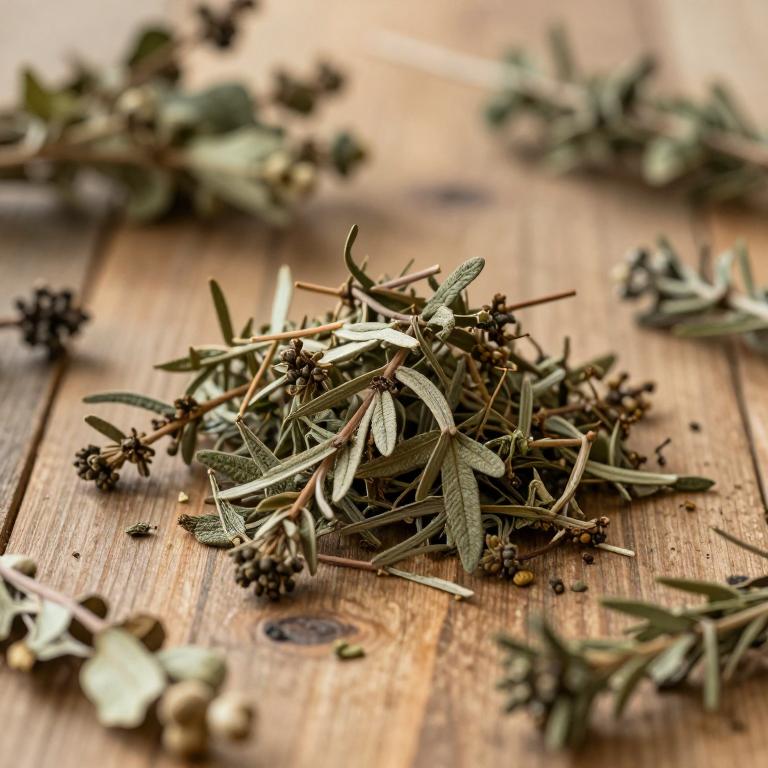
Cherry Ballart, scientifically known as Exocarpos cupressiiformis, is a resilient Australian shrub valued for its traditional medicinal properties. Often found in arid landscapes, this species is utilized by Indigenous communities to treat various ailments. Its unique botanical characteristics and potential therapeutic applications make it a significant subject of ethnobotanical study.
Names and Synonyms
Common Names
- Cherry Ballart
- Cypress Cherry
- Native Cherry
- forest-cherry
- wild cherry
Scientific Names
Accepted name
Exocarpos cupressiformisSynonyms
- Xylophyllos cupressiformis
- Exocarpos dasystachyus
- Exocarpos communis
Sources: Wikidata, Catalogue of Life
Taxonomical Classification
This plant belongs to the kingdom Plantae and is classified within the phylum Streptophyta and the class Equisetopsida. It is further categorized under the subclass Magnoliidae and the order Santalales, falling within the family Santalaceae. Ultimately, its taxonomic identity is defined by the genus Exocarpos, specifically the species Exocarpos cupressiformis.
| Rank | Classification |
|---|---|
| Kingdom | Plantae |
| Phylum | Streptophyta |
| Class | Equisetopsida |
| Subclass | Magnoliidae |
| Order | Santalales |
| Family | Santalaceae |
| Genus | Exocarpos |
Sources: The World Checklist of Vascular Plants (WCVP)
Distribution
This plant is native to several distinct regions across the Australian continent. Its geographical range extends through the state of New South Wales. Additionally, it can be found growing in the tropical and subtropical areas of Queensland. The species is also distributed throughout the southern regions of South Australia and Victoria. Finally, its presence is noted in the island state of Tasmania.
| Region | Area |
|---|---|
| Australia | New South Wales |
| Australia | Queensland |
| Australia | South Australia |
| Australia | Tasmania |
| Australia | Victoria |
Sources: The World Checklist of Vascular Plants (WCVP)
Botanical Identification
Life history
The life history of Exocarpos cupressiformis is characterized by its status as a perennial species, allowing it to persist in its environment over many growing seasons. Unlike annuals that complete their life cycle in a single year or biennials that require two, this plant maintains a long-term presence, establishing a stable foundation within its ecological niche. This perennial lifecycle enables the plant to undergo repeated reproductive cycles, contributing to its sustained development and long-term survival within its natural habitat.
- Lifecycle :
- perennial
Morphology
The morphology of Exocarpos cupressiformis is characterized by a woody growth form that can manifest as both a shrub and a tree. This species is primarily terrestrial in its habitat, rather than aquatic or epiphytic, and functions as an independent organism without parasitic tendencies. Structurally, it is a self-supporting plant that does not exhibit climbing behavior. In terms of stature, the plant displays significant vertical development, with a height ranging from a minimum of 3 meters to a maximum of 10 meters.
- Aquatic :
- terrestrial
- Climber :
- self-supporting
- Epiphyte :
- terrestrial
- Growth form :
- tree
- Growth form :
- shrub
- Parasite :
- independent
- Plant height max:
- 10 m
- Plant height min:
- 3 m
- Woodiness :
- woody
Physiology
The physiology of Exocarpos cupressiformis is characterized by a specialized photosynthetic mechanism and specific morphological adaptations related to its foliage. The plant utilizes the C3 photosynthetic pathway, a process wherein carbon dioxide is fixed directly into a three-carbon compound during the Calvin cycle, a characteristic common among many woody species in temperate and subtropical environments. In terms of its vegetative structure, the plant exhibits highly reduced leaf morphology; the leaf length is notably minute, reaching a maximum value of only 0.05 cm. This extreme reduction in leaf surface area is a physiological adaptation likely aimed at minimizing transpiration and managing water loss, reflecting a specialized evolutionary strategy for its specific ecological niche.
- Leaf length max:
- 0.05 cm
- Photosynthetic pathway :
- C3
Reproduction
The reproduction of Exocarpos cupressiformis is characterized by a specific phenological cycle and specialized dispersal mechanisms. The flowering period for this species begins in October and concludes in May, demonstrating a seasonal pattern that spans several months. Following pollination, the plant produces seeds with a highly consistent mass; the mean, maximum, and minimum seed mass are all recorded at 0.08005 g, indicating a uniform seed size. In terms of propagation, the species utilizes a zoochorous dispersal syndrome, meaning its seeds are primarily spread by animals, which plays a critical role in the plant's ability to colonize new habitats and maintain genetic diversity within its ecosystem.
- Dispersal syndrome :
- zoochorous
- Flowering time :
- Oct
- Flowering time :
- May
- Seed mass mean:
- 0.08005 g
Sources: Global Inventory of Floras and Traits (GIFT)
Plant Parts
Exocarpos cupressiformis has 1 reported plant parts identified across 1 scientific publications and several other databases that are studied for medicinal purposes. The most consistently reported plant part include leaf.
| Plant part | Supporting sources | Consensus |
|---|---|---|
| Leaf | 1 supporting sources | ★☆☆☆☆ |
Leaf
- Molecules (Basel, Switzerland)
Chemicals
Exocarpos cupressiformis has 4 reported phytochemicals identified across 1 scientific publications and several other databases. The most consistently reported chemicals include (+)-catechin, (-)-Epicatechin, Gallic acid, Tannins.
| Chemical | Supporting sources | Consensus |
|---|---|---|
| (+)-catechin | 1 supporting sources | ★☆☆☆☆ |
| (-)-Epicatechin | 1 supporting sources | ★☆☆☆☆ |
| Gallic acid | 1 supporting sources | ★☆☆☆☆ |
| Tannins | 1 supporting sources | ★☆☆☆☆ |
(+)-catechin
- Molecules (Basel, Switzerland)
(-)-Epicatechin
- Molecules (Basel, Switzerland)
Gallic acid
- Molecules (Basel, Switzerland)
Tannins
- Molecules (Basel, Switzerland)