Mediterranean Spurge
Euphorbia characias · Accepted scientific name
Scientific literature: Very Sparse (7 studies) · ★☆☆☆☆
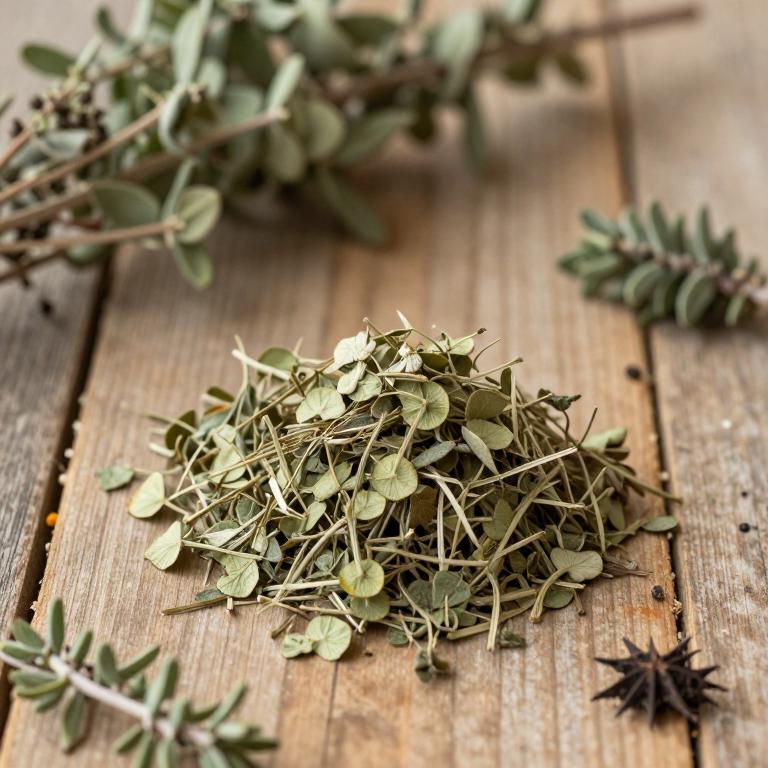
Mediterranean Spurge, scientifically known as Euphorbia characias, is a striking, evergreen perennial native to the Mediterranean region. Renowned for its architectural blue-green foliage and dramatic yellowish bracts, it is a staple in xeriscaping. While visually stunning, its milky sap requires careful handling due to its skin-irritating properties.
- Family
- Euphorbiaceae
- Native range
- Europe
- Parts used
- Not available
- Common names
- Mediterranean Spurge · Albanian Spurge · 1 more
- Scientific synonyms
- Esula Characias · Tithymalus Characias
Names and Synonyms
Common Names
- Mediterranean Spurge
- Albanian spurge
- large Mediterranean spurge
Scientific Names
Accepted name
Euphorbia characiasSynonyms
- Esula characias
- Tithymalus characias
Regional and Traditional Names
Spanish:
- caracias
- euforbia encarnada
- euforbia macho
- hierba topera
- lechetrezna encarnada
- lechetrezna macho
German:
- Palisaden-Wolfsmilch
- Palisaden-Wolfsmilch
French:
- Euphorbe characias
- euphorbe characias
- euphorbe des garrigues
- euphorbe des vallons
Sources: Wikidata, Catalogue of Life
Taxonomical Classification
This plant belongs to the kingdom Plantae and the phylum Streptophyta, falling under the class Equisetopsida and subclass Magnoliidae. Within the order Malpighiales, it is classified under the family Euphorbiaceae. Finally, its specific taxonomic placement is within the genus Euphorbia.
| Rank | Classification |
|---|---|
| Kingdom | Plantae |
| Phylum | Streptophyta |
| Class | Equisetopsida |
| Subclass | Magnoliidae |
| Order | Malpighiales |
| Family | Euphorbiaceae |
| Genus | Euphorbia |
Sources: The World Checklist of Vascular Plants (WCVP)
Distribution
This plant exhibits a diverse geographical distribution across several regions of the European continent. In Northern Europe, its presence can be observed within Great Britain. Moving toward Middle Europe, the species is found growing in Germany. The plant also extends into Southwestern Europe, specifically inhabiting the Baleares and Corse. Finally, its range continues through the landscapes of France.
| Region | Area |
|---|---|
| Northern Europe | Great Britain |
| Middle Europe | Germany |
| Southwestern Europe | Baleares |
| Southwestern Europe | Corse |
| Southwestern Europe | France |
| Southwestern Europe | Portugal |
| Southwestern Europe | Sardegna |
| Southwestern Europe | Spain |
| Southeastern Europe | Albania |
| Southeastern Europe | Greece |
Sources: The World Checklist of Vascular Plants (WCVP)
Botanical Identification
Ecology
The ecology of Euphorbia characias is defined by its preference for lowland environments, thriving in specific topographical conditions that favor its growth patterns. It is typically found across a broad altitudinal gradient, ranging from sea level up to a maximum elevation of 500 m AMSL. This low-altitude distribution suggests an adaptation to warmer, more stable climate zones characteristic of lowland habitats, where it can effectively establish itself within its ecological niche.
- Elevational range max:
- 500 m AMSL
- Elevational range min:
- 0 m AMSL
- Habitat :
- Lowland
Life history
The life history of Euphorbia characias is characterized by a perennial lifecycle, allowing the plant to establish a long-term presence within its ecosystem. Classified as a chamaephyte, its growth form is defined by buds located close to the soil surface, which helps it navigate its specific environmental niches. Throughout its existence, the plant maintains an evergreen deciduousness, ensuring that its structural foliage remains functional and present across various seasons rather than shedding all leaves annually.
- Deciduousness :
- evergreen
- Life form :
- chamaephyte
- Lifecycle :
- perennial
Morphology
The morphology of Euphorbia characias is characterized by a self-supporting growth habit, functioning as an independent organism without parasitic or epiphytic tendencies. It is a terrestrial plant that exhibits a woody structure, typically manifesting as a shrub or a herbaceous form. In terms of stature, the plant reaches a mean height of approximately 0.65 m, though it can attain a maximum height of up to 1.2 m. As a self-supporting species, it does not possess climbing tendencies such as vines or lianas, maintaining a stable, upright presence in its natural habitat.
- Aquatic :
- terrestrial
- Climber :
- self-supporting
- Epiphyte :
- terrestrial
- Growth form :
- shrub
- Growth form :
- herb
- Parasite :
- independent
- Plant height max:
- 1.2 m
- Plant height mean:
- 0.65 m
- Woodiness :
- woody
Physiology
The physiology of Euphorbia characias is characterized by a specialized metabolic and morphological structure adapted to its growth environment. It utilizes a C3 photosynthetic pathway, which involves the direct fixation of carbon dioxide through the Calvin cycle, typical of many temperate perennials. In terms of its vegetative morphology, the plant produces distinct foliage where the leaf length reaches a maximum of 7 cm. Furthermore, from a nutritional standpoint, the species does not function as a nitrogen fixer, meaning it relies on the availability of soil nitrates and ammonium rather than symbiotic relationships with nitrogen-fixing bacteria to satisfy its nitrogen requirements.
- Leaf length max:
- 7 cm
- Nitrogen fixer :
- no
- Photosynthetic pathway :
- C3
Reproduction
The reproduction of Euphorbia characias is characterized by a predominantly biotic pollination syndrome, relying on insects to facilitate the transfer of pollen. The plant produces dry fruits that contain seeds with a highly consistent length, measuring exactly 3 mm (ranging from a minimum to a maximum of 3 mm). Regarding seed dispersal, the species exhibits an unspecialized syndrome, though it is also noted for anthropochorous dispersal, meaning it can be spread by human activity. Furthermore, asexual reproduction is absent in this species, meaning it relies on sexual processes for propagation.
- Dispersal syndrome :
- unspecialized
- Dispersal syndrome :
- anthropochorous
- Fruit dryness :
- dry
- Pollination syndrome :
- insect
- Pollination syndrome :
- biotic
- Reproduction asexual :
- absent
- Seed length mean:
- 3 mm
Sources: Global Inventory of Floras and Traits (GIFT)
Chemicals
Euphorbia characias has 2 reported phytochemicals identified across 0 scientific publications and several other databases. The most consistently reported chemicals include Flavonoids, topaquinone.
| Chemical | Supporting sources | Consensus |
|---|---|---|
| Flavonoids | 1 supporting sources | ★☆☆☆☆ |
| topaquinone | 1 supporting sources | ★☆☆☆☆ |
Flavonoids
- Fitoterapia
topaquinone
- Journal of enzyme inhibition and medicinal chemistry
Conditions
Euphorbia characias has 4 reported investigations on conditions identified across 0 scientific publications and several other databases. The most consistently reported conditions include Candida albicans, HIV, warts, wounds.
| Condition | Supporting sources | Consensus |
|---|---|---|
| Candida albicans | 1 supporting sources | ★☆☆☆☆ |
| Hiv | 1 supporting sources | ★☆☆☆☆ |
| Warts | 1 supporting sources | ★☆☆☆☆ |
| Wounds | 1 supporting sources | ★☆☆☆☆ |
Candida albicans
- Journal of ethnopharmacology
Hiv
- Fitoterapia
Warts
- Journal of ethnopharmacology
Wounds
- Journal of ethnopharmacology
Preparations
Euphorbia characias has 2 reported preparations identified across 0 scientific publications and several other databases. The most consistently reported preparations include crude latex, latex.
| Preparation | Supporting sources | Consensus |
|---|---|---|
| Crude latex | 1 supporting sources | ★☆☆☆☆ |
| Latex | 1 supporting sources | ★☆☆☆☆ |
Crude latex
- Journal of ethnopharmacology
Latex
- Journal of ethnopharmacology