Small-leaved guarri, Fynblaarghwarrie
Euclea undulata · Accepted scientific name
Scientific literature: Very Sparse (34 studies) · ★☆☆☆☆
Small-leaved guarri, Fynblaarghwarrie, scientifically known as Euclea undulata, is a resilient, evergreen shrub native to Southern Africa. Renowned for its hardiness, this versatile plant holds significant ethnobotanical value. Traditionally used in various medicinal practices, it serves as a vital resource for treating ailments and supporting local biodiversity.
- Family
- Ebenaceae
- Native range
- Africa
- Parts used
- Root
- Common names
- Small-Leaved Guarri · Common Gwarrie · 5 more
- Scientific synonyms
- Euclea Undulata Var. Myrtina · Euclea Myrtina
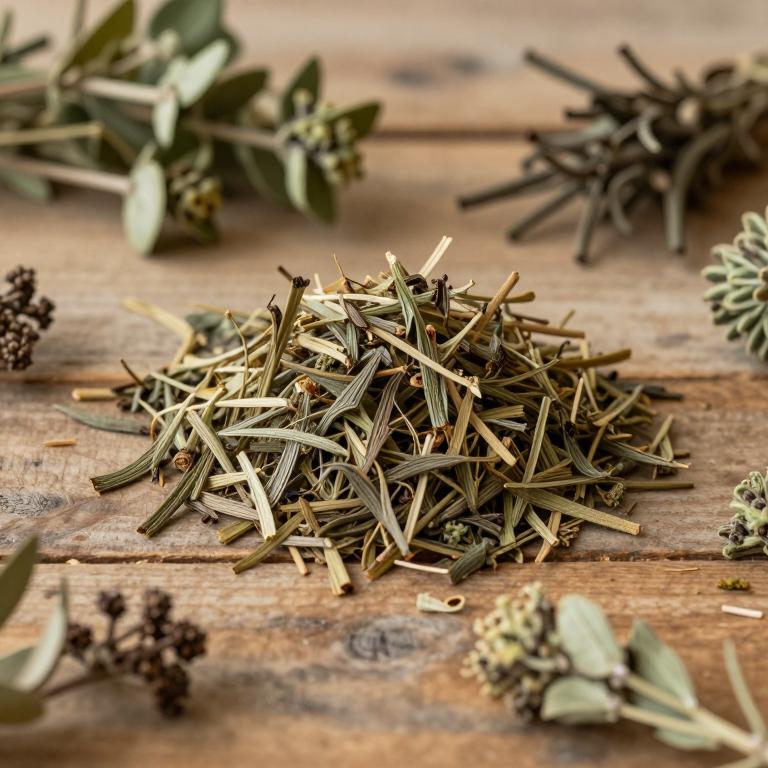
Names and Synonyms
Common Names
- Small-leaved Guarri
- Common Gwarrie
- Fire Fighter's Blessing
- Guarri Bush
- Guarriwood
- Gwarrie
- Thicket Euclea
Scientific Names
Accepted name
Euclea undulataSynonyms
- Euclea undulata var. myrtina
- Euclea myrtina
Regional and Traditional Names
German:
- Bergebenholzstrauch
- Feuerbusch
- Gemeiner Quarrenbusch
- Bergebenholzstrauch · Ndebele: Ihlangula
Sources: Wikidata, Catalogue of Life
Taxonomical Classification
This plant belongs to the kingdom Plantae and is classified under the phylum Streptophyta and the class Equisetopsida. Within the subclass Magnoliidae and the order Ericales, it is further categorized into the family Ebenaceae. Finally, it is identified by the genus Euclea, specifically as the species Euclea undulata.
| Rank | Classification |
|---|---|
| Kingdom | Plantae |
| Phylum | Streptophyta |
| Class | Equisetopsida |
| Subclass | Magnoliidae |
| Order | Ericales |
| Family | Ebenaceae |
| Genus | Euclea |
Sources: The World Checklist of Vascular Plants (WCVP)
Distribution
This plant exhibits a broad distribution across several key regions of the African continent. In South Tropical Africa, it can be found growing within the borders of Mozambique and Zimbabwe. Its presence extends into Southern Africa, where it is documented in Botswana and the Cape Provinces. Additionally, the species is known to inhabit the Caprivi Strip. Together, these locations highlight the diverse habitats occupied by Euclea undulata.
| Region | Area |
|---|---|
| South Tropical Africa | Mozambique |
| South Tropical Africa | Zimbabwe |
| Southern Africa | Botswana |
| Southern Africa | Cape Provinces |
| Southern Africa | Caprivi Strip |
| Southern Africa | Namibia |
| Southern Africa | KwaZulu-Natal |
| Southern Africa | Free State |
| Southern Africa | Eswatini |
| Southern Africa | Northern Provinces |
Sources: The World Checklist of Vascular Plants (WCVP)
Botanical Identification
Ecology
The ecology of Euclea undulata is defined by its adaptability to diverse topographic gradients and varying environmental conditions. This species is found across a broad vertical distribution, inhabiting environments ranging from low-lying coastal or riverine areas to more significant montane elevations. Specifically, its elevational range spans from a minimum of 6 m AMSL to a maximum of 1300 m AMSL. This wide altitudinal breadth suggests a high tolerance for varying temperature regimes and moisture levels, allowing it to establish itself in various woodland and forest ecosystems within its geographical range.
- Elevational range max:
- 1300 m AMSL
- Elevational range min:
- 6 m AMSL
Life history
The life history of Euclea undulata is characterized by a perennial lifecycle, allowing it to establish long-term presence within its natural ecosystem. As a phanerophyte, the plant maintains its stem tissue well above the ground, typically manifesting as a woody shrub or small tree. Its growth strategy is further defined by its evergreen deciduousness, meaning it retains its foliage throughout the year rather than shedding it seasonally. Depending on its specific environmental niche and growth stage, its structural habit may also be classified as a nanophanerophyte, reflecting its ability to maintain small, woody branches above the soil surface.
- Deciduousness :
- evergreen
- Life form :
- nanophanerophyte
- Life form :
- phanerophyte
- Lifecycle :
- perennial
Morphology
The morphology of Euclea undulata is characterized by its robust and woody growth form, primarily manifesting as a shrub or a tree. As a terrestrial plant, it maintains an independent existence, functioning as a non-parasitic and non-epiphytic species. The plant is self-supporting rather than a climber, exhibiting a structural habit that allows it to stand firmly within its habitat. In terms of stature, it displays significant size variability, with plant heights ranging from a minimum of 0.5 m to a maximum of 7 m, maintaining an average height of approximately 4 m.
- Aquatic :
- terrestrial
- Climber :
- self-supporting
- Epiphyte :
- terrestrial
- Growth form :
- shrub
- Growth form :
- tree
- Parasite :
- independent
- Plant height max:
- 7 m
- Plant height mean:
- 4 m
- Plant height min:
- 0.5 m
- Woodiness :
- woody
Physiology
The physiology of Euclelea undulata is characterized by its metabolic adaptations to the semi-arid and savanna environments of Southern Africa, where it functions as a resilient woody perennial. Its physiological processes are heavily oriented toward drought tolerance and efficient water use, often employing sclerophyllous leaf structures to minimize transpiration during periods of high evaporative demand. The plant's carbon assimilation and nutrient cycling are dictated by its root system's ability to scavenge moisture and minerals from varying soil depths. Regarding its role in soil nutrient enrichment, Euclea undulata is not a nitrogen fixer; it lacks the symbiotic relationship with diazotrophic bacteria, such as Rhizobium, that would allow it to convert atmospheric nitrogen into bioavailable forms, meaning its nitrogen uptake is entirely dependent on the existing organic and inorganic nitrogen available within the soil profile.
- Nitrogen fixer :
- no
Reproduction
The reproduction of Euclea undulata is characterized by a specialized biological process that relies on external agents for success. The species exhibits an absence of self-fertilization, indicating a reliance on cross-pollination to maintain genetic diversity. Following successful fertilization, the plant produces seeds that follow a zoochorous dispersal syndrome, meaning they are distributed by animals. These seeds possess specific physical dimensions, maintaining a consistent seed volume of 34 mm³ (with both minimum and maximum values recorded at this measurement). The mass of the seeds also shows slight variation, with a minimum mass of 0.03311 g, a maximum mass of 0.04338 g, and an average seed mass of approximately 0.037193333 g.
- Dispersal syndrome :
- zoochorous
- Seed mass max:
- 0.04338 g
- Seed mass mean:
- 0.037193333 g
- Seed mass min:
- 0.03311 g
- Seed volume max:
- 34 mm³
- Self fertilization :
- absent
Sources: Global Inventory of Floras and Traits (GIFT)
Plant Parts
Euclea undulata has 1 reported plant parts identified across 1 scientific publications and several other databases that are studied for medicinal purposes. The most consistently reported plant part include root.
| Plant part | Supporting sources | Consensus |
|---|---|---|
| Root | 1 supporting sources | ★☆☆☆☆ |
Root
- Journal of ethnopharmacology
Chemicals
Euclea undulata has 7 reported phytochemicals identified across 1 scientific publications and several other databases. The most consistently reported chemicals include Fatty acids, Flavonoids, Glycosides, Naphthoquinones, Phytosterols.
| Chemical | Supporting sources | Consensus |
|---|---|---|
| Fatty acids | 1 supporting sources | ★☆☆☆☆ |
| Flavonoids | 1 supporting sources | ★☆☆☆☆ |
| Glycosides | 1 supporting sources | ★☆☆☆☆ |
| Naphthoquinones | 1 supporting sources | ★☆☆☆☆ |
| Phytosterols | 1 supporting sources | ★☆☆☆☆ |
| Saponins | 1 supporting sources | ★☆☆☆☆ |
| Tannins | 1 supporting sources | ★☆☆☆☆ |
Fatty acids
- Asian Pacific journal of tropical medicine
Flavonoids
- Asian Pacific journal of tropical medicine
Glycosides
- Asian Pacific journal of tropical medicine
Naphthoquinones
- Asian Pacific journal of tropical medicine
Phytosterols
- Asian Pacific journal of tropical medicine
Saponins
- Asian Pacific journal of tropical medicine
Tannins
- Asian Pacific journal of tropical medicine
Activities
Euclea undulata has 4 reported activities identified across 1 scientific publications and several other databases. The most consistently reported activities include Anticholinesterase, Antimicrobial, Antioxidant, Antiplasmodial.
| Activity | Supporting sources | Consensus |
|---|---|---|
| Anticholinesterase | 1 supporting sources | ★☆☆☆☆ |
| Antimicrobial | 1 supporting sources | ★☆☆☆☆ |
| Antioxidant | 1 supporting sources | ★☆☆☆☆ |
| Antiplasmodial | 1 supporting sources | ★☆☆☆☆ |
Anticholinesterase
- Asian Pacific journal of tropical medicine
Antimicrobial
- Asian Pacific journal of tropical medicine
Antioxidant
- Asian Pacific journal of tropical medicine
Antiplasmodial
- Asian Pacific journal of tropical medicine
Conditions
Euclea undulata has 4 reported investigations on conditions identified across 1 scientific publications and several other databases. The most consistently reported conditions include cough, headaches, heart diseases, toothaches.
| Condition | Supporting sources | Consensus |
|---|---|---|
| Cough | 1 supporting sources | ★☆☆☆☆ |
| Headaches | 1 supporting sources | ★☆☆☆☆ |
| Heart diseases | 1 supporting sources | ★☆☆☆☆ |
| Toothaches | 1 supporting sources | ★☆☆☆☆ |
Cough
- Asian Pacific journal of tropical medicine
Headaches
- Asian Pacific journal of tropical medicine
Heart diseases
- Asian Pacific journal of tropical medicine
Toothaches
- Asian Pacific journal of tropical medicine
Preparations
Euclea undulata has 5 reported preparations identified across 1 scientific publications and several other databases. The most consistently reported preparations include Acetone plant extracts, decoctions of the bark, decoctions of the leaves, decoctions of the roots, extracts of these plant parts.
| Preparation | Supporting sources | Consensus |
|---|---|---|
| Acetone plant extracts | 1 supporting sources | ★☆☆☆☆ |
| Decoctions of the bark | 1 supporting sources | ★☆☆☆☆ |
| Decoctions of the leaves | 1 supporting sources | ★☆☆☆☆ |
| Decoctions of the roots | 1 supporting sources | ★☆☆☆☆ |
| Extracts of these plant parts | 1 supporting sources | ★☆☆☆☆ |
Acetone plant extracts
- Journal of ethnopharmacology
Decoctions of the bark
- Asian Pacific journal of tropical medicine
Decoctions of the leaves
- Asian Pacific journal of tropical medicine
Decoctions of the roots
- Asian Pacific journal of tropical medicine
Extracts of these plant parts
- Asian Pacific journal of tropical medicine