Blue guarri
Euclea crispa · Accepted scientific name
Scientific literature: Very Sparse (20 studies) · ★☆☆☆☆
Blue guarri, scientifically known as Euclea crispa, is a versatile evergreen shrub native to Southern Africa. Renowned for its medicinal properties, this plant is widely utilized in traditional healing to treat various ailments, including skin infections, digestive issues, and inflammation, making it a significant botanical resource in ethnobotany.
- Family
- Ebenaceae
- Native range
- Africa
- Parts used
- Leaf
- Common names
- Blue Guarri · Blue Leaved Euclea · 1 more
- Scientific synonyms
- Celastrus Crispus
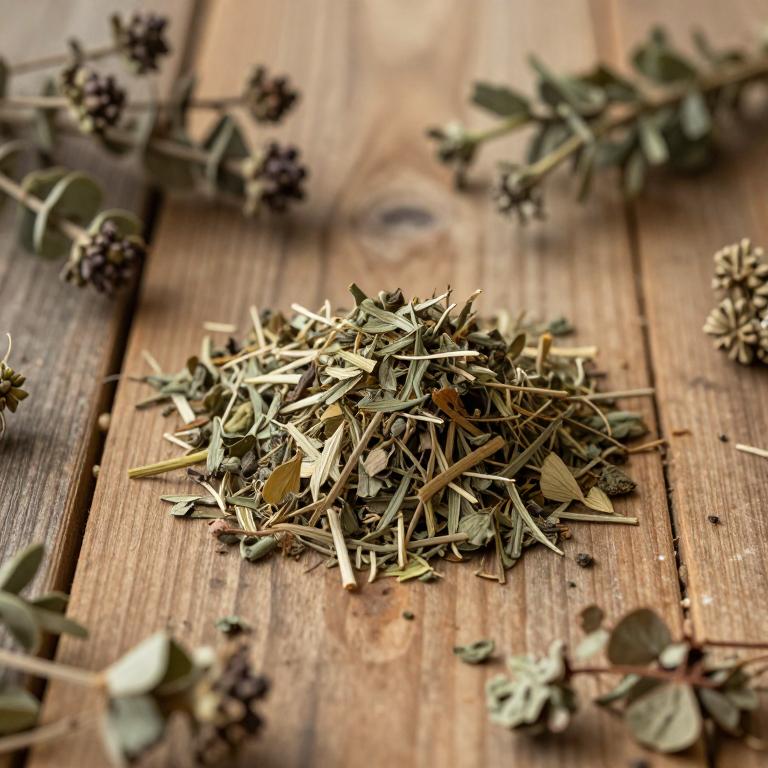
Names and Synonyms
Common Names
- Blue Guarri
- Blue Leaved Euclea
- Blue Gwarrie
Scientific Names
Accepted name
Euclea crispaSynonyms
- Celastrus crispus
Sources: Wikidata, Catalogue of Life
Taxonomical Classification
This plant belongs to the kingdom Plantae within the phylum Streptophyta and the class Equisetopsida. It is further classified under the subclass Magnoliidae and the order Ericales. Finally, it is a member of the family Ebenaceae and is situated within the genus Euclea.
| Rank | Classification |
|---|---|
| Kingdom | Plantae |
| Phylum | Streptophyta |
| Class | Equisetopsida |
| Subclass | Magnoliidae |
| Order | Ericales |
| Family | Ebenaceae |
| Genus | Euclea |
Sources: The World Checklist of Vascular Plants (WCVP)
Distribution
This plant, Euclea crispa, exhibits a specific geographical distribution throughout the South Tropical Africa region. It can be found growing within the borders of Angola, where it thrives in local ecosystems. The species also extends its range into Malawi, contributing to the area's floral diversity. Furthermore, its presence is well-documented across Mozambique and Zambia. Finally, the distribution of this medicinal plant reaches into Zimbabwe, completing its regional footprint.
| Region | Area |
|---|---|
| South Tropical Africa | Angola |
| South Tropical Africa | Malawi |
| South Tropical Africa | Mozambique |
| South Tropical Africa | Zambia |
| South Tropical Africa | Zimbabwe |
| Southern Africa | Botswana |
| Southern Africa | Cape Provinces |
| Southern Africa | Lesotho |
| Southern Africa | KwaZulu-Natal |
| Southern Africa | Free State |
Sources: The World Checklist of Vascular Plants (WCVP)
Botanical Identification
Ecology
The ecology of Euclea crispa is characterized by its prevalence within forest ecosystems, where it thrives under various canopy conditions. This species exhibits a broad altitudinal distribution, demonstrating significant adaptability to diverse topographic gradients. It can be found inhabiting environments ranging from low-lying areas at an elevation of 45 m AMSL to much higher montane regions, reaching a maximum elevation of 2200 m AMSL.
- Elevational range max:
- 2200 m AMSL
- Elevational range min:
- 45 m AMSL
- Habitat :
- forest
Life history
The life history of Euclea crispa is characterized by a perennial lifecycle, allowing the plant to persist in its habitat over many growing seasons. As a phanerophyte, it maintains its stem system above the ground, typically developing into a woody shrub or small tree. Its growth habit is further categorized as a nanophanerophyte, reflecting its structural scale within its ecosystem. Throughout its existence, the plant exhibits an evergreen deciduousness, meaning it retains its foliage year-round rather than shedding all its leaves seasonally.
- Deciduousness :
- evergreen
- Life form :
- nanophanerophyte
- Life form :
- phanerophyte
- Lifecycle :
- perennial
Morphology
The morphology of Euclea crispa is characterized by its growth form as a woody shrub, exhibiting a self-supporting structure rather than acting as a climber or vine. As a terrestrial species, it does not exhibit aquatic or epiphytic tendencies and functions as an independent organism without parasitic behavior. The plant displays significant variation in size, with heights ranging from a minimum of 0.3 m to a maximum of 9 m, maintaining a mean height of approximately 6.5 m.
- Aquatic :
- terrestrial
- Climber :
- self-supporting
- Epiphyte :
- terrestrial
- Growth form :
- shrub
- Parasite :
- independent
- Plant height max:
- 9 m
- Plant height mean:
- 6.5 m
- Plant height min:
- 0.3 m
- Woodiness :
- woody
Physiology
The physiology of Euclea crispa is characterized by its complex metabolic processes and specific nutritional strategies within its ecosystem. As a woody shrub or small tree, its physiological framework focuses on efficient resource acquisition and structural integrity through secondary metabolite production. Regarding its nutrient cycling capabilities, the plant is not a nitrogen fixer; it does not possess the symbiotic relationship with nitrogen-fixing bacteria required to convert atmospheric nitrogen into bioavailable forms, meaning its nitrogen uptake is entirely dependent on the availability of nitrates or ammonium in the soil. Its metabolic activity involves the synthesis of various bioactive compounds, including tannins and glycosides, which serve physiological roles in defense against herbivory and environmental stressors. Furthermore, its photosynthetic efficiency and transpiration rates are adapted to its specific habitat, allowing it to maintain water balance and energy production through regulated stomatal conductance and robust cellular respiration.
- Nitrogen fixer :
- no
Reproduction
The reproduction of Euclea crispa is characterized by specific reproductive strategies and seed morphological traits. In terms of its breeding system, the plant exhibits a lack of self-fertilization, as the trait for self-fertilization is documented as absent, suggesting a reliance on cross-pollination mechanisms to ensure genetic diversity. The resulting seeds demonstrate a relatively consistent mass profile; the mean seed mass is recorded at 0.12144 g. Individual seed weights show slight variations, ranging from a minimum mass of 0.10818 g to a maximum mass of 0.1347 g.
- Seed mass max:
- 0.1347 g
- Seed mass mean:
- 0.12144 g
- Seed mass min:
- 0.10818 g
- Self fertilization :
- absent
Sources: Global Inventory of Floras and Traits (GIFT)
Plant Parts
Euclea crispa has 1 reported plant parts identified across 1 scientific publications and several other databases that are studied for medicinal purposes. The most consistently reported plant part include leaf.
| Plant part | Supporting sources | Consensus |
|---|---|---|
| Leaf | 1 supporting sources | ★☆☆☆☆ |
Leaf
- Journal of pharmacy & bioallied sciences
Chemicals
Euclea crispa has 4 reported phytochemicals identified across 1 scientific publications and several other databases. The most consistently reported chemicals include 6-(4,6-DIOXO-1,4,5,6-TETRAHYDROPYRIMIDIN-2-YL-AMINO)HEXANOIC ACID TRIFLUOROACETATE, Betulin, hydrocortisone acetate, phenyl glucuronide.
| Chemical | Supporting sources | Consensus |
|---|---|---|
| 6-(4,6-DIOXO-1,4,5,6-TETRAHYDROPYRIMIDIN-2-YL-AMINO)HEXANOIC ACID TRIFLUOROACETATE | 1 supporting sources | ★☆☆☆☆ |
| Betulin | 1 supporting sources | ★☆☆☆☆ |
| hydrocortisone acetate | 1 supporting sources | ★☆☆☆☆ |
| phenyl glucuronide | 1 supporting sources | ★☆☆☆☆ |
6-(4,6-DIOXO-1,4,5,6-TETRAHYDROPYRIMIDIN-2-YL-AMINO)HEXANOIC ACID TRIFLUOROACETATE
- Journal of pharmacy & bioallied sciences
Betulin
- Dr. Duke
hydrocortisone acetate
- Journal of pharmacy & bioallied sciences
phenyl glucuronide
- Journal of pharmacy & bioallied sciences
Activities
Euclea crispa has 12 reported activities identified across 1 scientific publications and several other databases. The most consistently reported activities include AntiHIV, Anticarcinomic, Antifeedant, Antiflu, Antiinflammatory.
| Activity | Supporting sources | Consensus |
|---|---|---|
| AntiHIV | 1 supporting sources | ★☆☆☆☆ |
| Anticarcinomic | 1 supporting sources | ★☆☆☆☆ |
| Antifeedant | 1 supporting sources | ★☆☆☆☆ |
| Antiflu | 1 supporting sources | ★☆☆☆☆ |
| Antiinflammatory | 1 supporting sources | ★☆☆☆☆ |
| Antitumor | 1 supporting sources | ★☆☆☆☆ |
| Antiviral | 1 supporting sources | ★☆☆☆☆ |
| Aphidifuge | 1 supporting sources | ★☆☆☆☆ |
| Cytotoxic | 1 supporting sources | ★☆☆☆☆ |
| Hypolipemic | 1 supporting sources | ★☆☆☆☆ |
AntiHIV
- Dr. Duke
Anticarcinomic
- Dr. Duke
Antifeedant
- Dr. Duke
Antiflu
- Dr. Duke
Antiinflammatory
- Dr. Duke
Antitumor
- Dr. Duke
Antiviral
- Dr. Duke
Aphidifuge
- Dr. Duke
Cytotoxic
- Dr. Duke
Hypolipemic
- Dr. Duke
Conditions
Euclea crispa has 3 reported investigations on conditions identified across 1 scientific publications and several other databases. The most consistently reported conditions include breast cancer, cancer, ovarian cancer.
| Condition | Supporting sources | Consensus |
|---|---|---|
| Breast cancer | 1 supporting sources | ★☆☆☆☆ |
| Cancer | 1 supporting sources | ★☆☆☆☆ |
| Ovarian cancer | 1 supporting sources | ★☆☆☆☆ |
Breast cancer
- Journal of pharmacy & bioallied sciences
Cancer
- Journal of pharmacy & bioallied sciences
Ovarian cancer
- Journal of pharmacy & bioallied sciences
Preparations
Euclea crispa has 1 reported preparations identified across 1 scientific publications and several other databases. The most consistently reported preparations include hexane extract of E. crispa leaves.
| Preparation | Supporting sources | Consensus |
|---|---|---|
| Hexane extract of e. crispa leaves | 1 supporting sources | ★☆☆☆☆ |
Hexane extract of e. crispa leaves
- Journal of pharmacy & bioallied sciences