honey-box
Eucalyptus melliodora · Accepted scientific name
Scientific literature: Very Extensive (227 studies) · ★★★★★
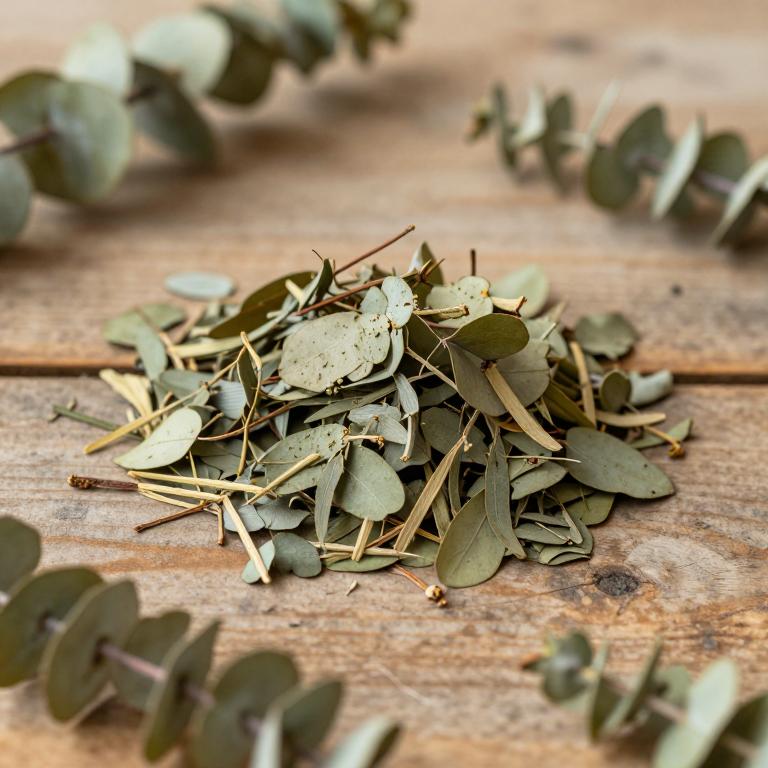
Honey-box, scientifically known as Eucalyptus melliodora, is a magnificent Australian flowering tree prized for its prolific nectar production. Renowned for creating exceptional honey, this species offers significant medicinal potential. Its essential oils possess potent antimicrobial and anti-inflammatory properties, making it a vital resource in traditional and modern herbal medicine.
Names and Synonyms
Common Names
- honey-box
- yellow-box
- yellow-ironbox
- Honey Box
- Yellow Box
- Yellow Ironbox
- yellow ironbark
- Yellow box gum
Scientific Names
Accepted name
Eucalyptus melliodoraSynonyms
- Eucalyptus forsythii
- Eucalyptus caerulescens
- Eucalyptus melliodora var. brachycarpa
- Eucalyptus melliodora var. elliptocarpa
- Eucalyptus patentiflora
Sources: Wikidata, Catalogue of Life
Taxonomical Classification
This plant belongs to the kingdom Plantae within the phylum Streptophyta and the class Equisetopsida. It is further classified under the subclass Magnoliidae, the order Myrtales, and the family Myrtaceae. Finally, it is identified by the genus Eucalyptus.
| Rank | Classification |
|---|---|
| Kingdom | Plantae |
| Phylum | Streptophyta |
| Class | Equisetopsida |
| Subclass | Magnoliidae |
| Order | Myrtales |
| Family | Myrtaceae |
| Genus | Eucalyptus |
Sources: The World Checklist of Vascular Plants (WCVP)
Distribution
This plant exhibits a diverse geographical distribution spanning several distinct regions across the globe. In the Atlantic, it can be found within the Macaronesia region, specifically on the Canary Islands. Its presence extends significantly into East Tropical Africa, where it inhabits both Kenya and Uganda. Furthermore, the species is established within China, covering both the South-Central and Southeast territories. This wide range demonstrates the plant's ability to adapt to various international environments.
| Region | Area |
|---|---|
| Macaronesia | Canary Is. |
| East Tropical Africa | Kenya |
| East Tropical Africa | Uganda |
| China | China South-Central |
| China | China Southeast |
| Australia | New South Wales |
| Australia | Queensland |
| Australia | Victoria |
Sources: The World Checklist of Vascular Plants (WCVP)
Botanical Identification
Ecology
The ecology of Eucalyptus melliodora is defined by its specific altitudinal distribution and adaptation to varied terrain. This species thrives within a distinct elevational range, typically occurring at altitudes starting from a minimum of 160 m AMSL. As the landscape ascends, the species maintains a presence through a mean elevation of approximately 430 m AMSL, reaching its upper ecological limits at a maximum of 700 m AMSL. This vertical distribution suggests an adaptation to specific climatic and topographical zones within its habitat, where it occupies mid-range elevations to optimize its growth and reproductive success.
- Elevational range max:
- 700 m AMSL
- Elevational range mean:
- 430 m AMSL
- Elevational range min:
- 160 m AMSL
Life history
The life history of Eucalyptus melliodora is characterized by its status as a perennial species, allowing it to establish a long-term presence within its ecological niche. As a phanerophyte, the plant maintains its photosynthetic organs on elevated branches well above the ground level, a structural adaptation that defines its growth habit and survival strategy. This phanerophyte life form is consistent across its developmental stages, ensuring that its crown remains the primary site for resource acquisition and reproductive effort throughout its extensive lifespan.
- Life form :
- phanerophyte
- Lifecycle :
- perennial
Morphology
The morphology of Eucalyptus melliodora is characterized by its growth form as a large, woody tree that reaches a maximum plant height of approximately 30 m. As a terrestrial species, it does not exhibit aquatic or semiaquatic tendencies, nor does it function as an epiphyte or a climber; instead, it is a self-supporting organism that maintains an independent existence without being a parasite. Its structural integrity is provided by its robust, woody composition, which allows it to stand firmly as a dominant forest component.
- Aquatic :
- terrestrial
- Climber :
- self-supporting
- Epiphyte :
- terrestrial
- Growth form :
- tree
- Parasite :
- independent
- Plant height max:
- 30 m
- Woodiness :
- woody
Physiology
The physiology of Eucalyptus melliodora is characterized by a specialized metabolic framework optimized for the seasonal fluctuations of its native Australian environments. A fundamental aspect of its energy production is its photosynthetic pathway, which functions exclusively via the C3 mechanism. This C3 pathway involves the direct fixation of atmospheric carbon dioxide by the enzyme RuBisCO during the Calvin cycle, a process that requires the plant to balance gas exchange with transpirational water loss. To support this metabolic process, the plant exhibits robust physiological adaptations to water stress, including regulated stomatal conductance and deep root systems that facilitate efficient nutrient and water uptake. This physiological efficiency allows the plant to maintain high rates of biomass production and nectar secretion, which are essential for its ecological role and its chemical profile.
- Photosynthetic pathway :
- C3
Reproduction
Reproduction in Eucalyptus melliodora is characterized by the production of specialized fruit and seeds that exhibit specific morphological dimensions. The fruit of this species maintains a consistent width, with recorded values showing a minimum, mean, and maximum of 0.5 cm, indicating a highly uniform fruit diameter. The seeds produced within these fruits vary more significantly in their physical properties; they possess a mean seed mass of 0.001025 g, with individual seed weights ranging from a minimum of 0.00027 g to a maximum of 0.0028 g.
- Fruit width max:
- 0.5 cm
- Seed mass max:
- 0.0028 g
- Seed mass mean:
- 0.001025 g
- Seed mass min:
- 0.00027 g
Sources: Global Inventory of Floras and Traits (GIFT)
Chemicals
Eucalyptus melliodora has 40 reported phytochemicals identified across 0 scientific publications and several other databases. The most consistently reported chemicals include 1,8-Cineole, ALPHA-PHELLANDRENE, ALPHA-PINENE, ALPHA-TERPINYL ACETATE, ALPHA-THUJENE.
| Chemical | Supporting sources | Consensus |
|---|---|---|
| 1,8-Cineole | 1 supporting sources | ★☆☆☆☆ |
| ALPHA-PHELLANDRENE | 1 supporting sources | ★☆☆☆☆ |
| ALPHA-PINENE | 1 supporting sources | ★☆☆☆☆ |
| ALPHA-TERPINYL ACETATE | 1 supporting sources | ★☆☆☆☆ |
| ALPHA-THUJENE | 1 supporting sources | ★☆☆☆☆ |
| Allo-Aromadendrene | 1 supporting sources | ★☆☆☆☆ |
| Alpha terpinene | 1 supporting sources | ★☆☆☆☆ |
| Aromadendrene | 1 supporting sources | ★☆☆☆☆ |
| BETA-CARYOPHYLLENE | 1 supporting sources | ★☆☆☆☆ |
| BETA-ELEMENE | 1 supporting sources | ★☆☆☆☆ |
1,8-Cineole
- Dr. Duke
ALPHA-PHELLANDRENE
- Dr. Duke
ALPHA-PINENE
- Dr. Duke
ALPHA-TERPINYL ACETATE
- Dr. Duke
ALPHA-THUJENE
- Dr. Duke
Allo-Aromadendrene
- Dr. Duke
Alpha terpinene
- Dr. Duke
Aromadendrene
- Dr. Duke
BETA-CARYOPHYLLENE
- Dr. Duke
BETA-ELEMENE
- Dr. Duke
Activities
Eucalyptus melliodora has 186 reported activities identified across 0 scientific publications and several other databases. The most consistently reported activities include (-)-Chronotropic, (-)-Inotropic, ACE-Inhibitor, AChE-Inhibitor, Acaricide.
| Activity | Supporting sources | Consensus |
|---|---|---|
| (-)-Chronotropic | 1 supporting sources | ★☆☆☆☆ |
| (-)-Inotropic | 1 supporting sources | ★☆☆☆☆ |
| ACE-Inhibitor | 1 supporting sources | ★☆☆☆☆ |
| AChE-Inhibitor | 1 supporting sources | ★☆☆☆☆ |
| Acaricide | 1 supporting sources | ★☆☆☆☆ |
| Aldose-Reductase-Inhibitor | 1 supporting sources | ★☆☆☆☆ |
| Allelochemic | 1 supporting sources | ★☆☆☆☆ |
| Allelopathic | 1 supporting sources | ★☆☆☆☆ |
| Allergenic | 1 supporting sources | ★☆☆☆☆ |
| Analgesic | 1 supporting sources | ★☆☆☆☆ |
(-)-Chronotropic
- Dr. Duke
(-)-Inotropic
- Dr. Duke
ACE-Inhibitor
- Dr. Duke
AChE-Inhibitor
- Dr. Duke
Acaricide
- Dr. Duke
Aldose-Reductase-Inhibitor
- Dr. Duke
Allelochemic
- Dr. Duke
Allelopathic
- Dr. Duke
Allergenic
- Dr. Duke
Analgesic
- Dr. Duke