cider-eucalypt-tree
Eucalyptus gunnii · Accepted scientific name
Scientific literature: Very Sparse (9 studies) · ★☆☆☆☆
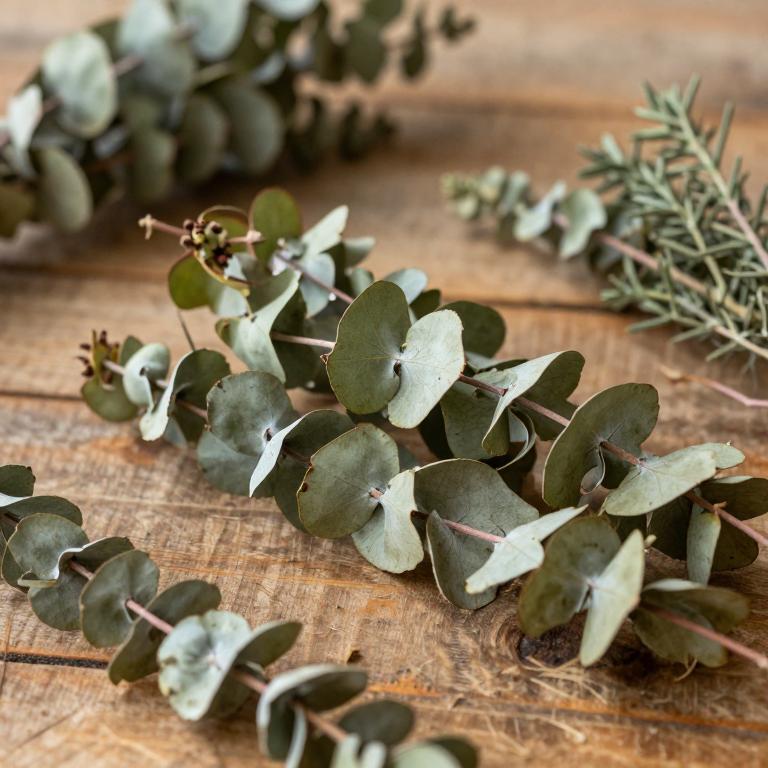
Cider-eucalypt-tree, scientifically known as Eucalyptus gunnii, is a versatile evergreen native to Australia. Renowned for its distinctively aromatic foliage, it offers significant medicinal potential. Often used in traditional remedies, its essential oils provide therapeutic properties, primarily serving as potent decongestants and antimicrobial agents to support respiratory health.
- Family
- Myrtaceae
- Native range
- Europe
- Parts used
- Not available
- Common names
- Cider-Eucalypt-Tree · Cider-Gum · 3 more
- Scientific synonyms
- Not available
Names and Synonyms
Common Names
- cider-eucalypt-tree
- cider-gum
- cider-gum-tree
- white-swamp-gum
- Cider Gum
Scientific Names
Accepted name
Eucalyptus gunniiRegional and Traditional Names
Spanish:
- Eucalipto de Gunn
- Eucalyptus divaricata
- Eucalyptus whittingehameii
German:
- Mostgummi-Eukalyptus
French:
- Eucalyptus de gunnii
Sources: Wikidata, Catalogue of Life
Taxonomical Classification
This plant belongs to the kingdom Plantae and the phylum Streptophyta, falling under the class Equisetopsida and subclass Magnoliidae. It is further classified within the order Myrtales and the family Myrtaceae. Finally, it is categorized under the genus Eucalyptus.
| Rank | Classification |
|---|---|
| Kingdom | Plantae |
| Phylum | Streptophyta |
| Class | Equisetopsida |
| Subclass | Magnoliidae |
| Order | Myrtales |
| Family | Myrtaceae |
| Genus | Eucalyptus |
Sources: The World Checklist of Vascular Plants (WCVP)
Distribution
This plant exhibits a diverse geographical range that spans across several different continents and regions. In Northern Europe, it can be found growing within the territories of Great Britain and Ireland. Its distribution also extends to the Caucasus region, specifically within the Transcaucasus area. The species is native to Australia, where it is prominently located in Tasmania. Additionally, it has established a presence in the northern parts of New Zealand.
| Region | Area |
|---|---|
| Northern Europe | Great Britain |
| Northern Europe | Ireland |
| Caucasus | Transcaucasus |
| Australia | Tasmania |
| New Zealand | New Zealand North |
| New Zealand | New Zealand South |
Sources: The World Checklist of Vascular Plants (WCVP)
Botanical Identification
Ecology
The ecology of Eucalyptus gunnii is characterized by its adaptation to specific environmental niches, most notably occupying lowland habitats where it can establish stable populations. Within these lowland regions, the species interacts dynamically with its surrounding ecosystem, influencing soil composition and providing critical structural complexity to the landscape. Its presence in these low-lying areas dictates its relationship with local hydrology and nutrient cycling, allowing it to thrive in specific microclimates that support diverse biological communities. By occupying these lowland zones, the plant plays a foundational role in the local trophic web, serving as a key component of the vegetation structure that dictates the distribution of associated flora and fauna.
- Habitat :
- Lowland
Life history
The life history of Eucalyptus gunnii is characterized by its status as a perennial species, allowing it to establish long-term presence within its ecological niche. As a phanerophyte, the plant maintains its photosynthetic organs on elevated woody stems, specifically exhibiting the growth habit of a phanerophyte to ensure survival through various environmental conditions. Furthermore, it maintains an evergreen deciduousness, retaining its foliage throughout the year rather than shedding it seasonally.
- Deciduousness :
- evergreen
- Life form :
- phanerophyte
- Lifecycle :
- perennial
Morphology
The morphology of Eucalyptus gunnii is characterized by its robust growth form as a woody tree, which stands as a self-supporting structure rather than a climber or liana. It is a terrestrial species, functioning as an independent organism without parasitic or epiphytic tendencies. Reaching a significant stature, the plant can achieve a maximum height of approximately 30 m. Its structural integrity is defined by its woody composition, allowing it to maintain its upright, tree-like habit within its natural environment.
- Aquatic :
- terrestrial
- Climber :
- self-supporting
- Epiphyte :
- terrestrial
- Growth form :
- tree
- Parasite :
- independent
- Plant height max:
- 30 m
- Woodiness :
- woody
Physiology
The physiology of Eucalyptus gunnii is characterized by a C3 photosynthetic pathway, which dictates its carbon fixation processes and metabolic efficiency in its natural habitat. The plant's leaf morphology plays a significant role in its physiological performance, featuring leaves with a consistent mean width of 1.8 cm, which does not vary between its minimum and maximum measurements. In terms of length, the leaves exhibit a maximum extent of 9 cm. Furthermore, the species does not function as a nitrogen fixer, relying instead on the uptake of available nitrogen from the soil to support its growth and physiological development.
- Leaf length max:
- 9 cm
- Leaf width mean:
- 1.8 cm
- Nitrogen fixer :
- no
- Photosynthetic pathway :
- C3
Reproduction
The reproduction of Eucalyptus gunnii is characterized by a biotic pollination syndrome, primarily involving insects as the key pollinators. The plant produces fruits that measure an average of 0.7 cm in length and 0.6 cm in width. Within these fruits, the seeds exhibit a significant range of mass, with a minimum value of 0.0003 g, a mean mass of 0.0016625 g, and a maximum mass reaching 0.0035 g. Regarding the movement of progeny, the species utilizes an unspecialized dispersal syndrome, lacking highly specific mechanisms for seed transport.
- Dispersal syndrome :
- unspecialized
- Fruit length mean:
- 0.7 cm
- Fruit width mean:
- 0.6 cm
- Pollination syndrome :
- insect
- Pollination syndrome :
- biotic
- Seed mass max:
- 0.0035 g
- Seed mass mean:
- 0.0016625 g
- Seed mass min:
- 3e-04 g
Sources: Global Inventory of Floras and Traits (GIFT)
Chemicals
Eucalyptus gunnii has 5 reported phytochemicals identified across 0 scientific publications and several other databases. The most consistently reported chemicals include LIGNIN, 4-coumaraldehyde, Coniferaldehyde, RAFFINOSE, fructose.
| Chemical | Supporting sources | Consensus |
|---|---|---|
| LIGNIN | 2 supporting sources | ★☆☆☆☆ |
| 4-coumaraldehyde | 1 supporting sources | ★☆☆☆☆ |
| Coniferaldehyde | 1 supporting sources | ★☆☆☆☆ |
| RAFFINOSE | 1 supporting sources | ★☆☆☆☆ |
| fructose | 1 supporting sources | ★☆☆☆☆ |
LIGNIN
- Plant molecular biology
- The Plant journal : for cell and molecular biology
4-coumaraldehyde
- Plant molecular biology
Coniferaldehyde
- Plant molecular biology
RAFFINOSE
- European journal of biochemistry
fructose
- European journal of biochemistry