rainbow eucalyptus
Eucalyptus deglupta · Accepted scientific name
Scientific literature: Very Sparse (3 studies) · ★☆☆☆☆
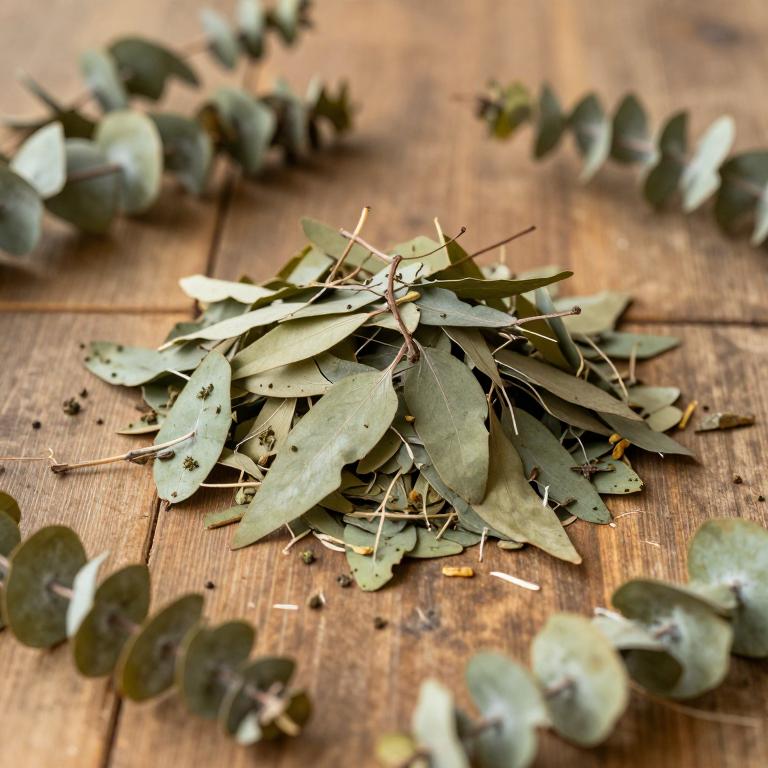
Rainbow eucalyptus, scientifically known as Eucalyptus deglupta, is a striking, fast-growing tree renowned for its vibrant, multi-colored bark. Beyond its ornamental beauty, this species holds medicinal potential. Its essential oils possess antimicrobial and anti-inflammatory properties, traditionally used to support respiratory health and provide soothing relief from congestion.
Names and Synonyms
Common Names
- kamarere
- mindanau-gum
- rainbow-eucalyptus
- rainbow-gum
- Mindanao Gum
- Rainbow Eucalyptus
- Rainbow Gum
- deglupta
- Mindanao Eucalyptus
- Indonesian gum
Scientific Names
Accepted name
Eucalyptus degluptaSynonyms
- Eucalyptus versicolor
- Eucalyptus naudiniana
- Eucalyptus schlechteri
- Eucalyptus sarassa
Regional and Traditional Names
Spanish:
- Eucalipto arcoiris
German:
- Regenbogenbaum
French:
- Eucalyptus arc-en-ciel
- Eucalyptus arc-en-ciel
Sources: Wikidata, Catalogue of Life
Taxonomical Classification
This plant belongs to the kingdom Plantae and the phylum Streptophyta, falling under the class Equisetopsida and subclass Magnoliidae. Within the order Myrtales and the family Myrtaceae, it is classified under the genus Eucalyptus.
| Rank | Classification |
|---|---|
| Kingdom | Plantae |
| Phylum | Streptophyta |
| Class | Equisetopsida |
| Subclass | Magnoliidae |
| Order | Myrtales |
| Family | Myrtaceae |
| Genus | Eucalyptus |
Sources: The World Checklist of Vascular Plants (WCVP)
Distribution
This plant is primarily distributed across the expansive region of Malesia. Within this zone, it can be found growing throughout the Philippines and the island of Sulawesi. Its presence also extends to the Lesser Sunda Islands and the Maluku archipelago. Additionally, the species reaches into the Papuasia region. Specifically, it inhabits the Bismarck Archipelago to complete its geographical range.
| Region | Area |
|---|---|
| Malesia | Lesser Sunda Is. |
| Malesia | Maluku |
| Malesia | Philippines |
| Malesia | Sulawesi |
| Papuasia | Bismarck Archipelago |
| Papuasia | New Guinea |
| Northwestern Pacific | Caroline Is. |
| North-Central Pacific | Hawaii |
| Central America | Costa Rica |
| Central America | El Salvador |
Sources: The World Checklist of Vascular Plants (WCVP)
Botanical Identification
Life history
The life history of Eucalyptus deglupta is characterized by its status as a perennial species, ensuring its long-term presence within its natural ecosystem. As a phanerophyte, it maintains its photosynthetic organs on elevated branches, growing into a large, dominant tree structure. The plant exhibits an evergreen deciduousness, meaning that while it retains its foliage throughout the year, it undergoes a unique process of shedding its bark in colorful, irregular strips rather than losing all its leaves seasonally. This combination of a perennial lifecycle and a phanerophyte life form allows it to establish a stable, long-lived canopy in its tropical habitats.
- Deciduousness :
- evergreen
- Life form :
- phanerophyte
- Lifecycle :
- perennial
Morphology
The morphology of Eucalyptus deglupta is characterized by its robust growth form as a large, woody tree. As a self-supporting species, it does not function as a climber or a liana, maintaining an independent life cycle without being a parasite or an epiphyte; it is strictly a terrestrial plant. This species is notable for its impressive stature, with a plant height that typically ranges from a minimum of 35 m to a maximum of 60 m, maintaining an average height of approximately 60 m. Its structural development is defined by its woody nature, which supports its significant vertical reach within its ecosystem.
- Aquatic :
- terrestrial
- Climber :
- self-supporting
- Epiphyte :
- terrestrial
- Growth form :
- tree
- Parasite :
- independent
- Plant height mean:
- 60 m
- Plant height min:
- 35 m
- Woodiness :
- woody
Physiology
The physiology of Eucalyptus deglupta is characterized by a C3 photosynthetic pathway, which facilitates carbon fixation through the standard Calvin cycle typically found in temperate and tropical woody species. Its foliar morphology plays a crucial role in gas exchange and light interception, with leaves exhibiting a length ranging from a minimum of 10 cm to a maximum of 20 cm, and a width varying between 6 cm and 10 cm. In terms of nutrient acquisition, the species does not function as a nitrogen fixer, relying instead on the uptake of available nitrogen from the soil through its root system.
- Leaf length max:
- 20 cm
- Leaf length min:
- 10 cm
- Leaf width max:
- 10 cm
- Leaf width min:
- 6 cm
- Nitrogen fixer :
- no
- Photosynthetic pathway :
- C3
Reproduction
The reproduction of Eucalyptus deglupta is characterized by a biotic pollination syndrome, primarily facilitated by insects such as bees. The reproductive process results in the development of fruits that typically range in width from 0.3 cm to a maximum of 0.5 cm. Within these fruits, the seeds are produced with a highly variable mass, ranging from a minimum of 7.9e-05 g to a maximum of 0.00023 g, with an average seed mass of approximately 0.0001418 g. Once mature, the dispersal of these seeds follows an anemochorous syndrome, relying on wind to distribute the progeny across the environment.
- Dispersal syndrome :
- anemochorous
- Fruit width max:
- 0.5 cm
- Fruit width min:
- 0.3 cm
- Pollination syndrome :
- insect
- Pollination syndrome :
- bee
- Pollination syndrome :
- biotic
- Seed mass max:
- 0.00023 g
- Seed mass mean:
- 0.0001418 g
- Seed mass min:
- 7.9e-05 g
Sources: Global Inventory of Floras and Traits (GIFT)
Plant Parts
Eucalyptus deglupta has 1 reported plant parts identified across 1 scientific publications and several other databases that are studied for medicinal purposes. The most consistently reported plant part include leaf.
| Plant part | Supporting sources | Consensus |
|---|---|---|
| Leaf | 1 supporting sources | ★☆☆☆☆ |
Leaf
- Journal of ethnopharmacology
Chemicals
Eucalyptus deglupta has 1 reported phytochemicals identified across 1 scientific publications and several other databases. The most consistently reported chemicals include Xanthine oxidase.
| Chemical | Supporting sources | Consensus |
|---|---|---|
| Xanthine oxidase | 1 supporting sources | ★☆☆☆☆ |
Xanthine oxidase
- Puerto Rico health sciences journal
Activities
Eucalyptus deglupta has 1 reported activities identified across 1 scientific publications and several other databases. The most consistently reported activities include Antibacterial.
| Activity | Supporting sources | Consensus |
|---|---|---|
| Antibacterial | 1 supporting sources | ★☆☆☆☆ |
Antibacterial
- Journal of ethnopharmacology
Preparations
Eucalyptus deglupta has 2 reported preparations identified across 1 scientific publications and several other databases. The most consistently reported preparations include Essential oils from the leaves, plant extracts.
| Preparation | Supporting sources | Consensus |
|---|---|---|
| Essential oils from the leaves | 1 supporting sources | ★☆☆☆☆ |
| Plant extracts | 1 supporting sources | ★☆☆☆☆ |
Essential oils from the leaves
- Journal of ethnopharmacology
Plant extracts
- Puerto Rico health sciences journal