khaki-gum
Eucalyptus alba · Accepted scientific name
Scientific literature: Very Sparse (2 studies) · ★☆☆☆☆
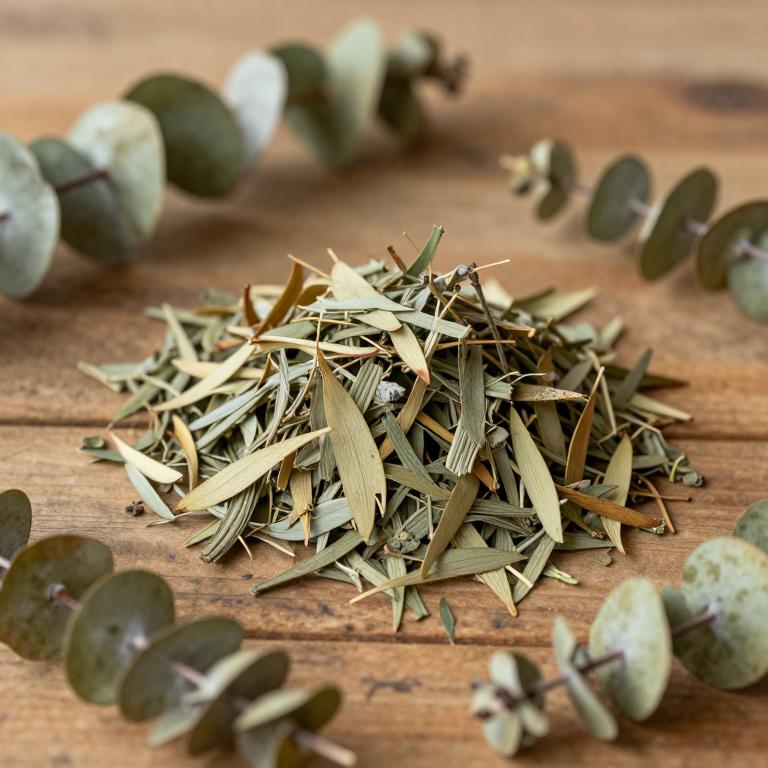
Khaki-gum, scientifically known as Eucalyptus alba, is a distinctive medicinal plant revered for its therapeutic properties. Renowned for its potent essential oils, it is widely utilized in traditional medicine to alleviate respiratory ailments, reduce inflammation, and act as a natural antiseptic, offering significant healing benefits through its aromatic leaves.
- Family
- Myrtaceae
- Native range
- Asia-Temperate
- Parts used
- Leaf
- Common names
- Khaki-Gum · Motled-Gum · 12 more
- Scientific synonyms
- Not available
Names and Synonyms
Common Names
- khaki-gum
- motled-gum
- poplar-gum
- ridge-gum
- timor-white-gum
- white-gum
- white-gum-tree
- Timor white gum
- khaki gum
- poplar gum
- ridge gum
- salmon gum
- white gum
- White Eucalyptus
Scientific Names
Accepted name
Eucalyptus albaSources: Wikidata, Catalogue of Life
Taxonomical Classification
This plant belongs to the kingdom Plantae and the phylum Streptophyta. Within the class Equisetopsida and subclass Magnoliidae, it is categorized under the order Myrtales and the family Myrtaceae. Finally, its taxonomic classification concludes with the genus Eucalyptus.
| Rank | Classification |
|---|---|
| Kingdom | Plantae |
| Phylum | Streptophyta |
| Class | Equisetopsida |
| Subclass | Magnoliidae |
| Order | Myrtales |
| Family | Myrtaceae |
| Genus | Eucalyptus |
Sources: The World Checklist of Vascular Plants (WCVP)
Distribution
This plant exhibits a broad geographical distribution across several key regions in Asia. In East Asia, it is specifically found throughout Southeast China. Its presence extends into the Indian Subcontinent, where it grows in Bangladesh, India, and Pakistan. Additionally, the species can be located within the Malesia region, specifically inhabiting the Lesser Sunda Islands. Together, these locations highlight the diverse range of environments where the plant thrives.
| Region | Area |
|---|---|
| China | China Southeast |
| Indian Subcontinent | Bangladesh |
| Indian Subcontinent | India |
| Indian Subcontinent | Pakistan |
| Malesia | Lesser Sunda Is. |
| Papuasia | New Guinea |
| Australia | Northern Territory |
| Australia | Queensland |
| Australia | Western Australia |
| South-Central Pacific | Easter Is. |
Sources: The World Checklist of Vascular Plants (WCVP)
Botanical Identification
Life history
The life history of Eucalyptus alba is characterized by a perennial lifecycle, allowing the plant to persist through multiple growing seasons and establish long-term presence in its ecosystem. As a phanerophyte, it maintains its photosynthetic organs on elevated branches above the ground, a structural strategy that facilitates its growth into a substantial woody form. Although many species within the Eucalyptus genus exhibit different foliage patterns, this specific plant is categorized as deciduous, undergoing seasonal changes in its leaf cover. This combination of a long-lived perennial habit and a phanerophyte life form ensures its ability to dominate its niche while managing seasonal environmental shifts through its deciduous nature.
- Deciduousness :
- deciduous
- Life form :
- phanerophyte
- Lifecycle :
- perennial
Morphology
The morphology of Eucalyptus alba is characterized by a woody growth form, specifically classified as a tree. As a terrestrial organism, it functions as an independent plant, neither acting as a parasite nor as an epiphyte. The species is self-supporting rather than being a climber, liana, or vine. In terms of its physical dimensions, the plant reaches a height ranging from a minimum of 5 m to a maximum of 15 m, with a mean height of approximately 15 m.
- Aquatic :
- terrestrial
- Climber :
- self-supporting
- Epiphyte :
- terrestrial
- Growth form :
- tree
- Parasite :
- independent
- Plant height mean:
- 15 m
- Plant height min:
- 5 m
- Woodiness :
- woody
Physiology
The physiology of Eucalyptus alba is characterized by a C3 photosynthetic pathway, which dictates its carbon fixation processes and metabolic efficiency. The plant's vegetative morphology, particularly regarding its foliage, shows specific dimensions where the leaf length averages 7.5 cm. The leaf width exhibits notable variation, ranging from a minimum of 2 cm to a maximum of 4 cm, with a mean width of 3 cm. Furthermore, regarding its nutrient acquisition strategies, Eucalyptus alba does not function as a nitrogen fixer, relying instead on soil nitrogen availability rather than symbiotic nitrogen-fixing bacteria.
- Leaf length mean:
- 7.5 cm
- Leaf width max:
- 4 cm
- Leaf width mean:
- 3 cm
- Leaf width min:
- 2 cm
- Nitrogen fixer :
- no
- Photosynthetic pathway :
- C3
Reproduction
The reproduction of Eucalyptus alba is characterized by the development of specialized fruits and the production of minute seeds. The fruit produced by this species is highly uniform in size, maintaining a consistent length of 0.6 cm, with both the minimum, mean, and maximum measurements recorded at this exact value. Following the maturation of these fruits, the plant releases seeds that exhibit a degree of variation in mass. These seeds possess a mean mass of 0.00238 g, though individual seed weights range from a minimum of 0.00105 g to a maximum of 0.00371 g.
- Fruit length max:
- 0.6 cm
- Seed mass max:
- 0.00371 g
- Seed mass mean:
- 0.00238 g
- Seed mass min:
- 0.00105 g
Sources: Global Inventory of Floras and Traits (GIFT)
Plant Parts
Eucalyptus alba has 1 reported plant parts identified across 1 scientific publications and several other databases that are studied for medicinal purposes. The most consistently reported plant part include leaf.
| Plant part | Supporting sources | Consensus |
|---|---|---|
| Leaf | 1 supporting sources | ★☆☆☆☆ |
Leaf
- Journal of ethnopharmacology
Activities
Eucalyptus alba has 1 reported activities identified across 1 scientific publications and several other databases. The most consistently reported activities include Antibacterial.
| Activity | Supporting sources | Consensus |
|---|---|---|
| Antibacterial | 1 supporting sources | ★☆☆☆☆ |
Antibacterial
- Journal of ethnopharmacology
Preparations
Eucalyptus alba has 1 reported preparations identified across 1 scientific publications and several other databases. The most consistently reported preparations include Essential oils from the leaves.
| Preparation | Supporting sources | Consensus |
|---|---|---|
| Essential oils from the leaves | 1 supporting sources | ★☆☆☆☆ |
Essential oils from the leaves
- Journal of ethnopharmacology