Eryngium cymosum
Eryngium cymosum · Accepted scientific name
Scientific literature: Very Sparse (19 studies) · ★☆☆☆☆
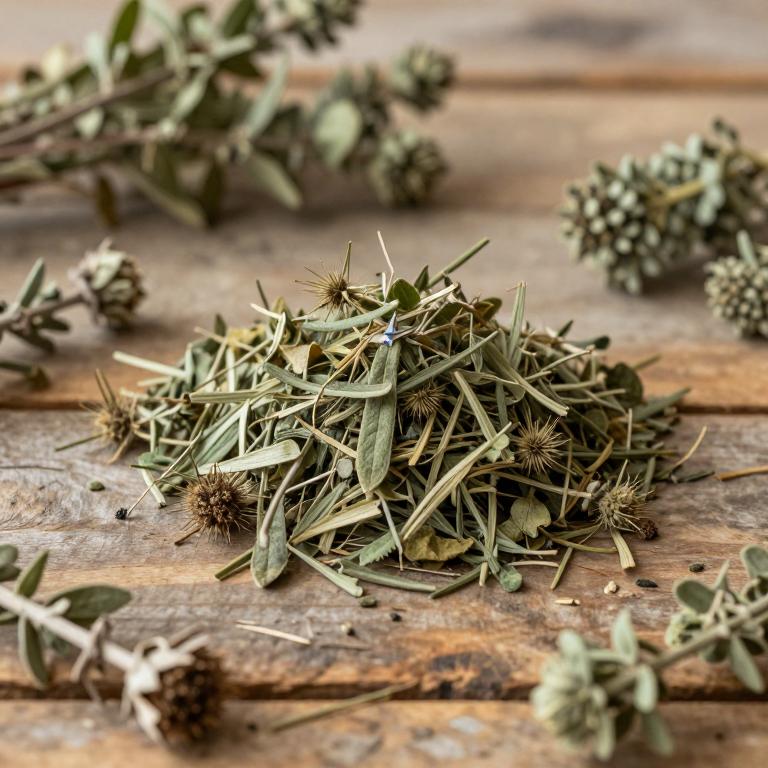
Eryngium cymosum, scientifically known as Eryngium cymosum, is a resilient perennial herb native to Southern Africa. Often referred to as "Devil's Bit," this plant is highly valued in traditional medicine. It is primarily utilized for its potent anti-inflammatory and wound-healing properties, playing a vital role in various folk remedies.
- Family
- Apiaceae
- Native range
- Northern America
- Parts used
- Not available
- Common names
- Not available
- Scientific synonyms
- Not available
Names and Synonyms
Scientific Names
Accepted name
Eryngium cymosumSources: Wikidata
Taxonomical Classification
This plant belongs to the kingdom Plantae within the phylum Streptophyta and the class Equisetopsida. As a member of the subclass Magnoliidae and the order Apiales, it is classified under the family Apiaceae. Specifically, it is identified by the genus Eryngium, which includes the species Eryngium cymosum.
| Rank | Classification |
|---|---|
| Kingdom | Plantae |
| Phylum | Streptophyta |
| Class | Equisetopsida |
| Subclass | Magnoliidae |
| Order | Apiales |
| Family | Apiaceae |
| Genus | Eryngium |
Sources: The World Checklist of Vascular Plants (WCVP)
Distribution
This plant exhibits a widespread presence across several distinct regions of Mexico. Its distribution includes significant populations found throughout Mexico Central and Mexico Northeast. Furthermore, it can be located within the diverse landscapes of Mexico Southwest and Mexico Southeast. Beyond the borders of Mexico, the species also extends its reach into Central America. Specifically, it is known to inhabit the territory of Guatemala.
| Region | Area |
|---|---|
| Mexico | Mexico Central |
| Mexico | Mexico Northeast |
| Mexico | Mexico Southwest |
| Mexico | Mexico Southeast |
| Central America | Guatemala |
Sources: The World Checklist of Vascular Plants (WCVP)
Chemicals
Eryngium cymosum has 4 reported phytochemicals identified across 0 scientific publications and several other databases. The most consistently reported chemicals include CHLOROGENIC ACID, caffeic acid, rosmarinic acid, protocatechuic acid.
| Chemical | Supporting sources | Consensus |
|---|---|---|
| CHLOROGENIC ACID | 2 supporting sources | ★☆☆☆☆ |
| caffeic acid | 2 supporting sources | ★☆☆☆☆ |
| rosmarinic acid | 2 supporting sources | ★☆☆☆☆ |
| protocatechuic acid | 1 supporting sources | ★☆☆☆☆ |
CHLOROGENIC ACID
- Plants (Basel, Switzerland)
- Journal of ethnopharmacology
caffeic acid
- Plants (Basel, Switzerland)
- Journal of ethnopharmacology
rosmarinic acid
- Plants (Basel, Switzerland)
- Journal of ethnopharmacology
protocatechuic acid
- Plants (Basel, Switzerland)
Activities
Eryngium cymosum has 4 reported activities identified across 0 scientific publications and several other databases. The most consistently reported activities include Antibacterial, Antioxidant, Hypocholesterolemic, Hypoglycemic.
| Activity | Supporting sources | Consensus |
|---|---|---|
| Antibacterial | 1 supporting sources | ★☆☆☆☆ |
| Antioxidant | 1 supporting sources | ★☆☆☆☆ |
| Hypocholesterolemic | 1 supporting sources | ★☆☆☆☆ |
| Hypoglycemic | 1 supporting sources | ★☆☆☆☆ |
Antibacterial
- Molecules (Basel, Switzerland)
Antioxidant
- Molecules (Basel, Switzerland)
Hypocholesterolemic
- Molecules (Basel, Switzerland)
Hypoglycemic
- Molecules (Basel, Switzerland)
Conditions
Eryngium cymosum has 4 reported investigations on conditions identified across 0 scientific publications and several other databases. The most consistently reported conditions include hyperglycemia, type 2 diabetes, dyslipidemia, insulin resistance.
| Condition | Supporting sources | Consensus |
|---|---|---|
| Hyperglycemia | 2 supporting sources | ★☆☆☆☆ |
| Type 2 diabetes | 2 supporting sources | ★☆☆☆☆ |
| Dyslipidemia | 1 supporting sources | ★☆☆☆☆ |
| Insulin resistance | 1 supporting sources | ★☆☆☆☆ |
Hyperglycemia
- Pharmaceuticals (Basel, Switzerland)
- Evidence-based complementary and alternative medicine : eCAM
Type 2 diabetes
- Plants (Basel, Switzerland)
- Journal of ethnopharmacology
Dyslipidemia
- Molecules (Basel, Switzerland)
Insulin resistance
- Pharmaceuticals (Basel, Switzerland)