Toad's Herb
Eryngium carlinae · Accepted scientific name
Scientific literature: Very Sparse (22 studies) · ★☆☆☆☆
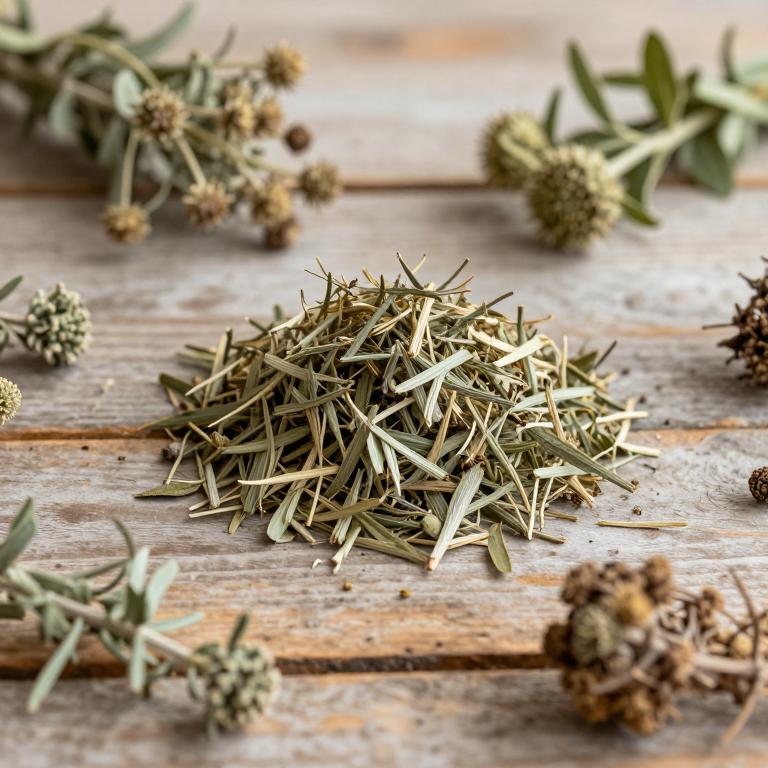
Toad's Herb, scientifically known as Eryngium carlinae, is a striking, thistle-like perennial native to European limestone grasslands. Renowned for its architectural, spiny bracts and silver-blue hues, this hardy plant holds historical significance in traditional medicine, long utilized for its purported restorative properties and unique botanical resilience in rugged terrains.
- Family
- Apiaceae
- Native range
- Northern America
- Parts used
- Not available
- Common names
- Toad'S Herb
- Scientific synonyms
- Eryngium Carlinae Var. Decumbens · Eryngium Carlinae Var. Erectum · 2 more
Names and Synonyms
Common Names
- Toad's Herb
Scientific Names
Accepted name
Eryngium carlinaeSynonyms
- Eryngium carlinae var. decumbens
- Eryngium carlinae var. erectum
- Eryngium radiatum
- Eryngium affine
Regional and Traditional Names
Spanish:
- hierba del sapo
- yerba del sapo
- cabezona
- cardón
- estrellita
- mosquitas
- perejil de monte
- cardon
- Cabezona
- Hierba del sapo
Sources: Wikidata, Catalogue of Life
Taxonomical Classification
This plant belongs to the kingdom Plantae and the phylum Streptophyta, falling under the class Equisetopsida and subclass Magnoliidae. Within the order Apiales, it is classified in the family Apiaceae. Finally, it is identified by the genus Eryngium.
| Rank | Classification |
|---|---|
| Kingdom | Plantae |
| Phylum | Streptophyta |
| Class | Equisetopsida |
| Subclass | Magnoliidae |
| Order | Apiales |
| Family | Apiaceae |
| Genus | Eryngium |
Sources: The World Checklist of Vascular Plants (WCVP)
Distribution
This plant exhibits a wide-reaching presence across several key regions within the country of Mexico. It can be found growing throughout Mexico Central, demonstrating its adaptability to various inland climates. The species also populates the coastal and inland areas of Mexico Northeast. Furthermore, its distribution extends into the rugged terrain of Mexico Southwest. Finally, the plant is also documented across the humid environments of Mexico Southeast and the tropical zones of Mexico Gulf.
| Region | Area |
|---|---|
| Mexico | Mexico Central |
| Mexico | Mexico Northeast |
| Mexico | Mexico Gulf |
| Mexico | Mexico Southwest |
| Mexico | Mexico Southeast |
| Central America | Costa Rica |
| Central America | Guatemala |
| Central America | Honduras |
| Central America | Panamá |
Sources: The World Checklist of Vascular Plants (WCVP)
Botanical Identification
Ecology
The ecology of Eryngium carlinae is defined by its preference for specific montane and subalpine environments, where it occupies a specialized niche within its habitat. This species is primarily distributed across altitudes ranging from a minimum of 1000 m AMSL to a maximum of 2000 m AMSL, positioning it in zones characterized by cooler temperatures and distinct seasonal variations. Within this elevational range, the plant typically thrives in rocky, well-drained substrates or calcareous soils, often appearing in open grasslands, rocky outcrops, or scrublands where competition from denser vegetation is limited. Its physiological adaptations allow it to withstand the environmental pressures found at these mid-to-high elevations, including intense solar radiation and fluctuating moisture availability, making it a resilient component of its specific montane ecosystem.
- Elevational range max:
- 2000 m AMSL
- Elevational range min:
- 1000 m AMSL
Life history
The life history of Eryngium carlinae is characterized by its nature as a perennial, though its growth patterns can exhibit variable lifecycles including annual or biennial stages depending on environmental conditions. As a hardy species, it establishes a persistent root system that allows it to survive through multiple growing seasons, often navigating the fluctuations of its habitat through long-term survival strategies. Throughout its life, the plant undergoes distinct seasonal phases, transitioning from vegetative growth to a reproductive stage where it produces characteristic inflorescences. This ability to function across various lifecycle durations ensures its resilience and ability to persist in its ecological niche over extended periods.
- Lifecycle :
- perennial
Morphology
The morphology of Eryngium carlinae is characterized by its growth form as a non-woody herb, typically reaching a mean plant height of approximately 0.2 m. It functions as a self-supporting organism, neither acting as a climber nor a liana, and is classified as a terrestrial plant rather than an aquatic or semiaquatic species. Furthermore, it does not exhibit epiphytic behavior, maintaining a strictly terrestrial existence, and it survives as an independent organism without any parasitic tendencies.
- Aquatic :
- terrestrial
- Climber :
- self-supporting
- Epiphyte :
- terrestrial
- Growth form :
- herb
- Parasite :
- independent
- Plant height mean:
- 0.2 m
- Woodiness :
- non-woody
Physiology
The physiology of Eryngium carlinae is characterized by specialized adaptations to Mediterranean-type climates, emphasizing water conservation and efficient nutrient uptake within calcareous or rocky substrates. As a perennial herb, it exhibits a robust physiological strategy centered on a deep taproot system that facilitates access to moisture in arid conditions and provides stability in disturbed soils. Its photosynthetic processes are supported by a structural morphology designed to minimize transpirational loss, often involving thickened, sclerophyllous leaves. Regarding its metabolic interaction with soil chemistry, Eryngium carlinae is not a nitrogen fixer; it lacks the symbiotic relationship with diazotrophic bacteria, such as Rhizobium, required to convert atmospheric nitrogen into bioavailable forms, and therefore relies entirely on the uptake of nitrates and ammonium present in the soil. Its physiological resilience is further marked by an ability to manage osmotic stress, allowing it to maintain cellular turgor and metabolic activity despite fluctuating environmental moisture levels.
- Nitrogen fixer :
- no
Sources: Global Inventory of Floras and Traits (GIFT)
Chemicals
Eryngium carlinae has 5 reported phytochemicals identified across 0 scientific publications and several other databases. The most consistently reported chemicals include Flavonoids, D-mannitol, Fatty acids, Sterols, Terpenoids.
| Chemical | Supporting sources | Consensus |
|---|---|---|
| Flavonoids | 2 supporting sources | ★☆☆☆☆ |
| D-mannitol | 1 supporting sources | ★☆☆☆☆ |
| Fatty acids | 1 supporting sources | ★☆☆☆☆ |
| Sterols | 1 supporting sources | ★☆☆☆☆ |
| Terpenoids | 1 supporting sources | ★☆☆☆☆ |
Flavonoids
- Molecules (Basel, Switzerland)
- Antioxidants (Basel, Switzerland)
D-mannitol
- Evidence-based complementary and alternative medicine : eCAM
Fatty acids
- Molecules (Basel, Switzerland)
Sterols
- Molecules (Basel, Switzerland)
Terpenoids
- Molecules (Basel, Switzerland)
Activities
Eryngium carlinae has 6 reported activities identified across 0 scientific publications and several other databases. The most consistently reported activities include Antioxidant, Antibacterial, Hepatoprotective, Hypocholesterolemic, Hypoglycemic.
| Activity | Supporting sources | Consensus |
|---|---|---|
| Antioxidant | 2 supporting sources | ★☆☆☆☆ |
| Antibacterial | 1 supporting sources | ★☆☆☆☆ |
| Hepatoprotective | 1 supporting sources | ★☆☆☆☆ |
| Hypocholesterolemic | 1 supporting sources | ★☆☆☆☆ |
| Hypoglycemic | 1 supporting sources | ★☆☆☆☆ |
| Hypolipidemic | 1 supporting sources | ★☆☆☆☆ |
Antioxidant
- Molecules (Basel, Switzerland)
- Antioxidants (Basel, Switzerland)
Antibacterial
- Molecules (Basel, Switzerland)
Hepatoprotective
- Antioxidants (Basel, Switzerland)
Hypocholesterolemic
- Molecules (Basel, Switzerland)
Hypoglycemic
- Molecules (Basel, Switzerland)
Hypolipidemic
- Antioxidants (Basel, Switzerland)
Conditions
Eryngium carlinae has 7 reported investigations on conditions identified across 0 scientific publications and several other databases. The most consistently reported conditions include Inflammation, NAFLD, Oxidative Stress, cardiovascular disease, dyslipidemia.
| Condition | Supporting sources | Consensus |
|---|---|---|
| Inflammation | 1 supporting sources | ★☆☆☆☆ |
| Nafld | 1 supporting sources | ★☆☆☆☆ |
| Oxidative stress | 1 supporting sources | ★☆☆☆☆ |
| Cardiovascular disease | 1 supporting sources | ★☆☆☆☆ |
| Dyslipidemia | 1 supporting sources | ★☆☆☆☆ |
| Hypercholesterolemia | 1 supporting sources | ★☆☆☆☆ |
| Obesity | 1 supporting sources | ★☆☆☆☆ |
Inflammation
- Antioxidants (Basel, Switzerland)
Nafld
- Antioxidants (Basel, Switzerland)
Oxidative stress
- Antioxidants (Basel, Switzerland)
Cardiovascular disease
- Journal of medicinal food
Dyslipidemia
- Molecules (Basel, Switzerland)
Hypercholesterolemia
- Evidence-based complementary and alternative medicine : eCAM
Obesity
- Antioxidants (Basel, Switzerland)
Preparations
Eryngium carlinae has 4 reported preparations identified across 0 scientific publications and several other databases. The most consistently reported preparations include Ethanol Extract, Ethyl Acetate Extract of Eryngium carlinae Inflorescences, ethyl acetate extract of the inflorescences of Eryngium carlinae, hydroalcoholic extract.
| Preparation | Supporting sources | Consensus |
|---|---|---|
| Ethanol extract | 1 supporting sources | ★☆☆☆☆ |
| Ethyl acetate extract of eryngium carlinae inflorescences | 1 supporting sources | ★☆☆☆☆ |
| Ethyl acetate extract of the inflorescences of eryngium carlinae | 1 supporting sources | ★☆☆☆☆ |
| Hydroalcoholic extract | 1 supporting sources | ★☆☆☆☆ |
Ethanol extract
- Journal of medicinal food
Ethyl acetate extract of eryngium carlinae inflorescences
- Antioxidants (Basel, Switzerland)
Ethyl acetate extract of the inflorescences of eryngium carlinae
- Antioxidants (Basel, Switzerland)
Hydroalcoholic extract
- Evidence-based complementary and alternative medicine : eCAM