field holly
Eryngium campestre · Accepted scientific name
Scientific literature: Very Sparse (5 studies) · ★☆☆☆☆
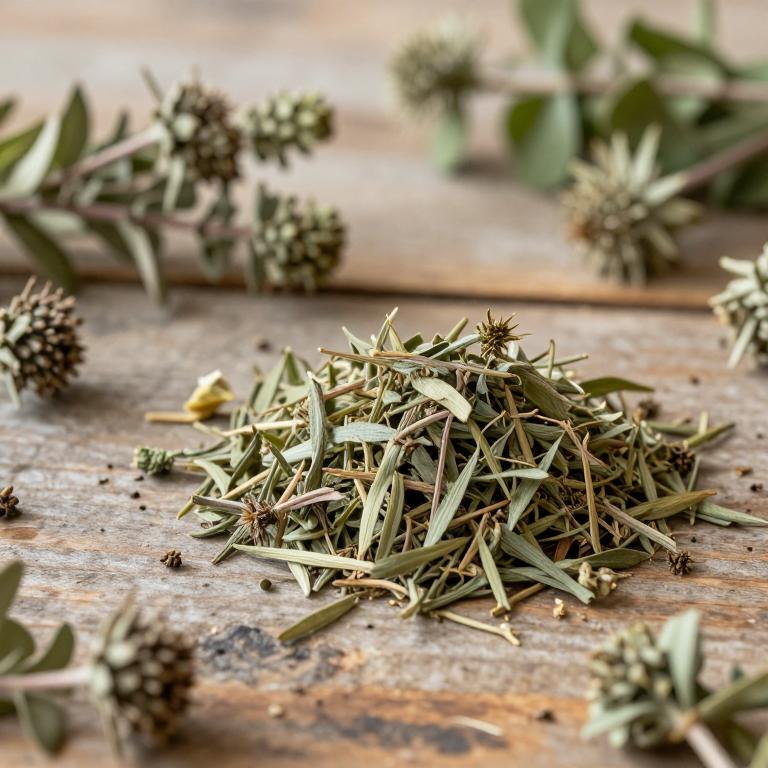
Field holly, scientifically known as Eryngium campesestris, is a striking, thistle-like perennial native to Europe and Asia. Characterized by its spiny, bluish-green foliage and distinctive rounded flower heads, this resilient plant thrives in dry, sandy soils, offering both ornamental beauty and traditional medicinal properties within diverse ecosystems.
- Family
- Apiaceae
- Native range
- Europe
- Parts used
- Leaf · Root
- Common names
- Field Eryngo · Watling Street Thistle · 3 more
- Scientific synonyms
- Not available
Names and Synonyms
Common Names
- field eryngo
- Watling Street Thistle
- eryngo
- sea-holly
- white-devil
Scientific Names
Accepted name
Eryngium campestreRegional and Traditional Names
Spanish:
- Cardo setero
- Cardo corredor
- Cardicuco
- Eryngium officinale
- Cardo virgen
- Cardo punchero
- Trabalón
- Barba cabruna
- Carderol
- Cardo de sombrilla
- Sombrillas
- Cardicuca
- Picos de la Virgen
- Cardo panical
- Carlincho
- Ciencabezas
- Trabalon
- Cardo Corredor
German:
- Feld-Mannstreu
- Feldmannstreu
- chardon roulant
- Feld-Mannstreu
French:
- Panicaut champêtre
- Panicaut champetre
- Chardon roulant
- Chardon Roland
- chardon roulant
- panicaut champêtre
- panicaut des champs
- Panicaut champetre
- Chardon Roland
Sources: Wikidata, Catalogue of Life
Taxonomical Classification
This plant belongs to the kingdom Plantae and the phylum Streptophyta, falling under the class Equisetopsida and subclass Magnoliidae. Within the order Apiales, it is classified under the family Apiaceae. Finally, it is identified by the genus Eryngium.
| Rank | Classification |
|---|---|
| Kingdom | Plantae |
| Phylum | Streptophyta |
| Class | Equisetopsida |
| Subclass | Magnoliidae |
| Order | Apiales |
| Family | Apiaceae |
| Genus | Eryngium |
Sources: The World Checklist of Vascular Plants (WCVP)
Distribution
This plant is widely distributed across several different regions of the European continent. In Northern Europe, it can be found growing in Denmark, Great Britain, and Sweden. Its range also extends into Middle Europe, where it inhabits various landscapes. Specifically, populations of the species are documented in Austria. Additionally, the plant is known to be present within the borders of Belgium.
| Region | Area |
|---|---|
| Northern Europe | Denmark |
| Northern Europe | Great Britain |
| Northern Europe | Sweden |
| Middle Europe | Austria |
| Middle Europe | Belgium |
| Middle Europe | Czechia-Slovakia |
| Middle Europe | Germany |
| Middle Europe | Hungary |
| Middle Europe | Netherlands |
| Middle Europe | Poland |
Sources: The World Checklist of Vascular Plants (WCVP)
Botanical Identification
Ecology
The ecology of Eryngium campestre is characterized by its preference for lowland environments, where it often thrives in open, disturbed, or sandy habitats such as dunes, heathlands, and dry grasslands. It is a resilient species capable of enduring nutrient-poor soils and significant solar exposure. Regarding its symbiotic relationships with soil fungi, this plant does not form mycorrhizal associations, meaning it lacks the specialized fungal partnerships typically used by many other vascular plants to enhance nutrient uptake. Instead, it relies on its own robust root system to navigate the specific edaphic conditions of its lowland ecological niche.
- Habitat :
- Lowland
- Mycorrhiza :
- no
Life history
The life history of Eryngium campestre is characterized by a perennial lifecycle, allowing the plant to persist through multiple growing seasons. It functions as a hemicryptophyte, a life form where the perennating buds are located at the soil surface, protected by leaf litter or soil. This species maintains an evergreen deciduousness, retaining its foliage to support its long-term survival and growth patterns within its ecological niche.
- Deciduousness :
- evergreen
- Life form :
- hemicryptophyte
- Lifecycle :
- perennial
Morphology
The morphology of Eryngium campestre is characterized by its growth form as a non-woody herb and forb, functioning as a self-supporting plant that does not require external climbing structures. This terrestrial species is independent in its nutritional requirements, neither acting as a parasite nor an epiphyte. In terms of stature, it exhibits moderate vertical development, with a plant height that typically ranges from a minimum of 0.15 m to a maximum of 0.7 m, maintaining an average height of approximately 0.281 m.
- Aquatic :
- terrestrial
- Climber :
- self-supporting
- Epiphyte :
- terrestrial
- Growth form :
- herb
- Growth form :
- forb
- Parasite :
- independent
- Plant height max:
- 0.7 m
- Plant height mean:
- 0.281 m
- Plant height min:
- 0.15 m
- Woodiness :
- non-woody
Physiology
The physiology of Eryngium campestre is characterized by a C3 photosynthetic pathway, a metabolic strategy typical of many temperate species that facilitates carbon fixation under moderate environmental conditions. The plant exhibits a non-carnivorous nutritional strategy and does not function as a nitrogen fixer, relying instead on soil nutrient uptake. Its leaf morphology plays a significant role in its resource management, with a mean leaf size of approximately 320.0042 cm² and a maximum leaf length reaching up to 12 cm. Furthermore, the plant maintains a mean Specific Leaf Area (SLA) of 93.8 cm²/g, a physiological metric that reflects its leaf thickness and the efficiency of its light-harvesting capabilities in relation to its biomass.
- Carnivory :
- non-carnivorous
- Leaf length max:
- 12 cm
- Leaf size mean:
- 320.0042 cm²
- Nitrogen fixer :
- no
- Photosynthetic pathway :
- C3
- Specific Leaf Area (SLA) mean:
- 93.8 cm²/g
Reproduction
The reproduction of Eryngium campestre is characterized by a sexual process, as both asexual reproduction and self-fertilization are noted to be absent. The flowering period typically begins in July and extends through September. The plant relies on biotic pollination syndromes, specifically utilizing insects, with bees identified as a key pollinator. Following pollination, the plant produces dry fruits with an average width of 0.2 cm. The resulting seeds are quite small, with a mean mass of approximately 0.0015793335 g, ranging from a minimum of 0.00066 g to a maximum of 0.003 g. Dispersal of these seeds follows an unspecialized syndrome, suggesting that the plant does not rely on highly specific mechanisms for the distribution of its progeny.
- Dispersal syndrome :
- unspecialized
- Flowering time :
- Jul
- Flowering time :
- Sep
- Fruit dryness :
- dry
- Fruit width mean:
- 0.2 cm
- Pollination syndrome :
- insect
- Pollination syndrome :
- bee
- Pollination syndrome :
- biotic
- Reproduction asexual :
- absent
- Seed mass max:
- 0.003 g
- Seed mass mean:
- 0.0015793335 g
- Seed mass min:
- 0.00066 g
- Self fertilization :
- absent
Sources: Global Inventory of Floras and Traits (GIFT)
Plant Parts
Eryngium campestre has 3 reported plant parts identified across 3 scientific publications and several other databases that are studied for medicinal purposes. The most consistently reported plant part include leaf, root, seed.
| Plant part | Supporting sources | Consensus |
|---|---|---|
| Leaf | 1 supporting sources | ★☆☆☆☆ |
| Root | 1 supporting sources | ★☆☆☆☆ |
| Seed | 1 supporting sources | ★☆☆☆☆ |
Leaf
- Journal of plant research
Root
- Journal of natural products
Seed
- Journal of plant research
Chemicals
Eryngium campestre has 2 reported phytochemicals identified across 3 scientific publications and several other databases. The most consistently reported chemicals include NONANOIC ACID, Spathulenol.
| Chemical | Supporting sources | Consensus |
|---|---|---|
| NONANOIC ACID | 1 supporting sources | ★☆☆☆☆ |
| Spathulenol | 1 supporting sources | ★☆☆☆☆ |
NONANOIC ACID
- Journal of food science and technology
Spathulenol
- Journal of food science and technology
Preparations
Eryngium campestre has 1 reported preparations identified across 3 scientific publications and several other databases. The most consistently reported preparations include roots.
| Preparation | Supporting sources | Consensus |
|---|---|---|
| Roots | 1 supporting sources | ★☆☆☆☆ |
Roots
- Journal of natural products