narrow-leaf yerba santa
Eriodictyon angustifolium · Accepted scientific name
Scientific literature: Very Sparse (9 studies) · ★☆☆☆☆
Narrow-leaf yerba santa, scientifically known as Eriodictyon angustifoliuim, is a resilient evergreen shrub native to the coastal mountains of California. Renowned for its medicinal properties, this plant has been traditionally used by indigenous cultures to treat respiratory ailments, skin irritations, and inflammation, offering a natural healing legacy.
- Family
- Boraginaceae
- Native range
- Northern America
- Parts used
- Leaf
- Common names
- Narrow-Leaf Yerba Santa · Narrow-Leaved Yerba Santa
- Scientific synonyms
- Eriodictyon Angustifolium Var. Amplifolium · Eriodictyon Angustifolium Var. Pubens · 1 more
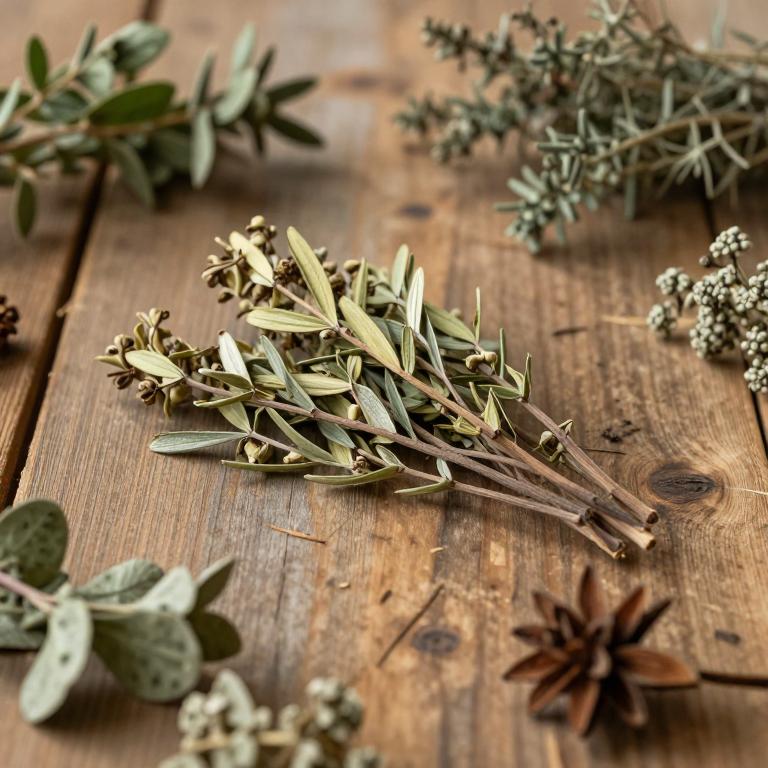
Names and Synonyms
Common Names
- narrow-leaf yerba santa
- narrow-leaved yerba santa
Scientific Names
Accepted name
Eriodictyon angustifoliumSynonyms
- Eriodictyon angustifolium var. amplifolium
- Eriodictyon angustifolium var. pubens
- Eriodictyon glutinosum var. angustifolium
Sources: Wikidata, Catalogue of Life
Taxonomical Classification
This plant belongs to the kingdom Plantae and is classified under the phylum Streptophyta and the class Equisetopsida. Within the subclass Magnoliidae, it is organized into the order Boraginales and the family Boraginaceae. Finally, it is identified by its specific genus, Eriodictyon.
| Rank | Classification |
|---|---|
| Kingdom | Plantae |
| Phylum | Streptophyta |
| Class | Equisetopsida |
| Subclass | Magnoliidae |
| Order | Boraginales |
| Family | Boraginaceae |
| Genus | Eriodictyon |
Sources: The World Checklist of Vascular Plants (WCVP)
Distribution
This plant is primarily distributed across the arid regions of the Southwestern United States. Within this territory, it can be found growing in the states of Arizona, California, Nevada, and Utah. Its range extends southward beyond the American border into the nation of Mexico. Specifically, it is located throughout the Northwest region of Mexico. This combined distribution highlights its preference for the unique landscapes of the southwestern North American continent.
| Region | Area |
|---|---|
| Southwestern U.S.A. | Arizona |
| Southwestern U.S.A. | California |
| Southwestern U.S.A. | Nevada |
| Southwestern U.S.A. | Utah |
| Mexico | Mexico Northwest |
Sources: The World Checklist of Vascular Plants (WCVP)
Botanical Identification
Life history
The life history of Eriodictyon angustifolium is characterized by its status as a perennial species, allowing the plant to persist through multiple growing seasons. As a long-lived woody shrub, it establishes a stable presence within its native habitats, often developing robust root systems that facilitate survival through varying environmental conditions. Throughout its life cycle, the plant undergoes seasonal cycles of vegetative growth and flowering, contributing to its long-term ecological stability and ability to regenerate over time.
- Lifecycle :
- perennial
Morphology
The morphology of Eriodictyon angustifolium is characterized by a woody growth form, specifically classified as a shrub. It functions as an independent organism, neither acting as a parasite nor an epiphyte, maintaining a primarily terrestrial existence rather than an aquatic or semiaquatic habit. Unlike climbing species that may function as lianas or vines, this plant is strictly self-supporting, lacking any obligatory or facultative climbing tendencies. Its structural development is defined by its woody nature, which supports its upright shrubby stature.
- Aquatic :
- terrestrial
- Climber :
- self-supporting
- Epiphyte :
- terrestrial
- Growth form :
- shrub
- Parasite :
- independent
- Woodiness :
- woody
Reproduction
The reproduction of Eriodictyon angustifolium is characterized by the production of exceptionally small seeds that play a critical role in its dispersal and colonization strategies. The reproductive output of this species is remarkably consistent in terms of individual seed size, with a documented seed mass mean of 0.00018 g. This uniformity is reflected across the entire range of its seed weight, as both the maximum and minimum seed mass values are recorded at exactly 0.00018 g. Such minute seed mass indicates a high-volume reproductive strategy, where the plant produces a large quantity of lightweight propagules to increase the probability of successful establishment within its natural habitat.
- Seed mass mean:
- 0.00018 g
Sources: Global Inventory of Floras and Traits (GIFT)
Plant Parts
Eriodictyon angustifolium has 1 reported plant parts identified across 1 scientific publications and several other databases that are studied for medicinal purposes. The most consistently reported plant part include leaf.
| Plant part | Supporting sources | Consensus |
|---|---|---|
| Leaf | 1 supporting sources | ★☆☆☆☆ |
Leaf
- Journal of natural products
Chemicals
Eriodictyon angustifolium has 5 reported phytochemicals identified across 1 scientific publications and several other databases. The most consistently reported chemicals include Homoeriodictyol, Chrysoeriol, ERIODICTYOL, Sterubin, hesperetin.
| Chemical | Supporting sources | Consensus |
|---|---|---|
| Homoeriodictyol | 2 supporting sources | ★☆☆☆☆ |
| Chrysoeriol | 1 supporting sources | ★☆☆☆☆ |
| ERIODICTYOL | 1 supporting sources | ★☆☆☆☆ |
| Sterubin | 1 supporting sources | ★☆☆☆☆ |
| hesperetin | 1 supporting sources | ★☆☆☆☆ |
Homoeriodictyol
- Journal of natural products
- Journal of agricultural and food chemistry
Chrysoeriol
- Journal of agricultural and food chemistry
ERIODICTYOL
- Journal of agricultural and food chemistry
Sterubin
- Journal of natural products
hesperetin
- Journal of natural products
Activities
Eriodictyon angustifolium has 2 reported activities identified across 1 scientific publications and several other databases. The most consistently reported activities include Astringent, Bitter.
| Activity | Supporting sources | Consensus |
|---|---|---|
| Astringent | 1 supporting sources | ★☆☆☆☆ |
| Bitter | 1 supporting sources | ★☆☆☆☆ |
Astringent
- Journal of agricultural and food chemistry
Bitter
- Journal of agricultural and food chemistry
Preparations
Eriodictyon angustifolium has 1 reported preparations identified across 1 scientific publications and several other databases. The most consistently reported preparations include leaves.
| Preparation | Supporting sources | Consensus |
|---|---|---|
| Leaves | 1 supporting sources | ★☆☆☆☆ |
Leaves
- Journal of natural products