Eriocephalus africanus
Eriocephalus africanus · Accepted scientific name
Scientific literature: Very Sparse (4 studies) · ★☆☆☆☆
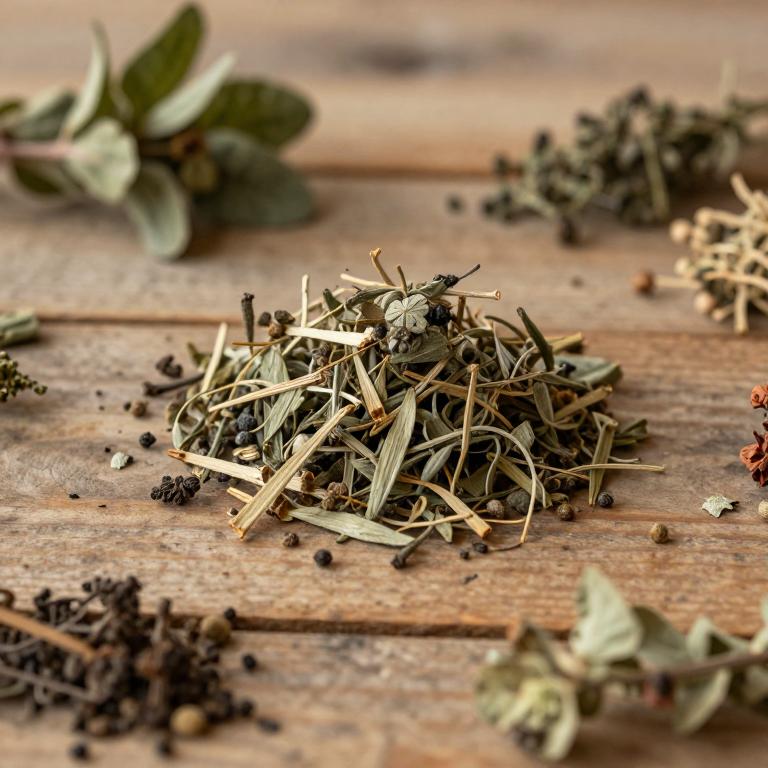
, scientifically known as Eriocephalus africanus, is a fragrant, woody shrub native to South Africa. Commonly called Rooibos or Wild Rosemary, this versatile medicinal plant is prized for its aromatic essential oils. It is traditionally used in herbal remedies to support digestive health, alleviate inflammation, and promote skin healing.
- Family
- Asteraceae
- Native range
- Europe
- Parts used
- Not available
- Common names
- Not available
- Scientific synonyms
- Eriocephalus Variifolius
Names and Synonyms
Scientific Names
Accepted name
Eriocephalus africanusSynonyms
- Eriocephalus variifolius
Regional and Traditional Names
German:
- Afrikanischer Rosmarin
- Wilder Rosmarin
- Afrikanischer Wollkopf
Sources: Wikidata
Taxonomical Classification
This plant belongs to the kingdom Plantae and is classified within the phylum Streptophyta and class Equisetopsida. As a member of the subclass Magnoliidae and order Asterales, it is further categorized under the family Asteraceae. Finally, its specific taxonomic identity is established within the genus Eriocephalus.
| Rank | Classification |
|---|---|
| Kingdom | Plantae |
| Phylum | Streptophyta |
| Class | Equisetopsida |
| Subclass | Magnoliidae |
| Order | Asterales |
| Family | Asteraceae |
| Genus | Eriocephalus |
Sources: The World Checklist of Vascular Plants (WCVP)
Distribution
This plant exhibits a widespread and fragmented geographical distribution across several continents. In Southwestern Europe, its presence is specifically noted on the island of Sardegna. Its range extends to the Macaronesian region, where it can be found in Madeira. Moving to the southern hemisphere, the species is established within the Cape Provinces of Southern Africa. Finally, it has also been documented in the Australian territory of New South Wales.
| Region | Area |
|---|---|
| Southwestern Europe | Sardegna |
| Macaronesia | Madeira |
| Southern Africa | Cape Provinces |
| Australia | New South Wales |
Sources: The World Checklist of Vascular Plants (WCVP)
Botanical Identification
Ecology
The ecology of Eriocephalus africanus is characterized by its remarkable adaptability to a wide range of altitudinal gradients, allowing it to inhabit diverse topographical landscapes. This species is found across an extensive vertical distribution, ranging from sea level at 0 m AMSL to high-altitude mountainous regions reaching up to 3000 m AMSL. This broad elevational range suggests a high tolerance for varying atmospheric pressures, temperature fluctuations, and solar radiation intensities. By spanning from coastal lowlands to sub-alpine environments, the plant occupies various ecological niches, enabling it to thrive in diverse microclimates and soil compositions associated with these shifting elevations.
- Elevational range max:
- 3000 m AMSL
- Elevational range min:
- 0 m AMSL
Life history
The life history of Eriocephalus africanus is characterized by its classification as a perennial species, allowing it to persist in its environment over multiple growing seasons rather than completing its cycle in a single year. This long-lived growth habit enables the plant to establish a robust presence within its ecological niche, often developing extensive root systems that support its survival through varying seasonal conditions. As a perennial, it undergoes repeated cycles of vegetative growth and reproductive phases, contributing to its long-term stability and ability to endure environmental fluctuations.
- Lifecycle :
- perennial
Morphology
The morphology of Eriocephalus africanus is characterized by a woody growth form, manifesting primarily as a shrub or subshrub. This plant is fundamentally a terrestrial species, functioning as an independent organism rather than an epiphyte or a parasite. It possesses a self-supporting structural habit, meaning it does not function as a liana, vine, or climbing plant. In terms of stature, the plant exhibits a relatively low profile, with a height ranging from a minimum of 0.3 m to a maximum of 0.89 m.
- Aquatic :
- terrestrial
- Climber :
- self-supporting
- Epiphyte :
- terrestrial
- Growth form :
- shrub
- Parasite :
- independent
- Plant height max:
- 0.89 m
- Plant height min:
- 0.3 m
- Woodiness :
- woody
Physiology
The physiological structure of the foliage in Eriocephalus africanus is characterized by highly specialized, narrow leaf morphology designed for efficient resource management. The leaves exhibit a significant dimensional range, with individual lengths varying from a minimum of 0.5 cm to a maximum of 2 cm. Complementing this length, the width of the leaves is notably slender, measuring as little as 0.1 cm at its narrowest point and reaching a maximum width of only 0.2 cm. This high aspect ratio in the leaf dimensions suggests a physiological adaptation to minimize transpiration and optimize surface area relative to volume, which is critical for maintaining cellular homeostasis in its specific environmental niche.
- Leaf length max:
- 2 cm
- Leaf length min:
- 0.5 cm
- Leaf width max:
- 0.2 cm
- Leaf width min:
- 0.1 cm
Reproduction
The reproduction of Eriocephalus africanus is characterized by a specific flowering phenology and specialized fruit development. The flowering period typically commences in May and extends through until September, though the timing can be variable. Once fertilization occurs, the plant produces fruit in the form of an achene. These fruits are notably indehiscent, meaning they do not spontaneously split open at maturity to release their contents. The seeds contained within are quite small, possessing a mean mass of approximately 0.02159 g, with individual seed weights ranging from a minimum of 0.01818 g to a maximum of 0.025 g.
- Dehiscence :
- indehiscent
- Flowering time :
- May
- Flowering time :
- Sep
- Fruit type :
- achene
- Seed mass max:
- 0.025 g
- Seed mass mean:
- 0.02159 g
- Seed mass min:
- 0.01818 g
Sources: Global Inventory of Floras and Traits (GIFT)
Activities
Eriocephalus africanus has 2 reported activities identified across 0 scientific publications and several other databases. The most consistently reported activities include Analgesic, Antipyretic.
| Activity | Supporting sources | Consensus |
|---|---|---|
| Analgesic | 1 supporting sources | ★☆☆☆☆ |
| Antipyretic | 1 supporting sources | ★☆☆☆☆ |
Analgesic
- Phytomedicine : international journal of phytotherapy and phytopharmacology
Antipyretic
- Phytomedicine : international journal of phytotherapy and phytopharmacology
Conditions
Eriocephalus africanus has 2 reported investigations on conditions identified across 0 scientific publications and several other databases. The most consistently reported conditions include Candida albicans, fever.
| Condition | Supporting sources | Consensus |
|---|---|---|
| Candida albicans | 1 supporting sources | ★☆☆☆☆ |
| Fever | 1 supporting sources | ★☆☆☆☆ |
Candida albicans
- Journal of ethnopharmacology
Fever
- Phytomedicine : international journal of phytotherapy and phytopharmacology