Shrubby Horsetail
Ephedra ciliata · Accepted scientific name
Scientific literature: Very Sparse (12 studies) · ★☆☆☆☆
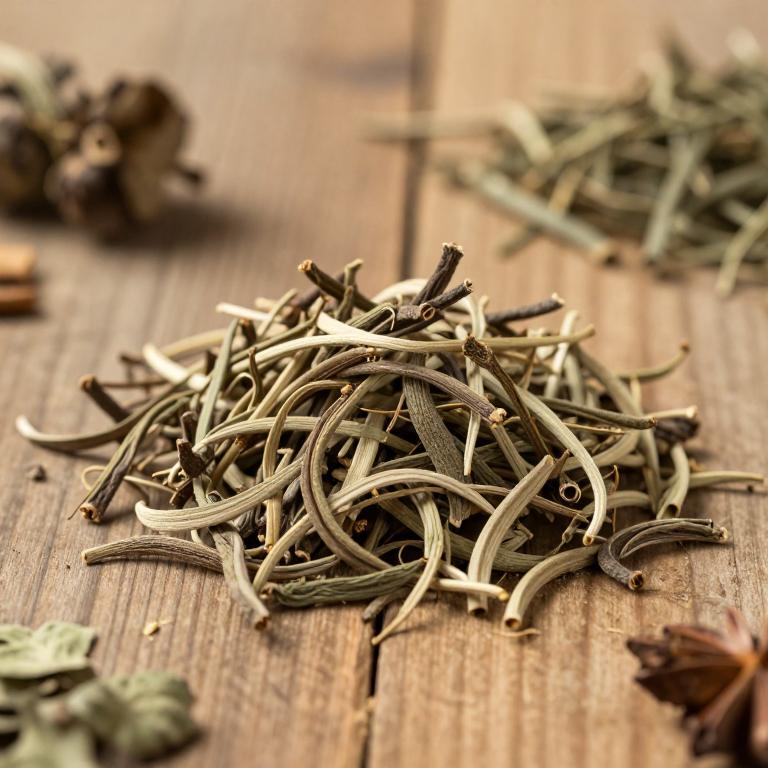
Shrubby Horsetail, scientifically known as Ephedra ciliata, is a distinctive medicinal plant native to the Indian subcontinent. Renowned for its unique morphology and alkaloid content, it has been used extensively in traditional medicine to treat respiratory ailments, fever, and various inflammatory conditions, offering significant pharmacological potential in modern therapeutics.
- Family
- Ephedraceae
- Native range
- Africa
- Parts used
- Not available
- Common names
- Shrubby Horsetail
- Scientific synonyms
- Ephedra Polylepis · Ephedra Peduncularis · 10 more
Names and Synonyms
Common Names
- Shrubby Horsetail
Scientific Names
Accepted name
Ephedra ciliataSynonyms
- Ephedra polylepis
- Ephedra peduncularis
- Ephedra rollandii
- Ephedra foliata
- Ephedra foliata var. aitchisonii
- Ephedra foliata var. ciliata
- Ephedra foliata var. polylepis
- Ephedra kokanica
- Ephedra alte
- Ephedra aitchisonii
- Ephedra asparagoides
- Ephedra ciliata var. polylepis
Sources: Wikidata, Catalogue of Life
Taxonomical Classification
This plant belongs to the kingdom Plantae and is classified under the phylum Streptophyta and class Equisetopsida. Within the subclass Gnetidae, it falls under the order Ephedrales and the family Ephedraceae. Finally, it is identified by the genus Ephedra, with the specific species being Ephedra ciliata.
| Rank | Classification |
|---|---|
| Kingdom | Plantae |
| Phylum | Streptophyta |
| Class | Equisetopsida |
| Subclass | Gnetidae |
| Order | Ephedrales |
| Family | Ephedraceae |
| Genus | Ephedra |
Sources: The World Checklist of Vascular Plants (WCVP)
Distribution
This plant is widely distributed across various regions within the Northern African continent. Specifically, its presence can be documented throughout the country of Algeria. It is also found within the desert landscapes of Egypt and Libya. Furthermore, the species extends its range into the territory of Morocco. Finally, its geographical footprint includes the arid regions of Western Sahara.
| Region | Area |
|---|---|
| Northern Africa | Algeria |
| Northern Africa | Egypt |
| Northern Africa | Libya |
| Northern Africa | Morocco |
| Northern Africa | Western Sahara |
| West Tropical Africa | Mauritania |
| Northeast Tropical Africa | Chad |
| Northeast Tropical Africa | Djibouti |
| Northeast Tropical Africa | Ethiopia |
| Northeast Tropical Africa | Socotra |
Sources: The World Checklist of Vascular Plants (WCVP)
Botanical Identification
Ecology
The ecology of Ephedra ciliata is defined by its ability to thrive within specific altitudinal gradients, typically inhabiting montane environments and rocky terrains. This species demonstrates a well-defined vertical distribution, occupying an elevational range that begins at a minimum of 500 m AMSL and extends up to a maximum of 1700 m AMSL. Within these parameters, the plant is adapted to the unique microclimates of mid-to-high altitude zones, where it often competes in well-drained, often arid or semi-arid substrates. Its presence within this 500-1700 m AMSL niche suggests a specialized physiological tolerance to the temperature fluctuations and varying moisture availability characteristic of these specific elevation levels.
- Elevational range max:
- 1700 m AMSL
- Elevational range min:
- 500 m AMSL
Life history
The life history of Ephedra ciliata is characterized by its status as a perennial species, allowing it to persist in its environment over many growing seasons. In terms of its structural growth strategy, the plant exhibits a life form classified as a nanophanerophyte, reflecting its compact and specialized growth habit. Additionally, its biological classification within certain ecological frameworks identifies it as a phanerophyte, indicating that its perennial shoots are borne above the ground, which supports its long-term survival and reproductive capabilities within its natural habitat.
- Life form :
- nanophanerophyte
- Life form :
- phanerophyte
- Lifecycle :
- perennial
Morphology
The morphology of Ephedra ciliata is characterized by its growth form as a woody shrub, appearing as a self-supporting plant that reaches a maximum height of approximately 5 m. It is classified as a terrestrial species, functioning as an independent organism rather than a parasite or an epiphyte. While it maintains a primarily shrubby habit, it exhibits facultative climbing tendencies under certain conditions. The structure is predominantly woody, supporting its upright development in its natural habitat.
- Aquatic :
- terrestrial
- Climber :
- facultative
- Epiphyte :
- terrestrial
- Growth form :
- shrub
- Parasite :
- independent
- Plant height max:
- 5 m
- Woodiness :
- woody
Reproduction
The reproduction of Ephedra ciliauta is characterized by a specific phenological cycle and distinct seed morphological properties. The flowering period for this species typically begins in April and concludes in May, although the timing can be variable across different environmental conditions. Following successful fertilization, the plant produces seeds with a notable range of mass; the average seed mass is recorded at 0.02927 g, with individual seeds fluctuating between a minimum weight of 0.02242 g and a maximum weight of 0.03612 g.
- Flowering time :
- Apr
- Flowering time :
- May
- Seed mass max:
- 0.03612 g
- Seed mass mean:
- 0.02927 g
- Seed mass min:
- 0.02242 g
Sources: Global Inventory of Floras and Traits (GIFT)
Chemicals
Ephedra ciliata has 10 reported phytochemicals identified across 0 scientific publications and several other databases. The most consistently reported chemicals include CATECHIN, Ephedrine, Epicatechin, N-Nitrosoephedrine, N-nitrosopseudoephedrine.
| Chemical | Supporting sources | Consensus |
|---|---|---|
| CATECHIN | 1 supporting sources | ★☆☆☆☆ |
| Ephedrine | 1 supporting sources | ★☆☆☆☆ |
| Epicatechin | 1 supporting sources | ★☆☆☆☆ |
| N-Nitrosoephedrine | 1 supporting sources | ★☆☆☆☆ |
| N-nitrosopseudoephedrine | 1 supporting sources | ★☆☆☆☆ |
| PSEUDOEPHEDRINE | 1 supporting sources | ★☆☆☆☆ |
| Protocatehuic acid | 1 supporting sources | ★☆☆☆☆ |
| catechins | 1 supporting sources | ★☆☆☆☆ |
| kaempferol | 1 supporting sources | ★☆☆☆☆ |
| quercetin | 1 supporting sources | ★☆☆☆☆ |
CATECHIN
- Natural product research
Ephedrine
- Cancer letters
Epicatechin
- Natural product research
N-Nitrosoephedrine
- Cancer letters
N-nitrosopseudoephedrine
- Cancer letters
PSEUDOEPHEDRINE
- Cancer letters
Protocatehuic acid
- Natural product research
catechins
- Natural product research
kaempferol
- Natural product research
quercetin
- Natural product research
Preparations
Ephedra ciliata has 3 reported preparations identified across 0 scientific publications and several other databases. The most consistently reported preparations include Aqueous extracts, alcoholic extracts, herb extracts.
| Preparation | Supporting sources | Consensus |
|---|---|---|
| Aqueous extracts | 1 supporting sources | ★☆☆☆☆ |
| Alcoholic extracts | 1 supporting sources | ★☆☆☆☆ |
| Herb extracts | 1 supporting sources | ★☆☆☆☆ |
Aqueous extracts
- Cancer letters
Alcoholic extracts
- Cancer letters
Herb extracts
- Natural product research