White Shrubby Horsetail
Ephedra alata · Accepted scientific name
Scientific literature: Very Sparse (33 studies) · ★☆☆☆☆
White Shrubby Horsetail, scientifically known as Ephedra alata, is a resilient medicinal shrub native to the arid regions of Central Asia. Renowned in traditional medicine, it contains potent alkaloids like ephedrine. This plant is widely utilized for its stimulant properties, aiding respiratory health and enhancing physical endurance.
- Family
- Ephedraceae
- Native range
- Africa
- Parts used
- Leaf · Seed
- Common names
- White Shrubby Horsetail
- Scientific synonyms
- Not available
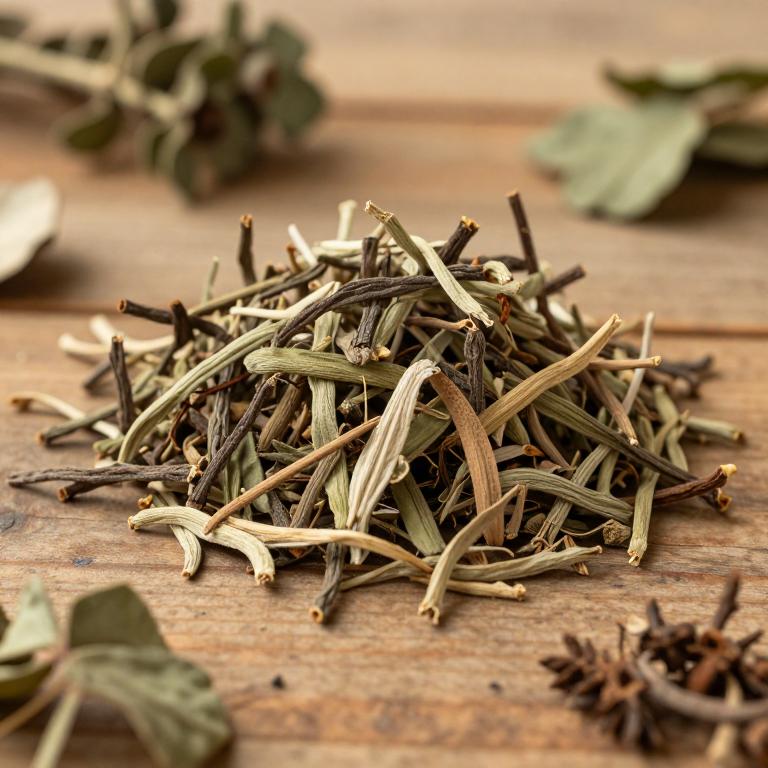
Names and Synonyms
Common Names
- White Shrubby Horsetail
Scientific Names
Accepted name
Ephedra alataSources: Wikidata, Catalogue of Life
Taxonomical Classification
This plant belongs to the kingdom Plantae and the phylum Streptophyta within the class Equisetopsida. It is further classified under the subclass Gnetidae and the order Ephedrales. Finally, it resides in the family Ephedraceae and the genus Ephedra, specifically identified as the species Ephedra alatas.
| Rank | Classification |
|---|---|
| Kingdom | Plantae |
| Phylum | Streptophyta |
| Class | Equisetopsida |
| Subclass | Gnetidae |
| Order | Ephedrales |
| Family | Ephedraceae |
| Genus | Ephedra |
Sources: The World Checklist of Vascular Plants (WCVP)
Distribution
This plant, known as Ephedra alata, is widely distributed across several regions in Northern Africa. Its presence is notably recorded in the country of Algeria, where it grows within specific arid habitats. In addition to this, the species can be found spanning across the territories of Egypt and Libya. It also inhabits various parts of Morocco, contributing to its regional diversity. Finally, the geographical range of this medicinal plant extends to Tunisia, completing its footprint across the North African landscape.
| Region | Area |
|---|---|
| Northern Africa | Algeria |
| Northern Africa | Egypt |
| Northern Africa | Libya |
| Northern Africa | Morocco |
| Northern Africa | Tunisia |
| Northern Africa | Western Sahara |
| West Tropical Africa | Mali |
| West Tropical Africa | Mauritania |
| Northeast Tropical Africa | Chad |
| Western Asia | Iraq |
Sources: The World Checklist of Vascular Plants (WCVP)
Botanical Identification
Life history
The life history of Ephedra alata is characterized by its status as a perennial plant, allowing it to persist through multiple growing seasons within its natural habitat. In terms of its growth architecture and survival strategy, it is classified as a chamaephyte, a life form where the ascending or descending shoots are near or just above the soil surface, often protected by the ground layer. This specific life form, categorized under both chamaephyte classifications, enables the species to endure environmental stressors by maintaining its reproductive and vegetative structures close to the substrate.
- Life form :
- chamaephyte
- Lifecycle :
- perennial
Morphology
The morphology of Ephedra alatata is characterized by a woody growth form, specifically manifesting as a self-supporting shrub. As a terrestrial species, it does not exhibit aquatic or semiaquatic tendencies, nor does it function as an epiphyte. The plant is an independent organism, lacking any parasitic nature, and relies on its robust, woody structure to maintain its stature without the need for climbing mechanisms.
- Aquatic :
- terrestrial
- Climber :
- self-supporting
- Epiphyte :
- terrestrial
- Growth form :
- shrub
- Parasite :
- independent
- Woodiness :
- woody
Reproduction
The reproduction of Ephedra alatata is characterized by specific seed morphologies and dispersal mechanisms tailored to its environment. The species produces seeds with a highly consistent mass, recorded at a mean, maximum, and minimum of 0.01372 g, indicating a lack of significant variation in seed weight within the population. Regarding its dispersal strategy, the plant exhibits an anemochorous syndrome, relying primarily on wind to transport its seeds to new locations, although the broader ecological context suggests a potential for more complex interactions involving other dispersal modes.
- Dispersal syndrome :
- anemochorous
- Seed mass mean:
- 0.01372 g
Sources: Global Inventory of Floras and Traits (GIFT)
Plant Parts
Ephedra alata has 2 reported plant parts identified across 2 scientific publications and several other databases that are studied for medicinal purposes. The most consistently reported plant part include leaf, seed.
| Plant part | Supporting sources | Consensus |
|---|---|---|
| Leaf | 1 supporting sources | ★☆☆☆☆ |
| Seed | 1 supporting sources | ★☆☆☆☆ |
Leaf
- Journal of ethnopharmacology
Seed
- Journal of ethnopharmacology
Chemicals
Ephedra alata has 14 reported phytochemicals identified across 2 scientific publications and several other databases. The most consistently reported chemicals include CHLOROGENIC ACID, Isorhoifolin, MAGNESIUM, Myricetin 3-rhamnoside, Quercetin 3-D-galactoside.
| Chemical | Supporting sources | Consensus |
|---|---|---|
| CHLOROGENIC ACID | 1 supporting sources | ★☆☆☆☆ |
| Isorhoifolin | 1 supporting sources | ★☆☆☆☆ |
| MAGNESIUM | 1 supporting sources | ★☆☆☆☆ |
| Myricetin 3-rhamnoside | 1 supporting sources | ★☆☆☆☆ |
| Quercetin 3-D-galactoside | 1 supporting sources | ★☆☆☆☆ |
| RUTIN | 1 supporting sources | ★☆☆☆☆ |
| SYRINGIC ACID | 1 supporting sources | ★☆☆☆☆ |
| Umbelliferone | 1 supporting sources | ★☆☆☆☆ |
| Vanillic acid | 1 supporting sources | ★☆☆☆☆ |
| apigenin | 1 supporting sources | ★☆☆☆☆ |
CHLOROGENIC ACID
- Scientific reports
Isorhoifolin
- Scientific reports
MAGNESIUM
- Scientific reports
Myricetin 3-rhamnoside
- African journal of traditional, complementary, and alternative medicines : AJTCAM
Quercetin 3-D-galactoside
- Scientific reports
RUTIN
- Scientific reports
SYRINGIC ACID
- Scientific reports
Umbelliferone
- Scientific reports
Vanillic acid
- Scientific reports
apigenin
- Scientific reports
Activities
Ephedra alata has 3 reported activities identified across 2 scientific publications and several other databases. The most consistently reported activities include Antioxidant, Antibacterial, Anticancer.
| Activity | Supporting sources | Consensus |
|---|---|---|
| Antioxidant | 2 supporting sources | ★☆☆☆☆ |
| Antibacterial | 1 supporting sources | ★☆☆☆☆ |
| Anticancer | 1 supporting sources | ★☆☆☆☆ |
Antioxidant
- African journal of traditional, complementary, and alternative medicines : AJTCAM
- Scientific reports
Antibacterial
- African journal of traditional, complementary, and alternative medicines : AJTCAM
Anticancer
- Scientific reports
Conditions
Ephedra alata has 7 reported investigations on conditions identified across 2 scientific publications and several other databases. The most consistently reported conditions include cancer, breast cancer, bronchial asthma, diabetes mellitus, liver cancer.
| Condition | Supporting sources | Consensus |
|---|---|---|
| Cancer | 2 supporting sources | ★☆☆☆☆ |
| Breast cancer | 1 supporting sources | ★☆☆☆☆ |
| Bronchial asthma | 1 supporting sources | ★☆☆☆☆ |
| Diabetes mellitus | 1 supporting sources | ★☆☆☆☆ |
| Liver cancer | 1 supporting sources | ★☆☆☆☆ |
| Oxidative stress | 1 supporting sources | ★☆☆☆☆ |
| Uterine cancer | 1 supporting sources | ★☆☆☆☆ |
Cancer
- Scientific reports
- Evidence-based complementary and alternative medicine : eCAM
Breast cancer
- Journal of ethnopharmacology
Bronchial asthma
- Scientific reports
Diabetes mellitus
- Environmental science and pollution research international
Liver cancer
- Scientific reports
Oxidative stress
- Scientific reports
Uterine cancer
- Evidence-based complementary and alternative medicine : eCAM
Preparations
Ephedra alata has 8 reported preparations identified across 2 scientific publications and several other databases. The most consistently reported preparations include decoction, 100% ethanol, 100% water, 80% ethanol, Hydro-alcoholic extracts.
| Preparation | Supporting sources | Consensus |
|---|---|---|
| Decoction | 2 supporting sources | ★☆☆☆☆ |
| 100% ethanol | 1 supporting sources | ★☆☆☆☆ |
| 100% water | 1 supporting sources | ★☆☆☆☆ |
| 80% ethanol | 1 supporting sources | ★☆☆☆☆ |
| Hydro-alcoholic extracts | 1 supporting sources | ★☆☆☆☆ |
| Aqueous extract from aerial parts | 1 supporting sources | ★☆☆☆☆ |
| Extracts | 1 supporting sources | ★☆☆☆☆ |
| Methanolic extract | 1 supporting sources | ★☆☆☆☆ |
Decoction
- Environmental science and pollution research international
- Journal of ethnopharmacology
100% ethanol
- African journal of traditional, complementary, and alternative medicines : AJTCAM
100% water
- African journal of traditional, complementary, and alternative medicines : AJTCAM
80% ethanol
- African journal of traditional, complementary, and alternative medicines : AJTCAM
Hydro-alcoholic extracts
- Journal of ethnopharmacology
Aqueous extract from aerial parts
- Environmental science and pollution research international
Extracts
- Archiv fur experimentelle Veterinarmedizin
Methanolic extract
- Scientific reports