Echinops macrochaetus
Echinops macrochaetus · Accepted scientific name
Scientific literature: Very Sparse (12 studies) · ★☆☆☆☆
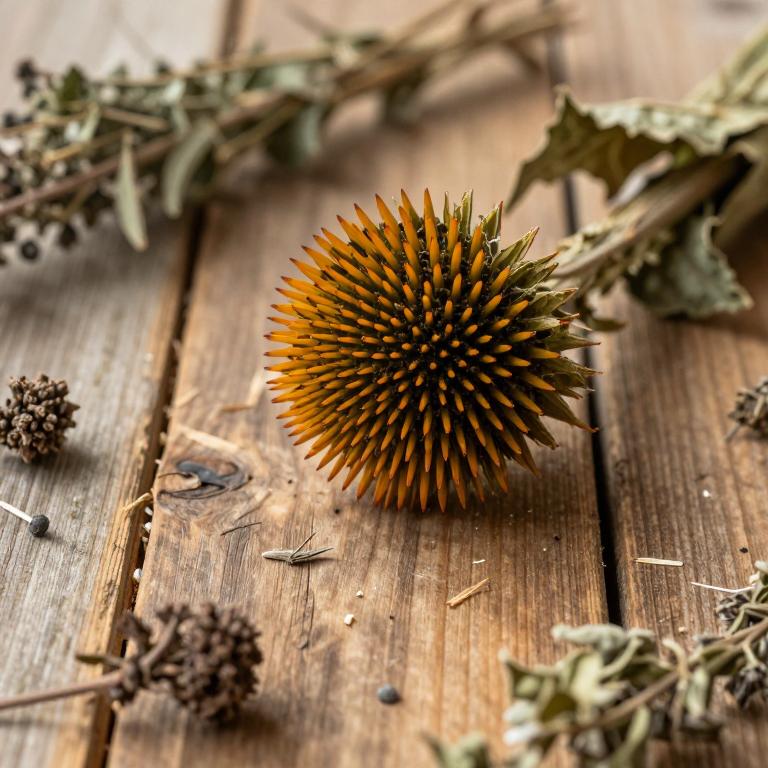
, scientifically known as Echinops macrochaeus, is a distinctive medicinal plant belonging to the Asteraceae family. Renowned for its unique spherical flower heads, it is traditionally utilized in various folk medicine practices. This species is valued for its potential therapeutic properties, particularly in treating inflammatory conditions and supporting digestive health.
- Family
- Asteraceae
- Native range
- Africa
- Parts used
- Not available
- Common names
- Not available
- Scientific synonyms
- Sphaerocephalus Macrochaetus
Names and Synonyms
Scientific Names
Accepted name
Echinops macrochaetusSynonyms
- Sphaerocephalus macrochaetus
Sources: Wikidata
Taxonomical Classification
This plant belongs to the kingdom Plantae and the phylum Streptophyta, falling under the class Equisetopsida and subclass Magnoliidae. Within the order Asterales, it is classified under the family Asteraceae and the genus Echinops.
| Rank | Classification |
|---|---|
| Kingdom | Plantae |
| Phylum | Streptophyta |
| Class | Equisetopsida |
| Subclass | Magnoliidae |
| Order | Asterales |
| Family | Asteraceae |
| Genus | Echinops |
Sources: The World Checklist of Vascular Plants (WCVP)
Distribution
This plant exhibits a specific geographical distribution centered primarily within Northeast Tropical Africa. It can be found inhabiting various regions across Djibouti, Eritrea, and Ethiopia. Furthermore, its range extends through the territories of both Sudan and South Sudan. Beyond the African continent, the species is also documented in Western Asia. Specifically, it is known to grow within the Sinai Peninsula.
| Region | Area |
|---|---|
| Northeast Tropical Africa | Djibouti |
| Northeast Tropical Africa | Eritrea |
| Northeast Tropical Africa | Ethiopia |
| Northeast Tropical Africa | Sudan-South Sudan |
| Western Asia | Sinai |
Sources: The World Checklist of Vascular Plants (WCVP)
Botanical Identification
Morphology
The morphology of Echinops macrochaeus is characterized by its growth form as a herb, exhibiting a non-woody structure throughout its vegetative development. As a terrestrial species, it grows directly in the soil rather than as an epiphyte, maintaining an independent existence without any parasitic relationship to other plants. While its structural habit is primarily herbaceously defined, its physical orientation allows it to function as a self-supporting climber, utilizing its own stem strength for upright positioning.
- Climber :
- self-supporting
- Epiphyte :
- terrestrial
- Growth form :
- herb
- Parasite :
- independent
- Woodiness :
- non-woody
Sources: Global Inventory of Floras and Traits (GIFT)
Chemicals
Echinops macrochaetus has 8 reported phytochemicals identified across 0 scientific publications and several other databases. The most consistently reported chemicals include APX, CHLOROPHYLL, Carotenoid, GR, Luteolin-7-rutinoside.
| Chemical | Supporting sources | Consensus |
|---|---|---|
| APX | 1 supporting sources | ★☆☆☆☆ |
| CHLOROPHYLL | 1 supporting sources | ★☆☆☆☆ |
| Carotenoid | 1 supporting sources | ★☆☆☆☆ |
| GR | 1 supporting sources | ★☆☆☆☆ |
| Luteolin-7-rutinoside | 1 supporting sources | ★☆☆☆☆ |
| SOD | 1 supporting sources | ★☆☆☆☆ |
| p-coumaric acid | 1 supporting sources | ★☆☆☆☆ |
| proline | 1 supporting sources | ★☆☆☆☆ |
APX
- Plants (Basel, Switzerland)
CHLOROPHYLL
- Plants (Basel, Switzerland)
Carotenoid
- Plants (Basel, Switzerland)
GR
- Plants (Basel, Switzerland)
Luteolin-7-rutinoside
- Plants (Basel, Switzerland)
SOD
- Plants (Basel, Switzerland)
p-coumaric acid
- Plants (Basel, Switzerland)
proline
- Plants (Basel, Switzerland)